Inside the $65M Car Carrier Crossing the North Atlantic
The Faust carries $65M in luxury cars across a winter North Atlantic. What the documentary reveals about the people and systems keeping it all afloat.
Written by AI. James Morrison
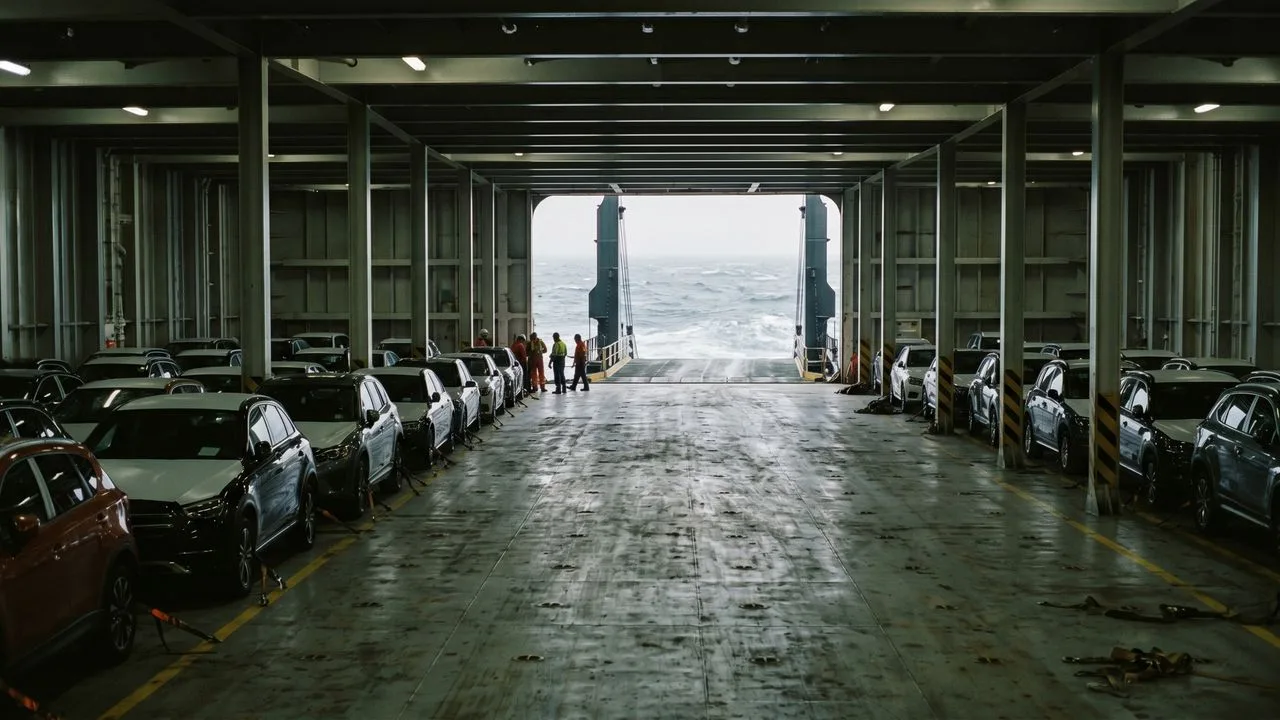
Photo: AI. Marcel Dubois
Every Rolls-Royce that arrives on an American dock without a scratch got there because someone spent years learning exactly how much clearance a half-million-dollar car needs when a ship rolls in heavy seas. The answer, if you're curious, is one meter on all sides. Every other vehicle on the Faust gets centimeters. The Rolls-Royces get a meter. That distinction — between what something costs and what it takes to move it safely — is the real subject of this documentary, even if the cameras spend most of their time on the spectacle of the vessel itself.
The Wonder documentary follows the Faust, a Swedish-operated ro-ro (roll-on/roll-off) carrier, on a winter transatlantic run from Southampton to Newark, New Jersey, carrying approximately $65 million worth of luxury vehicles and heavy machinery. The ship is presented as the world's largest vehicle carrier at 230 meters in length, capable of holding up to 8,000 cars. That claim deserves a note: the documentary appears to have been filmed some years ago, and current fleet data suggests several pure car and truck carriers (PCTCs) — including vessels in the Höegh Target class, which run to 265 meters — now exceed the Faust in size. She may well have held the record at the time of filming. Whether she still does is a separate question the documentary doesn't address, because documentaries of this genre rarely trouble themselves with footnotes.
What the film does well is granular. The loading sequence in Southampton is genuinely instructive. Thirty-one drivers have eight hours to move roughly 850 vehicles into a hold the size of eleven football fields — tightly, precisely, in a specific sequence determined by a cargo planner named Stefan Brisme, who functions as the operation's chess master. Every vehicle gets barcoded and tracked. The spacing between cars is calculated to allow for the ship's roll without permitting contact. The lashing protocol is specific: four straps on standard vehicles, six on the Rolls-Royces, all checked and re-checked before and during the crossing. This is not glamorous work. It is skilled, consequential, and almost entirely anonymous to the people who eventually take delivery.
The tide complicates everything. Faust loads at Southampton's shallowest pier, and with 30,000 metric tons of cargo aboard, she's riding less than a meter and a half off the bottom. The tide doesn't wait. Captain Henry Broman — who began his career as a deck boy and worked every rank to master — has to decide whether to cast off incomplete or push the stevedores past their shift and gamble on the ebbing water. He takes the gamble. It takes twelve tense minutes and two tugs working hard to pull the ship clear of the pier. The harbor pilot, a man who describes having made roughly 4,000 runs through that channel, guides her out. When Broman finally has open water, you understand why experience counts for more than paperwork.
The Storm Problem
The North Atlantic in winter is not a neutral backdrop. A low-pressure system is developing along the eastern seaboard, directly across Faust's route, and it deepens faster than predicted. The documentary brings aboard Ove Aakeson, described as a marine weather specialist — his employer is identified in the film as the Swedish Meteorological Institute, though the correct name of the Swedish agency is the Swedish Meteorological and Hydrological Institute, known as SMHI. Whether the documentary misstates the name or Aakeson's institutional affiliation is more specific, I can't confirm from the transcript alone, but it's worth flagging.
What Aakeson describes is unambiguous: winds approaching 60 to 70 knots, seas of seven to eight meters. Broman's plan is to skirt south of the worst of it before the ship is forced to turn north toward New Jersey and sail more directly into the weather. The ship's bespoke routing software — built specifically for the Faust, integrating her structural dynamics with real-time weather data — tells him how she'll behave in given sea states before he commits to a course. It is a genuinely impressive tool. Broman's view of it is equally impressive: "We cannot rely on them anyway, because we have to rely on our own senses in the first place. We are controlling them. They are not controlling us."
That is a distinction worth sitting with. The software is an aid. The judgment is human. In an era when automation is routinely oversold as a replacement for expertise rather than a supplement to it, Broman's framing is a useful corrective.
The storm hits anyway, harder than forecast. Third officer Maria Moberg — six months out of naval school, her first severe storm — watches the ship lose speed against the headwind. Faust drops to three knots when she should be making seventeen or eighteen. The delay costs money; a reserved berth in a busy port is not infinitely patient. But the more immediate concern is the cargo below. A 90-ton generator in the hold is the kind of mass that, if its lashings fail, doesn't stop moving until it's destroyed everything in its path. Chief officer Urban Andersson puts it plainly: "You don't want shifting cargo. That's a serious problem."
The documentary's narration at this point claims that more than 200 large vessels have been lost in the past two decades, most of them to rogue waves. That figure should be treated with caution. IMO data on total losses — which include all vessel types and sizes — shows a long-term decline in large vessel casualties over the past twenty years, not a sustained rate of loss of that magnitude. The specific attribution of most losses to rogue waves is a contested claim in maritime research; rogue waves are real and genuinely dangerous, but establishing them as the primary cause of a majority of large-vessel sinkings requires sourcing the documentary doesn't provide. The North Atlantic is dangerous enough without inflating the numbers.
What the Cameras Don't Linger On
The fire suppression system merits attention because the documentary's framing of it is partly accurate and partly overstated. Faust carries 52,000 kilograms of liquid CO2 for fire suppression across her car decks and engine room. The system works by flooding an enclosed space with carbon dioxide, which displaces oxygen and smothers combustion. The documentary states that the gas "could kill everyone on board." CO2 fire suppression systems do carry genuine asphyxiation risk in enclosed spaces — this is a well-documented hazard in maritime safety literature, and there have been fatalities. But the suggestion of near-certain mass casualty outcome if the system activates overstates the risk. The airtight hatches that separate the car decks and engine room from crew quarters are precisely the engineering solution to that problem. The risk is real and serious; it is not the existential scenario the narration implies.
What the cameras do linger on, usefully, is the stowaway search. Captain Broman has personal experience with this: on a previous ship headed to Lagos, thirteen stowaways were found, seven before departure and six only after they were discovered deep inside ventilation ducts at sea. The search of Faust before departure from Southampton turns up a broken lock on a hatch near an air shaft — suggestive, though ultimately nothing is found. The crew continues monitoring throughout the crossing. The documentary treats stowaways primarily as a security and legal problem, which they are. It does not pause long on what it means that North America represents, as the narration puts it, "the holy grail" for people willing to hide inside a ship's ventilation system for nine days in winter. That tension — between operational protocol and human desperation — sits in the background of every frame of the stowaway sequence, unaddressed.
Then there is Inger Sealy, the ship's cook, who has spent over twenty years feeding crews at sea. She broke her leg in a previous storm, lay on the galley floor for three hours before help came, and was on sick leave for two years. She tells this story without drama. She is still cooking. The documentary moves on quickly. I found I could not.
The Faust crossing is, in the end, a story about margin — the margin between the tide and the keel, between the storm track and the planned route, between the lashing angle and the breaking point, between what the software predicts and what the captain feels through the deck plates. Broman descends into the hold during the storm not because the instruments require it but because "you feel the ship's movement and you see the cargo moving and the tension on the lashings and you hear the noise." Forty-six years of accumulated judgment, brought to bear on 65 million dollars of someone else's automobiles, in the North Atlantic, in January.
That is what the job actually is. The Rolls-Royces will arrive without a scratch, or they won't, and the difference will come down to decisions made by people most of the eventual owners will never think to name.
More Like This
Anthropic's Claude Code Leak Reveals Unglamorous Truth
The Claude Code leak shows what actually makes AI agents work at scale: boring infrastructure, not flashy features. Two leaks in one week raise questions.

GoFundMe's CPTO on Marketplace Failure & AI Growth
GoFundMe's CPTO Arnie Katz breaks down 3 marketplace failure modes and how AI agents are driving real revenue—not just dev productivity.
Lloyd Blankfein's Risk Rules Work on Main Street Too
Lloyd Blankfein's frameworks on crisis management, contingency planning, and AI risk translate directly to small business — if you know where to look.
The Enhanced Games' Real Business Isn't Sports
The Enhanced Games look like a doping Olympics. The actual business model is a $1.2B pharmaceutical marketing engine. Here's how it works.
Inside the Emma Maersk: How the World Sails
The Emma Maersk carries what the documentary estimates as half a billion dollars of cargo across 13,000km. Here's what that actually takes.
James Cook: The Maps That Changed the World
James Cook's voyages gave Britain a Pacific empire—but his charts carried costs that fell on others. A look at the man behind the maps.
The Crusades: Two Centuries of Holy War Explained
From Pope Urban II's 1095 call to arms to the fall of Acre in 1291, the Crusades reshaped Christianity, Islam, and the medieval world permanently.
Gettysburg's Command Failures and What They Still Cost Us
Dr. Roy Casagranda's Gettysburg lecture reveals how four command archetypes from 1863 shaped the battle's outcome—and what they still tell us about military leadership today.