AI's Economic Impact: Jobs, Tasks, and the Iceberg
A new MIT index reveals AI's economic exposure is five times larger than headlines suggest—and concentrated in places no one is watching. Here's what the data shows.

Written by AI. Samira Barnes
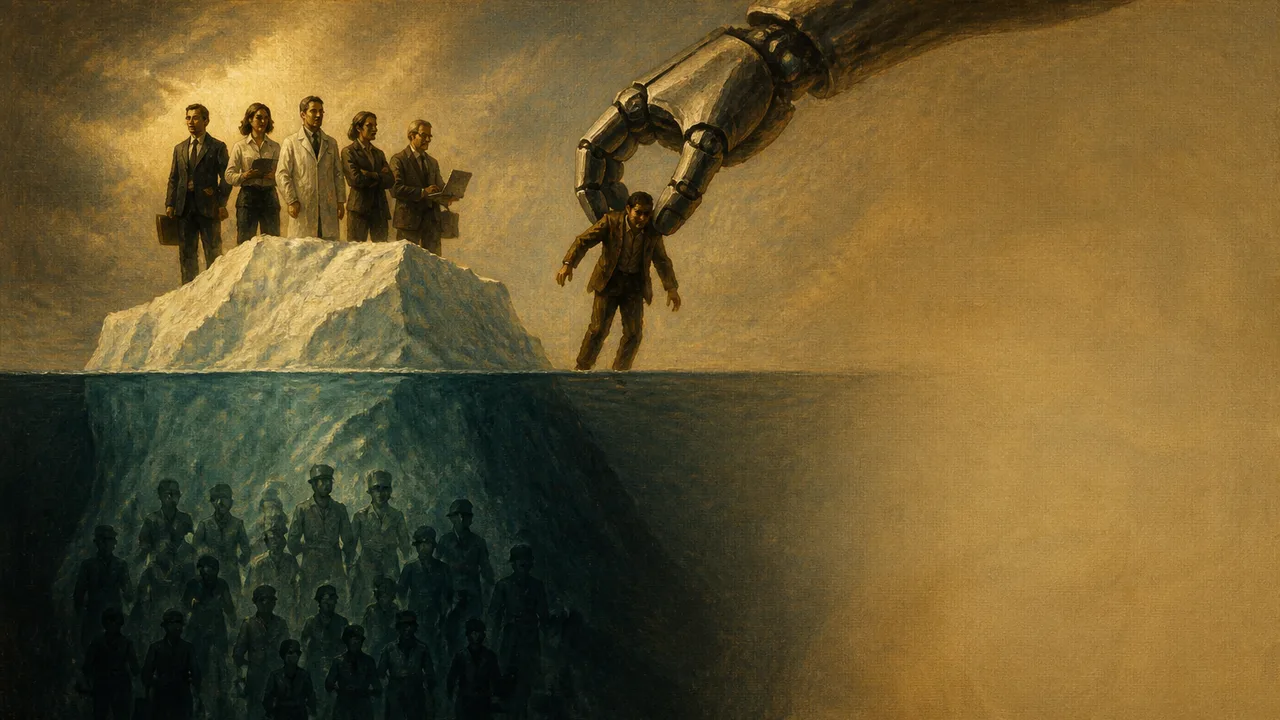
Photo: AI. Henrik Solberg
Back in 2019, when the Economics Explained channel published its first automation video, the threat model was intuitive: robots would come for the factory floor. The white-collar professional — the accountant, the analyst, the lawyer — felt comparatively safe. That assumption aged poorly at speed.
"What happened instead was almost the opposite," the channel's narrator observes in a new 47-minute retrospective. "When AI finally arrived, it came for call centers in Manila, data entry workers in Dhaka, and the entire outsourced service economies that developing countries had spent three decades carefully building. As it turned out, the factory floor was going to be fine. It was the people working in an office that had something to worry about."
That inversion is the entry point for an argument that gets considerably more granular — and more unsettling — from there.
The map we've been using is wrong
The video's most substantive material comes from a recent MIT study that approached the AI disruption question from an angle most analysis has missed. Rather than counting jobs at risk, the researchers built what they call the Iceberg Index: a skill-by-skill comparison between what human workers actually do and what existing, production-deployed AI tools can technically perform, weighted by the wage value of that work.
The methodology draws on ONET, the US Department of Labor's occupation skills database, which breaks down 923 occupations into their component tasks and assigns each an importance and difficulty rating. The researchers catalogued more than 13,000 real AI tools currently in commercial use, ran them through the same taxonomy, and produced a single exposure score for each occupation — not a prediction of job losses, but a map of where technical capability and human labor currently overlap.
What the map shows is that the public conversation has been aimed at roughly one-fifth of the actual problem.
When you measure AI's technical reach across the tech sector specifically — the industry generating all the layoff headlines — it accounts for about 2.2% of total US labor market wage value, or approximately $211 billion. That's the visible portion. Apply the same methodology economy-wide and the number jumps to 11.7%, roughly $1.2 trillion. The skills driving that broader exposure — document processing, routine analysis, data handling, synthesizing written information — don't belong to software engineers. They belong to HR coordinators, insurance claims processors, financial analysts, legal secretaries, and a wide range of highly educated professionals who have not appeared in a single anxious AI layoff headline.
A separate Anthropic study tracking actual AI usage in professional settings adds a detail worth sitting with: the most exposed group earns 47% more on average than the least exposed, is nearly four times as likely to hold a graduate degree, and is 16 percentage points more likely to be female. The disruption, in other words, is arriving first for people who did exactly what credentialed economies asked of them.
This connects directly to what Microsoft's AI chief Mustafa Suleyman has projected — that most white-collar tasks face automation within 18 months. The iceberg index gives that claim a structural foundation. It's not a prediction about which jobs disappear; it's a measurement of where the fault lines already run.
The geography problem
The video raises a pointed challenge to conventional workforce planning: the states with the highest iceberg index scores are not the ones generating anxious op-eds in national newspapers.
California's workforce is diversified enough that AI exposure spreads relatively thin. South Dakota, North Carolina, and Utah score higher than California or Virginia. Tennessee's tech sector exposure registers at 1.3% — well below alarm thresholds in any standard workforce model — but its iceberg index sits at 11.6%. The white-collar workforce administering Tennessee's industrial economy is roughly ten times more exposed than the tech sector everyone has been watching. Ohio and Michigan spent years preparing for robots to take manufacturing jobs. The white-collar disruption is arriving first.
The standard metrics policymakers use — GDP, per capita income, unemployment rates — explain less than 5% of the variation in iceberg index scores across states. In some cases, the relationship inverts: states that look safest by conventional measures aren't necessarily the least exposed. That means the billions currently allocated to workforce preparation may be systematically directed at the wrong places. The emerging BLS data on AI-driven productivity confirms that the gains are real and accelerating — but those aggregate figures offer no geographic or occupational granularity about where the corresponding losses are accumulating.
The developing world's timing problem
While the iceberg index focuses on the US, the video situates that domestic picture within a global dynamic that is already considerably further along.
The Philippines built a $37 billion outsourced services industry employing 1.3 million people, contributing over 7% of GDP. According to IMF estimates cited in the video, 89% of those outsourced service jobs are at high risk of AI automation — over a million positions whose competitive advantage against AI rested on human language skills, context sensitivity, and what was once called "the human touch." Large language models have eroded that advantage faster than the growth strategies of these economies anticipated.
Bangladesh faces a structurally identical problem in a smaller sector: 400 outsourcing firms, 80,000 workers, and a service mix centered on exactly the tasks AI handles most readily. The video frames the displacement mechanism bluntly: "A single slot in a server rack could soon replace an entire call center in Manila or Dhaka."
Both governments have responded with policy frameworks — the Philippines targeting retraining of over a million workers by 2028, Bangladesh releasing a draft strategy focused on AI talent development and digital inclusion. Whether those timelines and resource commitments are remotely adequate to absorb the disruption already underway is a genuinely open question. The video doesn't resolve it, and neither can anyone else with confidence.
What the economics does clarify is the structural dynamic. AI rewards infrastructure, advanced education, and capital concentration — all of which are overwhelmingly located in wealthy nations. The result is a reversal of the slow convergence trend that had been narrowing the gap between rich and developing economies for three decades. The Center for Economic Policy Research projects a 5.4% GDP boost for the US over the next decade from AI-driven productivity gains; lower-income countries are looking at 2.7 to 3.5%. PwC estimates AI will add $15.7 trillion to global GDP by 2030, with 70% of that going to the US and China because they own the underlying systems, the patents, and the hardware supply chain.
The workers AI can't touch — and why that's also a problem
The video introduces a wrinkle that most AI economic analysis ignores. Roughly 30% of the workforce has essentially zero AI exposure: cooks, mechanics, nurses, plumbers, childcare workers, skilled tradespeople. Physical, relational, hands-on work that no language model can replicate.
Those workers are not therefore safe.
The mechanism is Baumol's cost disease, identified by Princeton economists William Baumol and William Bowen in 1965. A string quartet performing Beethoven required four musicians for 25 minutes in the 19th century. It requires four musicians for 25 minutes today. Nothing about the performance has gotten more efficient. And yet the cost keeps rising, dragged upward by wages increasing everywhere else in the economy as productivity grows.
If the iceberg index is right and cognitive, administrative work is about to get dramatically more productive, the Baumol effect accelerates. A financial analyst using AI might compress a day's work into an hour. The nurse still needs the same time per patient. The plumber still needs to physically be there. Their relative costs rise — not because they got less efficient, but because everything around them did.
The complication is that most of the work AI cannot touch is non-discretionary. You don't opt out of healthcare or skip the plumber when the pipes burst. These services are also the ones governments fund or subsidize. Workers safe from AI disruption may find themselves in industries that governments will increasingly struggle to afford.
"The iceberg index tells you where the skill overlap sits right now," the video notes, "not what firms will do about it, how fast governments will respond, or which workers will successfully retrain. Those outcomes depend on decisions that haven't been made yet."
That qualifier matters. The index is an earthquake risk map, not a seismograph. It identifies fault lines; it doesn't record tremors. The tremors are already audible in the hiring data — entry-level job postings across the US have fallen 35% since January 2023, and employment among software developers under 25 has dropped 20% from its 2022 peak — but whether governments are building the instruments to detect what's coming at broader scale remains the practical policy question.
Most of the tools they're currently using cannot see 95% of the problem they're trying to measure. The iceberg index is an attempt to build something better. Whether it actually gets used — by workforce planners, by legislators, by the agencies allocating retraining funds — is, as the video puts it, another question entirely.
More Like This
Design.md Files Expose a Gap in AI Regulation Standards
How a GitHub repository of design system files reveals the absence of standardization frameworks for AI-generated interfaces—and why that matters.
The Iceberg Index: Rethinking AI's Economic Impact
MIT's Iceberg Index reveals AI's hidden economic impact, challenging job-centric narratives.

Why Context Engineering Is AI's Real Bottleneck
AI models aren't the problem anymore—accessing the right data at the right time is. Here's how context engineering changes what's actually possible.

Kimi K2.6 Is Free on NVIDIA NIM—Read the Fine Print
Kimi K2.6 is now free via NVIDIA's NIM API. But who controls AI model distribution when NVIDIA becomes the default inference layer?
Anthropic's CEO Says AI Could Kill Half of Entry-Level Jobs
Dario Amodei predicts AI will eliminate 50% of entry-level white-collar jobs within five years. The data suggests he might be right.

What Will Still Be Scarce When AI Can Do Everything?
Economists Alex Imas and Phil Trammell map what the AI economy actually looks like for workers, parents, and developing nations—and what nobody can predict.

AI Is Reshaping Silicon Valley Jobs and Finances
A new report finds AI-driven layoffs are eroding the financial security of Silicon Valley tech workers — a shift that's faster and broader than past tech disruptions.

AI Chip Smuggling and the US-China Tech Divide
FT's Eleanor Olcott investigates the black market for Nvidia AI chips reaching China despite US export controls — and what it reveals about the tech race.