What Will Still Be Scarce When AI Can Do Everything?
Economists Alex Imas and Phil Trammell map what the AI economy actually looks like for workers, parents, and developing nations—and what nobody can predict.

Written by AI. Marcus Obi
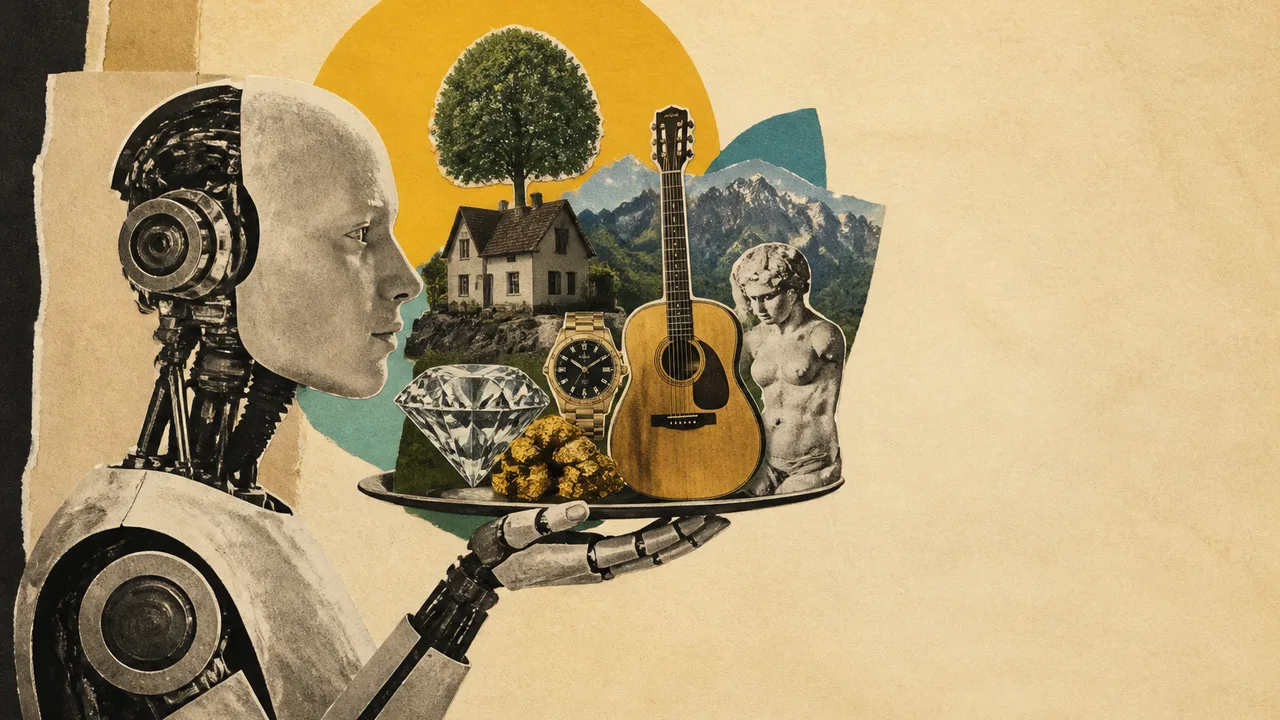
Photo: AI. Wren Sugimoto
My twins are seven. Last week one of them asked me what I do for work, and I said I write, and she said "can't a computer do that?" She wasn't being cruel. She'd just seen me use an AI tool to help draft something and filed it away the way kids file things: efficiently, without mercy.
I didn't have a great answer. I said something about how I write in a specific way that's hard to copy. She looked at me with the particular skepticism of a second-grader who knows when a grown-up is stalling.
I've been thinking about that moment while watching a recent conversation between Alex Imas—who holds appointments at both Google DeepMind and the University of Chicago (the precise nature of that dual arrangement wasn't fully specified in the conversation, so I'll characterize it as they described it)—and Phil Trammell, an economist affiliated with Epoch AI and Stanford whose exact current titles I'd encourage you to verify directly. The two of them spent over an hour with Dwarkesh Patel working through what economics actually tells us about an AI-dominated future. Not the vibes version. The model version. And the honest answer, it turns out, is: we don't really know, and here's why that matters more than any confident prediction.
The organizing question of the conversation is deceptively simple: after AGI, what's still scarce? Because scarcity is where value pools. If AI can produce everything, then "everything" becomes cheap—which sounds great until you realize that wages are paid for producing things, and if everything is cheap to produce, the economics of who gets paid what gets very strange very fast.
Imas introduces the concept of the "relational sector"—goods and services where the human being in the loop is part of what you're paying for. Not just the output, but the source. His team ran experiments where participants were asked how much they'd pay for an art print made by a human versus AI, with only one copy versus 500 copies in circulation. The human-made single print commanded a significant premium. When 500 copies existed, that premium collapsed—you're no longer connecting with an artist, you're buying a product. AI prints were already treated as commodities regardless of quantity. The implication: some human labor isn't interchangeable with capital the way a horse is interchangeable with a tractor. The human is part of the value.
But here's where the conversation gets genuinely uncomfortable. Even if the relational sector is real—even if some people will always pay a premium for a human doctor to deliver a diagnosis rather than an algorithm—that doesn't necessarily mean it'll be a large share of the economy. Trammell makes a point that I keep turning over: imagine a Mongolian economist sitting in 1400, trying to forecast the economy of 2025. They'd look at the things that were intrinsically human—singing, storytelling—and the things that weren't—horses for transport, yogurt production. They'd probably predict: automate the horses and yogurt, and eventually everyone's spending goes to singers. Didn't happen. We invented about a million new categories of non-human goods to spend money on instead, and the share going to singers stayed negligible.
So the real question isn't whether the relational sector exists. It's whether the machine economy keeps inventing new varieties of things to want faster than humans can generate demand for human-contact services. If it does, labor share—the portion of everything produced that goes to workers as wages, which has held remarkably stable around 60% or above across most major economies for much of the modern era (the robustness of that figure varies by country and methodology; economists including Anthony Atkinson have argued that accounting changes may have obscured the true stability of this number)—could collapse even in a world where people genuinely value human connection. The ballerina sells out every night. She just can't compete with a trillion new varieties of robot experience nobody had imagined wanting.
I told my daughter that I write in a way that's hard to copy, and I believed it when I said it. But here's what I notice when I look at her and her brother: I have no idea what categories don't exist yet that will define their working lives. I'm in exactly the position of that Mongolian economist. I can see the jobs that exist now—graphic designer, physical therapist, paralegal, truck driver. I'm watching some of them get chipped at. What I absolutely cannot see is the equivalent of "web developer" or "social media manager" before the internet—the categories that will absorb the labor that's being freed up, or won't.
Imas is remarkably honest about this: "We don't have any data. I've been saying we need a Manhattan Project for data. We don't have data on consumer demand elasticities. We're not really tracking what jobs are getting created or destroyed." The O*NET database of job tasks, which economists rely on to understand what's automatable, is, in his words, "rarely updated" and "super low quality." We're navigating an economic transition of potentially historic scale with instruments that were built for a different era. The deskilling shock already underway in white-collar work is happening faster than our data infrastructure can track it.
And yet—and this is the part that doesn't make headlines—when you look at the actual data that does exist, the white-collar apocalypse isn't showing up yet. The Budget Lab at Yale has been tracking this closely. According to Imas, if you look at software engineering, "you really have to squint to see anything happening." There's a possible signal of slower growth in junior developer hiring, and some uptick in demand for senior engineers, which is roughly what you'd expect if AI is handling more of the entry-level work. But it's a trend, not a cliff. The data right now looks more like a gradual reshuffling than a mass displacement—which Imas notes might actually be the worrying scenario, not the reassuring one.
That's the "messy middle"—a framing associated with Brookings Institution researcher Molly Kinder, whose work on AI and labor markets Patel and his guests discuss. The concern isn't sudden mass unemployment. Mass unemployment would be politically legible; governments know how to respond to a spike. The concern is the slow drip: workers moving into lower-paying jobs, underemployed, not obviously "unemployed" in any way that triggers emergency response. Imas draws the comparison to telephone operators, whose jobs were automated over a period of roughly two decades after the technology existed to do it faster—a claim about the specific timeline worth treating as approximate rather than settled. When full automation came, the workers were mostly reabsorbed, but at lower wages. "That's the scenario," he says, "where things aren't a disaster but they're not good."
What this means for redistribution is where the conversation gets politically specific in ways economists rarely go. A negative income tax can be implemented quickly—the day it becomes law, there's a floor. Universal basic capital—giving everyone an ownership stake in the AI economy—is structurally appealing but has a targeting problem: what do you put in people's portfolios? If you'd given everyone a stake in the right companies, they'd be fine. If you'd given them the wrong ones, nothing. Imas also raises a concern I find genuinely troubling about UBI-style approaches: when your income comes from a government check rather than your own labor, you're suddenly dependent on who's in power. "Right now we're endowed with labor that can turn into income," he says. "When that is no longer the case and we are now at the mercy of the elected official for basic needs—that feels like a power-sharing arrangement that's really dangerous."
For developing countries—Nigeria, India, much of the Global South—the question is even more acute. Imas and Trammell largely agree that the strategic priority should be figuring out how to index the AI economy: buy stakes in the companies building it, rather than trying to compete by training more AI engineers. If AGI ends up being like electricity—a broad infrastructure that every company eventually runs on—then owning a slice of the economy broadly is enough. If it ends up more like social media—where the rents concentrate at the platform level—then the countries without a seat at the table get left out entirely. The honest answer is that nobody knows which of those it'll be, and the decision about what to prioritize needs to be made now, before the outcome is clear.
My daughter's question—"can't a computer do that?"—is the same question economists have been asking about every new automation technology for two hundred years. David Ricardo watched the Industrial Revolution beginning and predicted mass unemployment. He was right about the jobs that got automated and completely wrong about what happened next, because he couldn't see the categories that didn't exist yet.
I can't see them either, when I look at my kids. I don't know if the things they'll be good at will turn out to be in the relational sector, or in some new variety of machine-adjacent work that doesn't have a name yet, or in something that doesn't exist. That uncertainty isn't a failure of imagination on my part. It's the actual situation.
What I do know—and what this conversation clarifies—is that the families who end up okay through this transition won't necessarily be the ones who picked the right skills. They'll be the ones who had some claim on the assets doing the producing. Which means the policy question isn't really about retraining programs. It's about who owns what, and who gets to own what they don't own yet.
My daughter is seven. She has time. Whether the systems around her will catch up in time is a different question, and the economists here don't have a confident answer. Neither do I. But I think asking it clearly is better than telling her the work-hard-get-skills story and hoping it still holds.
More Like This
Paperclip Wants You to Run a Company With Zero Humans
Open-source tool Paperclip promises to orchestrate AI agents into a working company. David Ondrej demonstrates the setup—and the gaps between vision and reality.
The Starbucks Problem: Why AI Might Not Kill Jobs After All
Economist Alex Imas argues AI won't eliminate work—it'll shift value toward human connection, taste, and relationships in a 'post-commodity economy.'

AlphaGo From Scratch: What Go Teaches Modern AI
Eric Jang rebuilt AlphaGo with modern tools—and what he found reveals a fundamental tension at the heart of how we're training today's LLMs.
AI Agents Are Now Hiring Humans for Real-World Tasks
New platforms let AI agents post jobs and hire humans, creating an inverted gig economy. What happens when automation needs manual labor?
AI vs. Human Brain: What’s Missing in the Machine?
Explore the gap between AI and human brain. Can neuroscience bridge it?
AI Productivity Gains Surface in Economic Data
Recent Bureau of Labor Statistics revisions point to emerging AI-driven productivity growth, sparking debate about measurement, timing, and job displacement.
Peanut Allergies Are Declining. Here's What Changed.
Peanut allergy diagnoses in kids have dropped over 40% since 2017. Here's how a decade-old guideline reversal finally shows up in the data.

How to Make a College Tour Actually Matter
College tour season is here. Here's how families can shift from passive observers to active explorers—and why who leads the visit changes everything.