AI vs. Human Brain: What’s Missing in the Machine?
Explore the gap between AI and human brain. Can neuroscience bridge it?

Written by AI. Marcus Obi
AI vs. Human Brain: What’s Missing in the Machine?
There’s a peculiar charm in watching kids and robots alike as they stumble through learning. You know, the classic toddler trying to fit a square peg into a round hole, versus your smart speaker mangling your last name—again. They're both trying hard, bless their circuits and synapses. But according to Adam Marblestone, there’s something fundamental missing in the way AI learns, compared to the human brain.
The Brain's Secret Sauce
Marblestone thinks the key to unlocking AI's potential lies in our understanding of the brain's learning mechanisms. Imagine if we could decipher the brain's "loss functions"—the criteria it uses to decide what's important to learn. Current AI models, like those impressive large language models (LLMs), operate on rather simplistic loss functions, such as predicting the next word in a sentence. But Marblestone suggests that evolution has gifted our brains with a more complex playbook.
"Evolution may have built a lot of complexity into the loss functions," Marblestone speculates. This, he suggests, allows humans to learn and adapt in ways machines struggle to replicate.
Learning from Life’s Curriculum
Picture this: your kid learns not just from the ABCs you painstakingly recite but from a thousand other tiny interactions—sharing a toy, watching you burn dinner, or even eavesdropping on your heated phone call with the insurance company. Marblestone believes the brain's ability to generalize predictions comes from such a rich curriculum of experiences.
Current AI systems, by contrast, often require extensive data and still fall short of such nuanced understanding. "What if the cortex is natively made so that any area of cortex can predict any pattern in any subset of its inputs given any other missing subset?" Marblestone asks, hinting at the brain's remarkable ability to infer and generalize.
The Innate and the Learned
Another fascinating point Marblestone raises is the interplay between our innate responses and learned behaviors. Think of it as nature and nurture having a lively chat over coffee. He describes how the brain's "Steering Subsystem," the part wired for instinctual responses, works in tandem with the "Learning Subsystem," which continuously updates based on new information.
It's like when your toddler learns to avoid touching the stove not just because you yelled "hot!" but because they’ve seen you recoil from it too many times. AI lacks this kind of intuitive layering of knowledge—at least for now.
Can Neuroscience Bridge the Gap?
So, how do we bridge the gap between AI's current capabilities and the brain's multifaceted approach to learning? Marblestone suggests empowering neuroscience to explore these questions further. "We have to empower the field of neuroscience to just make neuroscience a more powerful field technologically and otherwise," he says.
This means not just relying on more data or faster processors for AI but delving into the biological intricacies that make our brains so darn effective. Perhaps the answer lies in creating AI that learns more like a child—through diverse, context-rich experiences and a blend of innate and learned responses.
A Parenting Parable
As parents, we’re all too familiar with the rollercoaster of raising a child. There are moments of brilliance and times when you wonder if they’ll ever stop using the cat as a pillow. But much like AI, each experience—every scraped knee and bedtime story—adds to their learning.
Marblestone’s insights remind us that just as our children flourish in an environment rich with varied stimuli and emotional cues, perhaps AI needs a similar nurturing ground. One where it can engage with complex, layered learning processes akin to those in the human brain.
In the end, maybe the future of AI isn't about perfecting the technology but about giving it room to grow, stumble, and learn—just like the rest of us.
More Like This
Could Space be the Future for AI Deployment?
Elon Musk predicts AI deployment in space within 36 months, but is this vision realistic?
AI's Impact on Uber: Jobs at Risk
Explore Uber CEO's view on AI replacing 9.4M jobs and its mental impact.
Dementia's Lessons: Living with Less Regret
Explore insights from dementia patients on living a life with less regret through self-improvement.
Living in the Now: Eckhart Tolle's Wisdom for Parents
Discover Eckhart Tolle's insights on mindfulness and presence, and how they relate to parenting.
Are We Obedient or Just Trained? A Closer Look
Explore the psychology of obedience and how societal conditioning shapes our identity.
How Roman Virtues Sparked a Renaissance Revolution
Explore how resuscitating Roman virtues in Renaissance Italy led to cultural shifts and the scientific revolution.
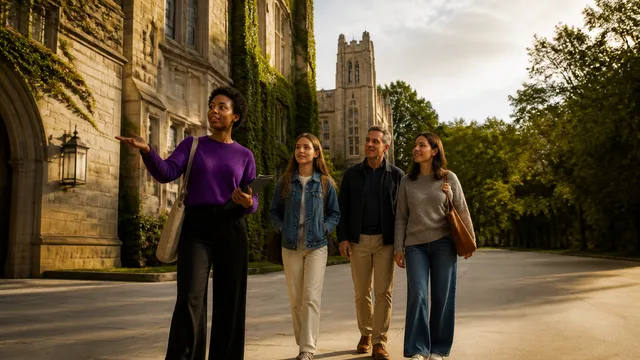
How to Make a College Tour Actually Matter
College tour season is here. Here's how families can shift from passive observers to active explorers—and why who leads the visit changes everything.
Public Trust in Science Is Fragile and Complicated
Trust in science is eroding—but the data is more complicated than the panic suggests. Here's what's actually happening, and why it matters.