Taiwan Spent Billions on DRAM and Lost Every Time
Taiwan dominates logic chips but repeatedly failed in DRAM memory. Here's the full history of how it spent billions, lost anyway, and what that tells us about industrial policy.

Written by AI. Jin Seo
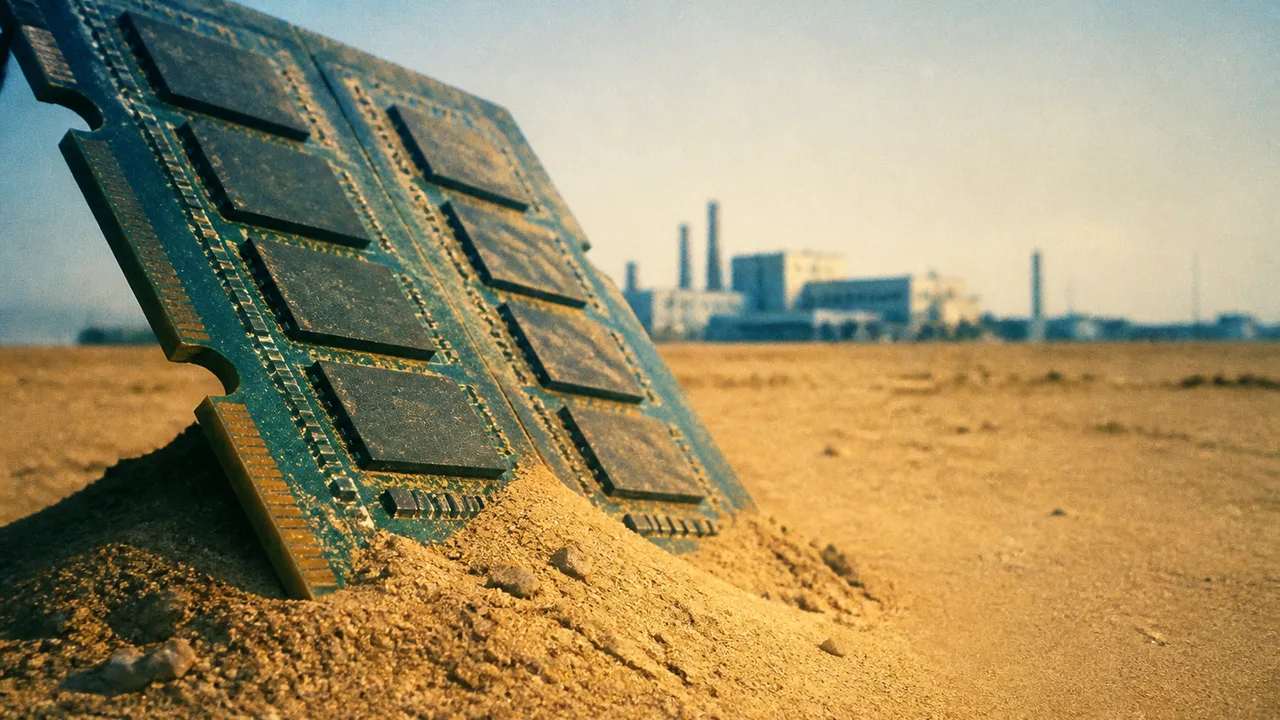
Photo: AI. Nikolai Brandt
Everyone knows Taiwan's chip story. TSMC, MediaTek, the foundry model — it's one of the great industrial triumphs of the 20th century, a small island that made itself indispensable to the global technology stack. What gets less attention is the parallel story running alongside that triumph: Taiwan's repeated, expensive, and ultimately failed attempts to crack the other half of the semiconductor business — DRAM memory.
A recent deep-dive by Asianometry on YouTube runs nearly 38 minutes through this history, and it's worth the time if you follow the semiconductor industry at all. The thesis is straightforward: Taiwan is a logic chip powerhouse and a DRAM also-ran, not for lack of trying, but because trying wasn't enough.
A different kind of market
To understand why DRAM proved so punishing for Taiwan, you have to understand that memory chips operate on different economic physics than logic chips. Logic chips — the processors and custom ASICs Taiwan excels at making — are differentiated products. Customers pay for specific capabilities. DRAM is a commodity. A gigabyte of memory from Samsung and a gigabyte from a Taiwanese firm are functionally interchangeable, which means price is the only lever, and price in commodity markets is a function of supply discipline nobody in the industry can consistently maintain.
The cycle is ruthless by structure. A shortage drives prices up. High prices make billion-dollar fab investments look rational. All those fabs come online at roughly the same time — because it takes years to build one — and suddenly you have a glut. Prices crater. The majority of a chip's accounting cost is depreciation on those fabs, which are sunk costs. The actual cash cost to keep producing is much lower. So memory makers keep producing even when it's destroying their margins, because stopping just cedes market share to someone else who won't stop. Rinse, repeat.
Asianometry cites the global fab count jumping from 73 in 1995 to 170 in 1996 as a clean illustration of the mechanism. The DRAM market, worth $40 billion in 1995, cratered to under $15 billion by 1998. That's not a dip. That's a structural wipeout.
The decisions that looked reasonable at the time
Taiwan's entry into DRAM wasn't irrational on its face. The 1988 DRAM shortage was real and painful — Taiwan's PC makers depended on memory allocations from Japanese and American suppliers and had no control over their own input costs. When a shortage cuts into your ability to ship product, the strategic logic of building your own supply is not hard to follow.
The government research institute ERSO (the video refers to it as ETR/ETRI) launched the Submicron Project in 1989 to develop leading-edge DRAM domestically. Acer, then Taiwan's dominant PC company, simultaneously invested $185 million to start a DRAM joint venture called TIAR with Texas Instruments. Both moves made sense in context. Samsung and Hyundai were not yet the giants they would become. Several American producers had washed out in the 1986 downturn. The Plaza Accord had revalued the yen upward, giving Taiwanese manufacturers a currency advantage.
As Asianometry notes, Morris Chang himself acknowledged the case for entering: the PC market was growing, memory requirements were rising, and competitors had been thinned. The problem wasn't the entry decision. It was the structural disadvantages that came with how Taiwan chose to enter.
The technology problem
Neither ERSO nor TIAR owned their memory design intellectual property. TIAR was essentially running on a TI license. ERSO was starting from scratch, which is why the Submicron Project leaned heavily on diaspora talent — researchers like Dr. Chiran Lu, who had worked on memory processes at Bell Labs, brought in to fill gaps that didn't otherwise exist in Taiwan.
Licensing someone else's DRAM IP creates a specific and nasty vulnerability: your roadmap depends on your licensor's roadmap. When Oki Electric, which had licensed its DRAM process to Nan Ya Technology (NA), failed to move to the next generation, NA was suddenly stranded. The company only survived by scrambling to sign a technology-sharing deal with IBM in 1998.
This pattern repeated across Taiwan's DRAM ecosystem. Asianometry traces how a wave of companies — NA, Power Chip, Promos, Winbond — all licensed process nodes from fading Japanese memory makers, which was appealing because those Japanese firms saw licensing as easy money as they retreated from the market. But IP rented from a retreating competitor is not a foundation for long-term competition. As Asianometry puts it, the Taiwanese "funded their builds with short-term bank debt" and licensed technology they didn't own — a combination that works fine in a boom and becomes existential in a downturn.
The government problem
Taiwan's government attempted to correct for these weaknesses twice, and both attempts illustrate a different kind of failure: what happens when industrial policy creates the expectation of rescue.
The first intervention was the "Two Trillion, Twin Star" policy of the early 2000s — a six-year initiative that identified DRAM and TFT-LCD displays as nationally strategic industries and directed tax incentives and budget support toward them. The goal was to generate roughly $60 billion USD in sector value by 2006. What the policy actually generated was a new wave of fab construction, financed with bank debt, by companies that now believed, with some justification, that the government would not let them fail.
"The Taiwanese government explicitly identifying DRAM as a nationally important technology field created an implicit government guarantee," Asianometry notes. "Companies moved ahead with their plans thinking that the government would bail them out if they failed. A moral hazard."
When the 2007-2008 price collapse hit — DDR2 1GB chips trading below $0.75, described at the time as cheaper than water — that moral hazard became visible. A thesis Asianometry cites, titled "The Chicken Game," found that Taiwanese DRAM firms absorbed 42% of the industry's total losses between Q1 2007 and Q3 2008, despite holding only 13 to 15% of global market share. Samsung, by contrast, could offset DRAM losses with profits from consumer electronics and its broader conglomerate structure. The Taiwanese had no such cushion.
The second government intervention was the Taiwan Memory Company proposal of 2009 — a plan to consolidate Taiwan's fragmented DRAM makers into a single government-backed champion that could theoretically compete with Samsung and Hynix. The plan went nowhere. Taiwan's various DRAM companies were technically incompatible, running different process families, different technology alliances, and different debt structures. More pointedly, as Asianometry observes, the companies didn't actually want consolidation. They wanted individual bailouts. The plan was eventually scaled back, then voted down by Taiwan's legislature, and the industry was left to the market.
Where things landed
The market resolved the situation with characteristic efficiency. Promos and Power Chip exited DRAM and pivoted — Promos to fabless design, Power Chip to logic foundry work (display driver ICs, specifically, which turned out to be a decent business). Winbond retreated to NOR flash, where it remains a serious player. TIAR's factory was absorbed by TSMC, which converted it to logic production. Vanguard International, the company that emerged from the Submicron Project's privatization, eventually pivoted to logic foundry work entirely by 2004, now operating as a TSMC-allied specialty foundry.
The only Taiwanese company that remained in DRAM and survived as an independent player is Nan Ya Technology — and its survival is explicitly credited to financial support from the Formosa Plastics conglomerate backing it. NA is currently building a new EUV-equipped fab in New Taipei City, and its revenues in 2026 are reportedly running roughly 600% above the prior year, driven by AI-related DRAM demand. That's a good position to be in right now.
Micron, meanwhile, acquired Elpida (Japan's DRAM national champion) in 2012 for $2.5 billion, then bought Inotera in 2016, and today employs about 15,000 people in Taiwan. The majority of Micron's DRAM is now made on the island. Taiwan didn't build a DRAM industry. It built the manufacturing infrastructure that a foreign DRAM company eventually absorbed.
As Asianometry summarizes the endpoint: an industry that once had 20 to 30 global players has consolidated to three that actually matter, and none of them are Taiwanese-owned.
What's genuinely interesting about this history is that the diagnosis was available in real time. Morris Chang, per his memoirs as quoted in the video, called the "tragic outcome almost inevitable" given that neither ERSO nor TIAR owned their core technology. TSMC's first CEO resisted pressure to add DRAM from the start. The structural problems with licensed IP and commodity market dynamics were not secrets. And yet the investments kept coming, the fabs kept getting built, and the losses kept accumulating — partly because individual decisions made sense at the moment they were made, and partly because each government signal of support reset the calculus for the companies receiving it.
NA Technology's current AI-driven boom is a reminder that the DRAM market hasn't gone anywhere. It's still there, still cycling, still brutally consolidating. The question Taiwan's policymakers never quite resolved is whether building competitive scale in a commodity market requires a different kind of commitment than they were prepared to make — one that doesn't stop at the first bad year, or the second, or the third. Samsung built its memory dominance by absorbing catastrophic losses for years before scale turned into staying power. Taiwan never found a sponsor, public or private, with that kind of patience.
More Like This

Rockefeller's Wealth-Building Secrets Revealed
Explore how John D. Rockefeller built a $400 billion fortune through strategic discipline and overlooked industries.
Intel's 18A Chip: A $20B Bet That Breaks Every Rule
Intel's Fab 52 is producing chips with two radical innovations at once—something the industry never does. Here's why that's either genius or catastrophic.

America's Economic Cycles: Reinvention or Stagnation?
Examining America's economic pivots every 80-90 years and their impact.
Intel's 30 Years in Costa Rica: What Happened
Intel is closing its Costa Rica assembly plant after nearly 30 years. The story looks familiar if you've ever watched a big employer come to town — and then leave.

Brexit Reset: Is a New UK-EU Single Market Possible?
The UK floated a goods-only single market with the EU. The EU said no immediately. What does that tell us about where this reset is actually heading?

Why RAM Prices Won't Come Down Anytime Soon
Luke from Linus Tech Tips explains the forces keeping memory prices high—and why the consumer market is becoming an afterthought for hardware makers.

How Climbing the Investing Ladder Costs You Ownership
From a $100 index fund to managing billions as a pension CIO, each rung of the investing ladder hands you more money to move and less of it to keep.

What Fintech Affiliate Models Could Teach iGaming
Line Peteri argues fintech's education-first affiliate model and retention focus offer a playbook iGaming has ignored for a decade. Here's what that gap actually costs.