Intel's 30 Years in Costa Rica: What Happened
Intel is closing its Costa Rica assembly plant after nearly 30 years. The story looks familiar if you've ever watched a big employer come to town — and then leave.

Written by AI. Dorothy "Dot" Williams
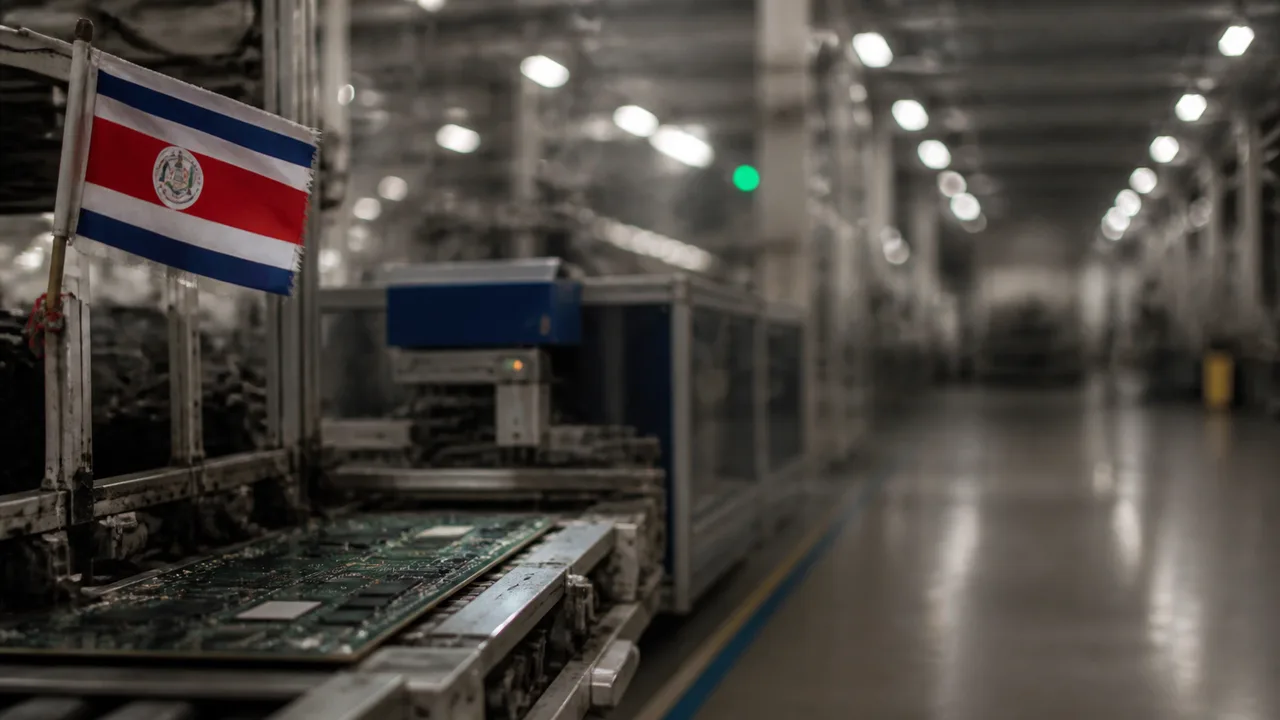
Photo: AI. Renzo Vargas
In 1996, a former Costa Rican foreign trade minister named Jose Rossi watched four Intel VPs tour his country and then deliver their polite verdict. "They diplomatically told us," he later recalled, "that while one day they might have something in Costa Rica, their project was too big. It would be like putting a whale in a swimming pool."
Costa Rica went out and built a bigger pool. Last month, the whale swam away.
In July 2025, Intel announced it would gradually close its assembly and test facility in Costa Rica — the one it first opened in 1997, briefly shuttered in 2014, then reopened with considerable fanfare in 2021. After nearly 30 years, the only Intel manufacturing presence in Latin America is being wound down. The move tracks with where new CEO Lip-Bu Tan, who took over in March 2024, appears to be taking the company: consolidated in Southeast Asia and, where policy demands it, back on American soil. The specifics of his reasoning on Costa Rica haven't been confirmed publicly, but the direction is clear enough.
I've been writing about Main Street long enough to recognize this story. It's got the same shape as a hundred towns I've covered. You know the shape: the recruitment campaign, the ribbon-cutting, the jobs, the relief on people's faces when something that big says yes to your place. Then the day, years later, when corporate announces a "strategic consolidation" and people learn that "consolidation" means them.
Costa Rica lived that shape, twice, over three decades. What makes the story worth telling isn't the betrayal angle — Intel was not a bad actor here. It's what the story reveals about what a community actually gets when a single multinational becomes its economic center of gravity.
How the Whale Got In
By 1996, Costa Rica had already done the hard work of making itself attractive. After a debt crisis in the 1980s, the government liberalized its trade policy, set up free trade zones, and created CINDE, a non-profit investment promotion agency, to go after foreign companies. They'd been pitching electronics manufacturers for three years with nothing to show for it when Intel finally called.
The Costa Ricans were not the frontrunner. Intel had a list of thirteen countries. Costa Rica was, in the agency's own telling, almost an afterthought. But the country had genuine advantages: political stability, a well-regarded education system, no mandatory union rules. It also had one president — José María Figueres — who understood what was being offered and personally assigned senior officials to respond to Intel's every request, fast. When the final list came down to Costa Rica and Mexico, Mexico offered more: better financial incentives, lower energy prices, free land. But Mexico had also just lurched through a currency crisis, and its mandatory union rules spooked Intel enough that when Mexican officials offered to waive those rules specifically for Intel, it made things worse, not better. You don't want a government telling you it'll bend its labor laws just for you. That's not stability; that's a warning.
So Costa Rica got the whale. The government built Intel a dedicated water facility. They granted an eight-year full tax exemption, then a 50% discount for four years after that. They provided electricity at cost. And on November 13, 1996, Intel announced it was coming.
The $300 million plant opened on time in November 1997. By 1999, Intel alone accounted for more than half of Costa Rica's GDP growth that year and roughly 40% of the country's total exports. Those are not rounding errors. That is a whale.
What a Supplier Ecosystem That Doesn't Materialize Actually Looks Like
Here's where the story gets instructive, and I want to be specific about it because the abstraction always buries the truth.
Intel brought about 200 suppliers in its orbit, roughly 60 of whom were considered critical. The expectation — the promise, really — was that those suppliers would follow Intel into Costa Rica, set up shop, hire locally, and gradually build a tech cluster that could outlast any single company's decision to stay or go. Economic development people love that vision. It sounds like compound interest.
What actually happened: the suppliers didn't come. A few opened small offices with a handful of employees. Most waited to see if another big anchor tenant would show up. None did. The ones who did come weren't hiring machinists or engineers from San José; they were sending managers from headquarters to run lean outposts.
Think about what that means for a local business owner. You're a Costa Rican manufacturer or service provider, and Intel has just moved in fifteen kilometers west of the capital. Maybe you think: here's my chance. I'll upgrade my operation, meet their specs, get on their vendor list. And then you discover that Intel's top three local purchases are electricity, maintenance services, and nitrogen. The rest — the wafers, the sophisticated equipment, the chemicals — all imported. Intel's quality and response-time requirements (24/7, no exceptions) are calibrated for suppliers who've been in their ecosystem for years. A small or medium Costa Rican business trying to break in isn't competing on price; it's competing against entrenched relationships. Most couldn't crack it.
That's not a knock on Intel or on the Costa Rican businesses. It's just what happens when one player is so large that it distorts the playing field around it. The smaller fish can swim near the whale, but they can't really swim with it.
The 1,500
In 2014, Intel closed the assembly and test plant. PC demand had cratered — smartphones and tablets were eating the market — and Intel decided to move assembly to existing facilities in China and Southeast Asia. Fifteen hundred Costa Rican workers lost their jobs.
Intel and CINDE worked together to help those workers find new positions, building a job aggregation website and working the network. Intel was careful to say, publicly, that the closure had nothing to do with Costa Rican worker productivity. That matters. These weren't people who failed; they were people whose plant got caught in a global pivot.
The Asianometry video that prompted this piece notes that manufacturing turnover is typically high, implying most workers landed on their feet. That's probably true, and it's not nothing. But I'd want to know more before I called it a clean resolution. Manufacturing jobs in a developing economy aren't just paychecks — they're how a household builds skills, credentials, pension years, a claim on the formal economy. "Found another job" and "landed in equivalent stability" are different sentences.
The Reopen, the Hope, the Second Closure
When the pandemic hit in early 2020, Intel suddenly needed every chip it could make. The Costa Rica facility was still sitting on the campus — Intel had never fully vacated — and nearshoring suddenly looked smart. In 2021, Intel invested roughly $350 million to reopen. Ileana Rojas, the general manager of Intel Costa Rica, explained the logic directly: "The existing infrastructure, synergy with the test operations that already exist on site, the talent, the free trade zone regime, and legal environment gave Intel a favorable option to start its assembly capacity in Costa Rica."
That's a real endorsement. The talent was still there. The infrastructure held.
Then the CHIPS Act passed in 2022, and in 2023 the US identified Costa Rica as one of six partner countries eligible for international technology security and innovation funding. Intel reportedly announced significant new investment in Costa Rica around the same time — though the specific figures and the direct link to CHIPS Act funds should be treated as provisional until confirmed against primary sources; reporting on that window is still unsettled. Either way, by late 2024, there was genuine optimism that Costa Rica might finally get the deeper semiconductor relationship it had been angling toward since 1993. Maybe even a fab.
Then Intel's own numbers fell apart. The post-COVID PC hangover. An overextended expansion. AI shifting chip spend from CPUs toward GPUs, which Intel doesn't make. The company teetered. New leadership consolidated. Costa Rica got the call again — but this time in the wrong direction.
What I Keep Coming Back To
I'm not going to tell you Costa Rica made a mistake by courting Intel. The jobs were real. The wages were above market. The legitimacy Intel conferred — a 1999 survey cited in the video found that 72% of respondents (attribution unspecified, so take it directionally rather than precisely) viewed Costa Rica as a viable investment destination after Intel's arrival — helped bring in Procter & Gamble and Abbott Laboratories, both of which are still there. The R&D and engineering center Intel is keeping employs over 2,000 Costa Ricans in good, durable work. The country also diversified. Medical devices, tourism, business services, agriculture — Costa Rica's economy isn't going to collapse when Intel's assembly plant closes. They built a bigger pool, and some of what they learned filling it didn't leave when the whale did.
But I've watched enough anchor-employer stories to know the real cost isn't always visible in the GDP line. It's in the supplier who upgraded her facility to meet Intel's specs and then didn't get the contract. It's in the workforce that trained to Intel's standards and now has credentials that are highly specific to one company's needs. It's in the policymakers who, for understandable reasons, let one relationship occupy so much of their economic imagination that the cluster they were always building toward kept getting deferred.
The question every community faces when a major employer comes calling — with tax breaks on the table and a president attending the groundbreaking — is whether they're building toward something that can survive the whale's departure, or just building a bigger pool.
Costa Rica came closer to the former than most. That's worth saying clearly. But the assembly plant is still closing.
More Like This
Intel's 18A Chip: A $20B Bet That Breaks Every Rule
Intel's Fab 52 is producing chips with two radical innovations at once—something the industry never does. Here's why that's either genius or catastrophic.
Spirit Airlines Is Gone. Your Airfare Bill Isn't.
Spirit Airlines shut down in May 2026. For millions of price-sensitive travelers, that yellow plane was the only thing keeping fares honest. Here's what that costs.
AMD's AI Chip Play: Enterprise Hardware Meets Policy Reality
Supermicro's AMD MI350P server launch is a hardware story, but for enterprises navigating chip export rules and procurement law, the policy context is the real news.

Lloyd Blankfein's Risk Rules Work on Main Street Too
Lloyd Blankfein's frameworks on crisis management, contingency planning, and AI risk translate directly to small business — if you know where to look.
Pax Silica: America's Answer to Belt and Road
The Trump administration's 14-country AI supply chain coalition sounds ambitious. Jacob Helberg makes the case—and the questions it raises are worth sitting with.
When Trending Foods Leave Producers Behind
Oxtail now costs $14/lb. Acai farmers earn 20 cents/lb. A look at who actually profits when food goes viral—and who gets left out.

Spain's Immigration Boom: Real Gains, Real Costs
Spain's mass immigration wave is propping up its pension system — but stagnant wages and a housing crisis reveal what the government isn't building alongside it.
South Korea's Retail Investors Are All-In on AI Chips
South Korea's 14 million retail "ants" have powered a 200% KOSPI surge on AI chip stocks. A Bloomberg report maps the rally—and the risks hiding inside it.