AMD's AI Chip Play: Enterprise Hardware Meets Policy Reality
Supermicro's AMD MI350P server launch is a hardware story, but for enterprises navigating chip export rules and procurement law, the policy context is the real news.

Written by AI. Samira Barnes
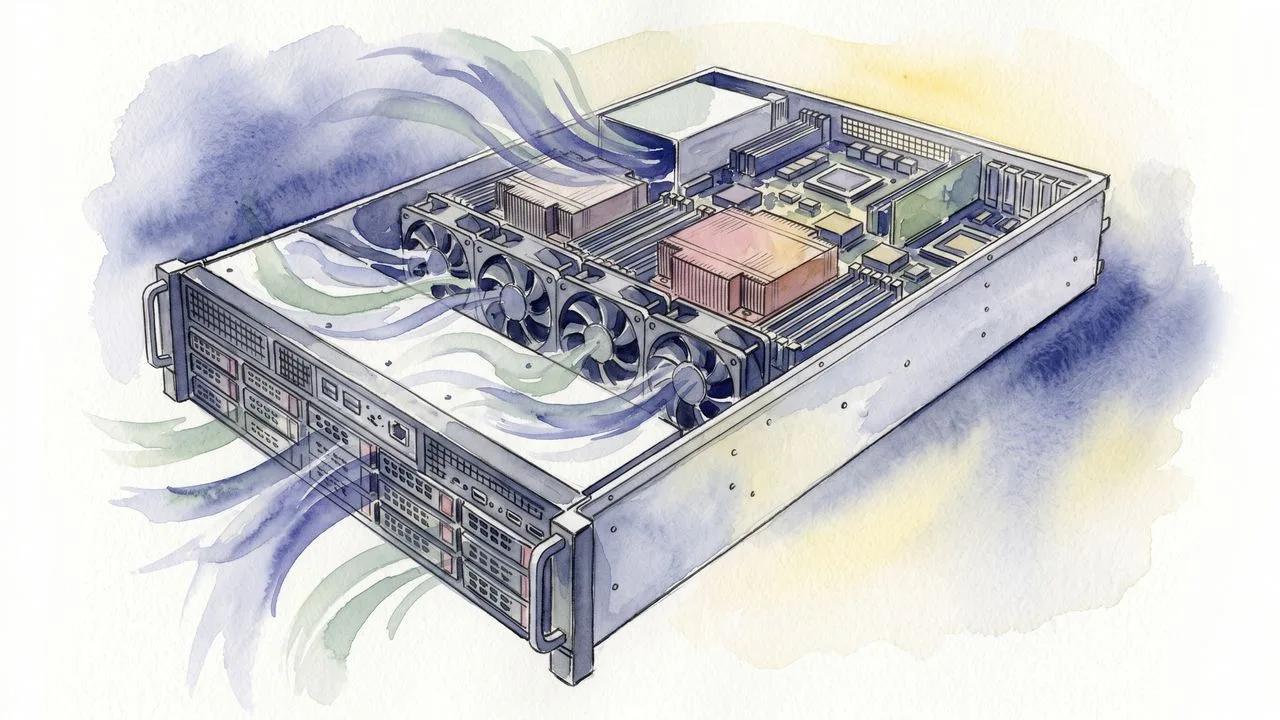
Photo: AI. Júlia Almeida
The question Supermicro says it hears most often from enterprise customers — "how do we deliver next-generation AI performance without redesigning our entire data center?" — is an infrastructure question dressed up as a procurement question. But for a significant slice of the organizations actually asking it, it's also a legal and regulatory question. That part doesn't make it into the five-minute product video.
Supermicro this week announced configurations of its AS-5126GS-TNRT and AS-5126GS-TNRT2 servers featuring AMD's new Instinct MI350P PCIe GPUs. The technical pitch is coherent: fully air-cooled 5U chassis, dual AMD EPYC 9005 ("Turin," fifth-generation, Zen 5 architecture — not to be confused with the EPYC 9004 "Genoa" line), PCIe Gen 5 connectivity with direct CPU-to-GPU attachment, and up to 144 GB of HBM3e memory per accelerator delivering up to 3.6 terabytes per second of memory bandwidth. The MI350P also supports hardware-level partitioning into up to four isolated GPU instances, which matters for multi-tenant workloads and security-conscious deployments. The power supplies carry 80 PLUS Titanium certification, which specifies up to 96% efficiency at 50% load — meaningfully high, though efficiency curves at other load levels run somewhat lower.
The architecture is explicitly built around PCIe rather than a tightly coupled scale-up fabric. Supermicro describes the design as "clean, purpose-built, direct CPU to GPU attached, high bandwidth, low latency, and minimal architectural complexity." That's a technical description of a specific choice: optimizing for inference workloads at enterprise scale rather than the high-bandwidth inter-GPU communication you'd want for large-scale model training. The MI350P's CDNA architecture generation — AMD describes the MI300 series as CDNA 3; the MI350P's precise generation positioning relative to that lineage has not been definitively confirmed in public AMD documentation as of this writing — is worth watching as AMD's own disclosures develop.
None of that is the story I'm here to write.
The Political Economy of Not Buying NVIDIA
AMD's enterprise AI hardware push doesn't exist in a vacuum. It exists in a market where NVIDIA controls, by most estimates, somewhere between 70% and 90% of AI accelerator revenue — a concentration that has drawn sustained attention from competition regulators on both sides of the Atlantic. The European Commission has been examining NVIDIA's market position in AI chips. The U.S. Department of Justice and the Federal Trade Commission have both been circling questions about whether NVIDIA's dominance in GPU hardware, combined with its software ecosystem (CUDA), constitutes a competition problem. The FTC under both the Biden and Trump administrations has shown interest in AI supply chain concentration.
When AMD and Supermicro pitch enterprise customers on PCIe-based AI infrastructure that slots into existing data centers, they are making a technical argument, yes — but also a political economy argument. The argument is: you don't have to be locked into a single vendor's ecosystem to run serious AI workloads. The MI300X uses AMD's Infinity Fabric for inter-chip communication, not NVIDIA's proprietary NVLink. The MI350P's PCIe form factor is, by design, interoperable with standard rack infrastructure. This is the kind of competition that antitrust regulators say they want to see. Whether the market responds accordingly is a separate and genuinely open question.
For enterprises that are government contractors or operate in federally regulated industries, the hardware decision is not purely a performance-per-dollar calculation. Federal procurement rules — including FAR provisions and agency-specific acquisition regulations — shape which vendors and which hardware configurations are eligible for government contract use. The CHIPS and Science Act of 2022 created domestic manufacturing incentive structures that are gradually reshaping where AI chips get made and, by extension, which suppliers can credibly claim supply chain security for government buyers. AMD's domestic and allied-nation fabrication relationships are part of its procurement story, even when they don't appear in product videos.
The Export Control Dimension
Here is where the policy stakes become most concrete for a specific category of enterprise buyer. The Commerce Department's Bureau of Industry and Security has spent the past two years constructing an increasingly detailed export control framework for advanced AI accelerators. The October 2023 rules, expanded in 2024, created tiered country groupings that determine which AI chips can be exported where — and at what performance thresholds licenses are required. The rules specifically target chips above defined total processing performance and performance density benchmarks.
Enterprises in defense, intelligence, dual-use research, and certain financial sectors procuring AI infrastructure need to understand not just what hardware performs best, but what hardware they can legally deploy given their customer relationships, data handling obligations, and international operations. For a multinational running AI inference workloads across multiple jurisdictions, "deploy today in the data center you already operate" carries more complexity than any five-minute product video can resolve — and I mean that as a statement about regulatory reality, not a criticism of the marketing format.
The MI350P's PCIe positioning — optimized for inference rather than the large-scale training clusters that have attracted the most regulatory attention around compute thresholds — may actually give it a somewhat different export control profile than the highest-performance data center accelerators. But enterprises in regulated sectors should not take hardware marketing materials as compliance guidance. That's what export counsel is for.
What Enterprises Actually Need to Know
Supermicro's pitch on the technical side is genuinely aimed at a real problem. "Inference workloads in particular are expanding rapidly and becoming part of core business operations," the company notes in the video — and that's accurate. The AI deployment wave most enterprises are living through right now is predominantly an inference wave, not a training wave. Most organizations are running models, not building them. That changes the hardware calculus: you need memory bandwidth, efficient compute for high-throughput low-latency serving, and the ability to run multiple workloads in parallel. The MI350P's hardware partitioning feature — dividing a single GPU into up to four isolated instances — directly addresses the resource efficiency problem that makes AI inference expensive at scale.
The air-cooling argument also lands differently once you've talked to enterprise data center operators. Liquid cooling is coming, and for the highest-density training clusters it's essentially mandatory. But the installed base of enterprise data center infrastructure is overwhelmingly air-cooled, and retrofitting for liquid cooling involves facility modifications, additional operational risk, and capital expenditure that most IT budgets aren't structured to absorb quickly. A platform that delivers serious AI inference performance within existing thermal envelopes is genuinely deployable in a way that many competing configurations are not.
What the video doesn't address — because it's a product video, and product videos don't address this — is the total cost of compliance for regulated enterprises. Data residency requirements under GDPR, state privacy laws, and sector-specific regulations like HIPAA determine where AI inference workloads can physically run. Federal Risk and Authorization Management Program (FedRAMP) authorization governs cloud-based AI deployments for government customers. The hardware platform matters, but so does the entire software and infrastructure stack sitting on top of it, and whether that stack carries the certifications a regulated buyer actually needs.
AMD's competition against NVIDIA in the enterprise AI accelerator market is, at minimum, useful for buyers — competitive markets produce better pricing and more innovation than monocultures do. Whether AMD can close the software ecosystem gap that CUDA has built over more than a decade is the more consequential question for enterprise adoption, and it's one the regulatory environment can't resolve for them. Antitrust scrutiny might prevent NVIDIA from foreclosing competition through contractual or technical lock-in. It cannot make ROCm match CUDA's developer adoption overnight.
The organizations best positioned to take Supermicro's offer seriously are the ones that have already done the regulatory homework — mapped their export control obligations, confirmed their procurement compliance posture, and assessed their data governance requirements against their AI deployment plans. For them, a capable PCIe-based inference platform that deploys into existing infrastructure without facility overhaul is genuinely useful. For the rest, the infrastructure question and the compliance question need to be answered in the same room, and usually aren't.
More Like This

The Complexity Paradox in Multi-Agent AI Systems
Exploring the real impact of AI agent quantity on performance and regulation.

Inside an AI Factory: What 144 GPUs in One Rack Actually Means
Supermicro's NVIDIA B300 systems pack unprecedented GPU density. But the networking, cooling, and power infrastructure reveals the real engineering challenge.

Google Cloud's Chip Strategy Explained by CEO Thomas Kurian
Google Cloud CEO reveals why owning TPU chips gives them a compute advantage over competitors relying on Nvidia—and why they're still hiring despite AI automation.
Nvidia's DGX Station Brings 20 Petaflops to Your Desk
Supermicro's new DGX Station delivers datacenter AI performance in a deskside package. Academic computing just got a lot more interesting.

AI Agents Are Building Their Own Economy on the Web
Major tech companies are simultaneously building payment, search, and execution infrastructure for AI agents—creating an economic layer where software transacts autonomously.

Anthropic's API Shift: Impact on OpenCode Users
Anthropic limits Claude API to Claude Code, impacting OpenCode users. Explore the implications and future of AI coding tools.

AI Chip Smuggling and the US-China Tech Divide
FT's Eleanor Olcott investigates the black market for Nvidia AI chips reaching China despite US export controls — and what it reveals about the tech race.

Promptware: When AI Agents Become Attack Vectors
Prompt injection attacks on AI agents follow a structured kill chain — and existing legal frameworks have almost nothing to say about who's liable when it works.