Rockefeller, Morgan, and Ford: Who Really Built America
How Rockefeller, Morgan, Ford, and immigrant entrepreneurs shaped American capitalism — and who paid the price along the way.

Written by AI. Margaret "Maggie" Holloway
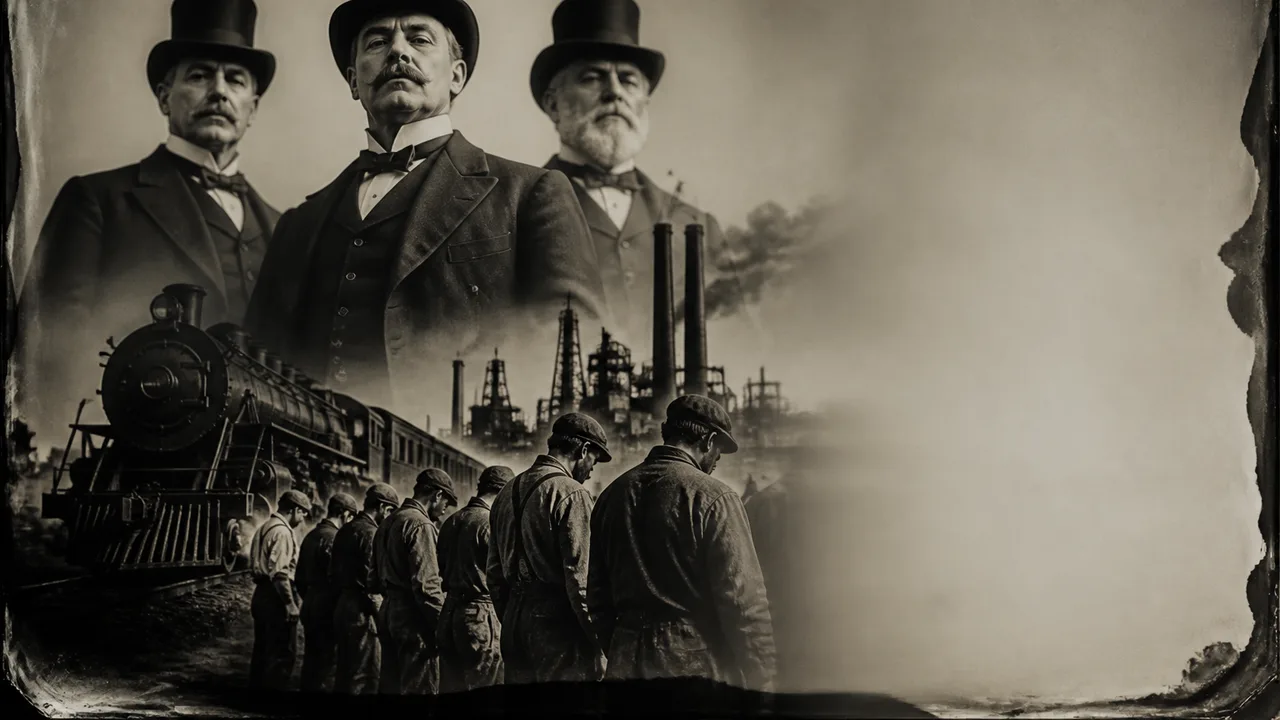
Photo: AI. Otieno Okello
Every December, workers erect a Christmas tree in the plaza at Rockefeller Center, and every December, most of the people stopping to photograph it have no idea the tradition started in 1933 — pooled from the wages of construction workers grateful just to be employed, in the depths of the worst economic collapse the country had ever seen. A monument to capitalism, funded by workers terrified capitalism had abandoned them. That tension — between the system's grandeur and its human cost — is the real subject of Doc of the Day's sweeping archival documentary on the American industrial dynasties.
The film is built from rare footage, much of it genuinely remarkable: John D. Rockefeller at over ninety, filmed in his early-1930s dotage, pressing dimes into strangers' hands. Home movies of the DuPonts on their Cuban estate, shot in nitrocellulose color film — a component, the documentary dryly notes, also used in their main business of explosives. J.P. Morgan Sr. and his son actively avoiding the camera for most of their lives, glimpsed only at the edges of other events. The archive-alongside-the-home-movie is a particular kind of historical whiplash: the public record and the private man occupying the same frame, and refusing to resolve into a single coherent portrait.
The Architecture of Accumulation
The documentary's argument, broadly stated, is this: the post-World War I American boom was not an accident of geography or democracy. It was engineered by a small number of families who had positioned themselves, over decades, to capture the upside of an industrializing economy — and who, when the boom collapsed, were insulated from the worst of it in ways ordinary Americans were not.
Rockefeller is the film's organizing figure. His genius, as the documentary presents it, was not in finding oil but in refusing to look for it. He let the wildcatters — surrounded by what the film describes as "doodlebug men, oil witches, oil smellers, and other diviners in immediate abundance" — absorb the risk of exploration. Then he bought what they found, refined it, and negotiated freight rates that crushed anyone trying to compete. The result was a market grip that became a textbook case in monopoly.
The Morgans operated differently but to similar effect. The House of Morgan, the documentary tells us, carried no nameplate on its Wall Street facade. The public may not deal here. Before the Federal Reserve's establishment in 1913, J.P. Morgan & Company effectively functioned as the nation's central bank — and even afterward, its influence extended further than any elected official's. The film makes the striking claim that at the Paris Peace Conference following World War I, Morgan interests shaped the reparations terms imposed on Germany, overriding Woodrow Wilson's preferences, with Allied war debts to American banks as the underlying motivation. Whether one accepts that framing fully or not, the structural point stands: private financial power was directing geopolitical outcomes in ways the public didn't see and couldn't vote on.
The Other Builders
What lifts the documentary above simple hagiography — or simple takedown — is its insistence on telling a more crowded story. The dynastic families share the screen with the people who fled to America and built things here too, usually without the benefit of inherited capital or political access.
Max Factor's story is the one that lingers. A cosmetician to Russian aristocrats, Factor fled the pogroms following the Russian Revolution, moving his family by foot through forests to the nearest seaport, hiding the children under leaves when strangers approached. He arrived in America barely literate. His children translated for him. He made his way to Hollywood — which itself existed, the documentary argues, because Jewish film entrepreneurs fled Thomas Edison's patent enforcement regime and headed west far enough that his lawyers couldn't easily follow. What they built in that flight was the American film industry. Paramount, Warner Brothers, 20th Century Fox: the documentary notes that all of the so-called Big Five studios had Jewish founders.
Edison, by the film's account, was complicated about this. His private views, quoted in the documentary, are the particular variety of backhanded anti-Semitism that imagines itself as a compliment: "The moment they get into art, music, and science, and literature, the Jew is fine." The man who held patents on the motion picture camera was, in other words, being financially outmaneuvered by the people he condescended to. The irony writes itself.
The documentary doesn't romanticize immigrant success. One survivor's account captures the ambient hostility plainly: "I remember my mother saying, 'As a Jew, you will always have to be twice as good to get ahead in life.'" Those who rose did so against structural resistance, not merely by joining an open competition.
Philanthropy as Strategy
The section on the Rockefeller Foundation is where the documentary's analytical lens gets sharpest — and most uncomfortable. John D. Rockefeller Jr., "Junior," adopted what the film presents as the family's governing philosophy: world peace through trade. The Foundation deployed that philosophy across Korea, China, and Africa, funding hospitals and public health campaigns to combat diseases like malaria and yellow fever.
The documentary doesn't shy from the embedded logic. A research report quoted in the film documents that 320 laborers cured of hookworm infection showed dramatically increased productivity — and notes that "each laborer was paid less per unit of work, but was able to work harder and longer." Healthier workers were more profitable workers. The Foundation's humanitarian work and its commercial function were not in conflict; they were the same project.
This is the genuine open question the documentary surfaces and does not resolve: when philanthropy improves lives and expands markets, what exactly is being given? The DuPonts, who supplied 40% of allied gunpowder in World War I and were called "merchants of death" in Congress, pivoted after the war into consumer synthetics — nylon stockings, eventually, proved more profitable than munitions. Rockefeller Center, built at a loss during the Depression with more than 70,000 workers employed in its construction, was simultaneously a jobs program and a monument to a family ideology. Where does the gift end and the investment begin?
Black Thursday and Its Aftermath
Five days after J.P. Morgan & Company sent President Herbert Hoover a memorandum declaring that "the future appears brilliant," the market collapsed. The documentary presents the memo — read aloud, with its smooth institutional confidence — as something close to dark comedy. Blue-chip stocks lost as much as half their value in a single week.
Morgan Jr. was later called before what became known as the Pecora Commission, the Senate investigation into the crash and its causes. According to the Commission's findings, as documented in its Wikipedia record, the hearings revealed deeply embarrassing details about the financial practices of major Wall Street figures — including testimony about Morgan Jr.'s Depression-era tax payments that suggested he had paid little or nothing in federal income tax during those years. For the people losing farms and heading west on Route 66, that particular detail landed like a charge.
Rockefeller, for his part, issued a public statement from the rubble that has aged in complicated ways: "Depressions have come and gone. Prosperity has always returned and will again. Let us with faith in God, in ourselves, and in humanity, move forward to courageous living." From a man whose assets were structured to survive almost anything, it reads less like comfort than instruction.
The Skyline as Argument
The Chrysler Building went up during this period, its Art Deco spire still one of the more beautiful things in the Manhattan skyline — measuring 319 meters to the top of its spire, according to architectural records documented at ArtInContext.org. It was a record at the time. The competition for vertical height during the late 1920s is, in retrospect, a perfect spatial metaphor for an economy running on borrowed confidence: the higher you built, the further down you could fall.
In 2001, the buildings that carried the Rockefeller family's "world peace through trade" philosophy in their very name were destroyed in a single morning. The documentary frames the World Trade Center's destruction as the moment the Rockefeller century truly ended — the family ideal meeting the century's central contradiction in the most literal possible terms.
That may be too neat. History does not often provide such clean punctuation. But the documentary earns the image by spending fifty-two minutes establishing what the buildings meant to the people who conceived them — and who built them, and who cleaned them, and who could never have afforded an office in them. The Christmas tree in the plaza was always theirs more than it was anyone else's.
The question the film leaves open is whether any of that has changed.
More Like This
WW1 Trench Life: What the Western Front Was Really Like
From Pals' Battalions to the Vickers gun, a new documentary unpacks the grim machinery of survival on the WW1 Western Front in unflinching detail.
Rockefeller's Wealth-Building Secrets Revealed
Explore how John D. Rockefeller built a $400 billion fortune through strategic discipline and overlooked industries.
Unveiling Rome's Gladiator Underworld
Explore the hidden world beneath ancient Rome's arenas, unveiling gladiator training, underground tunnels, and cultural practices.
Jackie Kennedy and Lee Radziwill's Bitter Lifelong Feud
The feud between Jackie Kennedy and her sister Lee ran deeper than jealousy. A look at the betrayals—plural—that made it permanent.
How Baby Boomers Reshaped the American Economy
A look at the data behind generational wealth gaps, housing unaffordability, rising tuition, and tax policy shifts—and what they mean for younger Americans.
Secret Societies: Power, Myth, and Who Gets to Write History
From the Carbonari to Skull and Bones, ten secret societies reveal how influence actually works — and who gets to decide what's real.
How William Penn's 1682 Grid Still Shapes Philadelphia
From Penn's Quaker grid to Ed Bacon's urban renewal, Daniel Steiner's video traces how Philadelphia's original plan survived — and who it cost along the way.
Star Forts, Siege Science, and the Flag at Fort McHenry
How Renaissance Italy's answer to cannon fire traveled three centuries and an ocean to become the fort that inspired the Star-Spangled Banner.