The Crusades: Two Centuries of Holy War Explained
From Pope Urban II's 1095 call to arms to the fall of Acre in 1291, the Crusades reshaped Christianity, Islam, and the medieval world permanently.

Written by AI. James Morrison
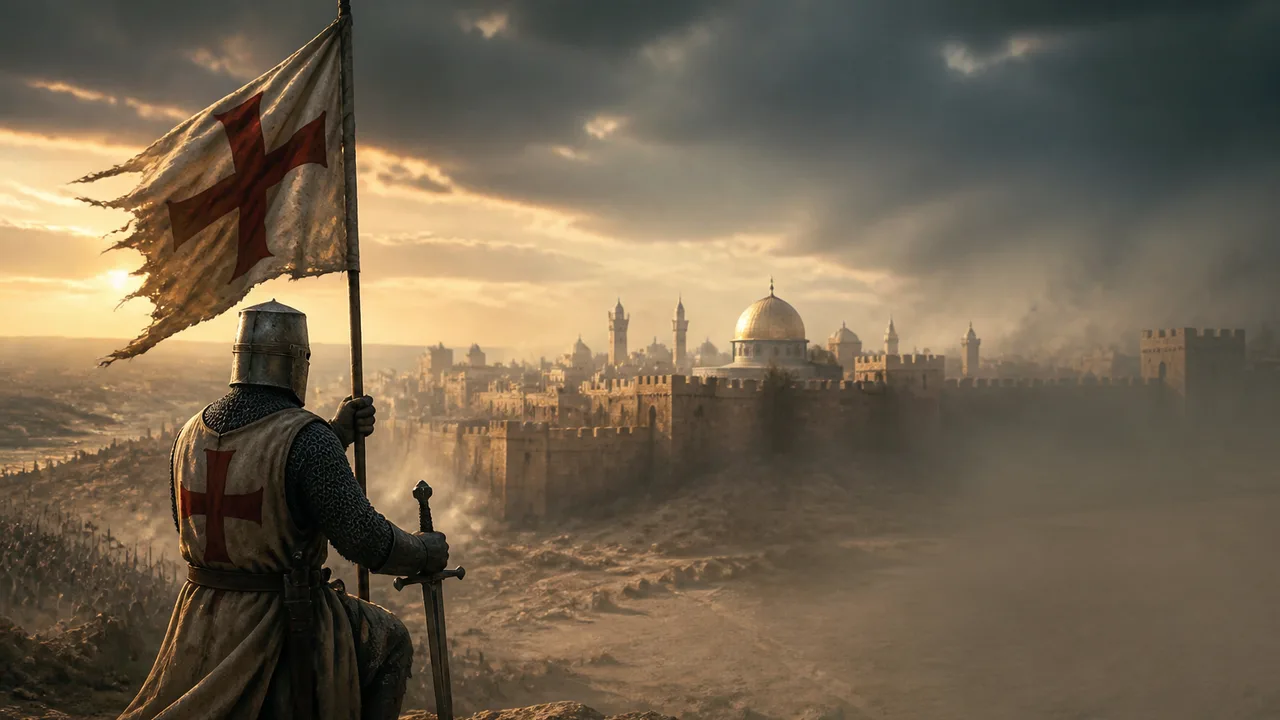
Photo: AI. Astrid Lehmann
On the 15th of July 1099, the army of the First Crusade breached the walls of Jerusalem. They had marched over 2,000 miles from Europe to the Middle East. And now, as the channel This Is History puts it in a newly released documentary overview of the period, "their grueling ordeal and pent-up religious fervor gave way to an indiscriminate massacre of the holy city's inhabitants — a slaughter carried out in the belief they were doing God's will."
That single image — heavily armed European knights cutting down the inhabitants of a city they had never seen, convinced of divine sanction — has defined how the Crusades have been argued about ever since. The This Is History documentary, running nearly 27 minutes, attempts something genuinely difficult: a comprehensive account of two centuries of crusading warfare that neither whitewashes the violence nor reduces the whole enterprise to a simple morality tale. It largely succeeds, and the tensions it surfaces are worth sitting with.
A Crisis of Geopolitics, Dressed in Theology
The documentary's strongest contribution is its insistence on grounding the Crusades in hard political reality before invoking religious motivation. The Seljuk Turks — nomadic converts to Sunni Islam from Central Asia — had by 1055 captured Baghdad and effectively absorbed the Abbasid Caliphate. In 1071, Sultan Alp Arslan crushed the Byzantine army at Manzikert, a defeat that cracked open Anatolia and sent Emperor Alexios I reaching westward for help he had no other way to secure.
What landed on Pope Urban II's desk in 1095 was not a spiritual summons but a desperate military request from a rival Christian emperor. Urban's genius — or his cynicism, depending on where you stand — was in reframing it. At the Council of Clermont, he called on the knights of Europe to "set aside their petty feudal quarrels and march east." Jerusalem was added to the mission as Urban's own objective. The crowd's response, Deus vult — God wills it — became the crusading motto. Whether God willed anything is a question the documentary wisely leaves to the viewer.
The financing alone tells you something about who these men actually were. Many knights pledged their feudal estates as collateral to monasteries in exchange for campaign cash. According to Knowledge Stew, this arrangement was known in Old French as a mort gage — a "death pledge" — the etymological ancestor of the modern mortgage. Holy war, it turns out, required mundane credit arrangements. The spiritual and the transactional were never as separate as the rhetoric suggested.
The Violence the Narrative Keeps Having to Absorb
The documentary does not flinch from the costs, and that matters. The People's Crusade — the peasant mob that set out ahead of the official expedition under a preacher named Peter the Hermit — massacred Jewish communities in the Rhineland cities of Speyer, Worms, Mainz, and Cologne before a single blow was struck against any Muslim army. Thousands died in what the documentary correctly identifies as atrocities that preceded the Crusade's arrival in the Holy Land. The official First Crusade then killed the inhabitants of Jerusalem after breaching its walls in July 1099.
The contrast with Saladin's conduct in 1187 is striking and the documentary notes it deliberately. When Saladin retook Jerusalem after destroying the crusader army at the Battle of Hattin, he spared the city's population. This was not weakness — the man had just dismantled a century of crusader military power in a single afternoon. It was policy, and a calculated one. The documentary frames the contrast without editorializing, which is the right call. Readers should draw their own conclusions about what those contrasting choices meant.
The Fractures Within
One of the more useful things the documentary does is resist presenting "the Crusades" as a coherent Western Christian project. The Fourth Crusade (1202–04) is the most damning exhibit. Assembled under Pope Innocent III and contracted to strike at Egypt, it never got there. Indebted to Venice and manipulated by Byzantine court politics, the crusading army sacked the Christian city of Zara in November 1202 — earning immediate excommunication — and then, months later, turned its full force on Constantinople itself.
Three days of looting and burning destroyed what the documentary calls "arguably the greatest city in all of Christendom, if not the world." Among the most famous plunder were four bronze horses taken from the Hippodrome, which the Venetians transported home and mounted above the entrance to St. Mark's Basilica. According to Images of Venice, the originals were moved indoors to the Museo Marciano in the 1980s to protect them from weathering; replicas now stand in their place outside. The Byzantine Empire fragmented and never fully recovered. That the crusaders accomplished this to a Christian city, in the name of a crusade, is the kind of historical irony that tends to get smoothed over in popular accounts. The documentary does not smooth it over.
Meanwhile, crusading was being repurposed closer to home. The Albigensian Crusade (1209) targeted Cathar heretics in southern France; entire towns like Béziers were massacred, with participants granted the same spiritual rewards as those fighting in the Holy Land. The Teutonic Order was Christianizing the Baltic. The Reconquista continued in Iberia. "Crusade" had become a franchise, and the papacy was its franchisor.
The Diplomat Who Won What Warriors Couldn't
The Sixth Crusade deserves more attention than it typically receives, and the documentary gives it its due. Holy Roman Emperor Frederick II — excommunicated by the Pope, fluent in Arabic, genuinely interested in Islamic philosophy — chose negotiation over siege. In 1229, he secured by treaty the return of Jerusalem, Bethlehem, and Nazareth to crusader possession. He did not fire a shot.
The Church was furious. The Pope had excommunicated the man leading the crusade, and that man had succeeded where armies had failed. Frederick's success pointed toward something the crusading movement could never quite accept: that the political and religious divisions within the Islamic world — between Cairo, Damascus, and Aleppo — were better exploited diplomatically than militarily. The crusaders occasionally understood this. They rarely acted on it consistently enough to matter.
The Mamluks and the End
The decisive force that finally extinguished the crusader presence was not another Arab army or a resurgent Ayyubid sultanate. It was the Mamluks — described by Wikipedia as a military caste of soldiers of slave origin who had supplanted the Ayyubid dynasty in 1250, seizing power during the political fallout from the disastrous Seventh Crusade, in which King Louis IX of France was captured and ransomed for an enormous sum.
The Mamluks proved more formidable than anything the crusaders had previously faced. They stopped the Mongols at Ain Jalut in 1260 — a moment that effectively ended any realistic hope of a Christian-Mongol alliance against the remaining Islamic powers. Then, under Sultan Baybars and his successors, they dismantled the crusader states systematically, fortress by fortress.
The end came at Acre in 1291. Sultan al-Ashraf Khalil arrived with a force that contemporaries described in the tens of thousands — Warfare History Network, drawing on period accounts, places the army in that range — and fought the remaining crusaders down over a six-week siege until the city fell. According to the documentary, "the remaining coastal towns surrendered without resistance over the following weeks. And with that, after almost 200 years, the crusader presence in the Holy Land was extinguished once and for all."
The Templars and Hospitallers relocated to Cyprus. The Templars were dissolved by papal decree in 1312. The Hospitallers went on to conquer Rhodes from the Byzantine Empire in 1310 and would eventually become the Knights of Malta — a thread of institutional continuity that persisted well into the modern era.
What Remains
The This Is History documentary frames the Crusades as a story that never quite ended — only transformed. The Ottoman Empire's rise rekindled the structural conflict between Christian Europe and the Islamic world that crusading had both expressed and inflamed.
That framing has merit, though it also carries a risk: treating centuries of complex, contingent history as an inevitable cycle can shade into fatalism, or worse, into the kind of civilizational-clash narrative that modern politicians reach for when they want to dress up contemporary grievances in ancient armor. The documentary is careful enough to avoid that trap, but the material it covers has been misused by others who are not.
The honest read of the Crusades is that they were driven by the intersection of genuine religious conviction, naked political ambition, economic opportunity, and institutional momentum — and that those forces produced results that no one fully intended and no one could fully control. A medieval knight pledging his estate as a mort gage to fund a march to Jerusalem was not a symbol of faith alone. He was also a man making a financial bet on his own survival, which is perhaps the most human detail in the entire story.
More Like This

Ray Dalio's Framework for Tracking Empire Decline
Ray Dalio argues empires follow measurable, repeating cycles of rise and fall. His framework deserves scrutiny—and raises questions relevant to today's geopolitics.
Medieval England: How Peasants and Guilds Shaped Society
A new documentary traces medieval England's social divide through two real families—one peasant, one guild merchant—and the starkly different worlds they inhabited.
Unraveling Rome's Dodecahedron Mystery
Exploring the enigmatic Roman dodecahedron, its theories, and historical significance in modern archaeology.
FBI's Struggle Against Omega 7: A Tale of Terrorism and Intrigue
Explore the FBI's complex investigation of Omega 7, a Cuban exile terrorist group, amid community challenges and evolving tactics.
The Gods of Pre-Islamic Arabia, In Their Own Words
Ancient desert inscriptions reveal the polytheistic world before Islam—gods, prayers, sacrifice, and fate, recorded by the nomads who lived it.
Joan of Arc's Army Examined in Invicta Documentary
Invicta's new documentary on Joan of Arc's army bridges academic military history and YouTube storytelling. Harry Goodman examines what that translation costs and earns.
Gettysburg's Command Failures and What They Still Cost Us
Dr. Roy Casagranda's Gettysburg lecture reveals how four command archetypes from 1863 shaped the battle's outcome—and what they still tell us about military leadership today.
The Arab Revolt and the Ottoman Collapse of 1916
How British strategy, Russian pressure, and Sharif Hussein's ambitions combined in 1916 to fracture Ottoman power across the Middle East.