Ray Dalio's Framework for Tracking Empire Decline
Ray Dalio argues empires follow measurable, repeating cycles of rise and fall. His framework deserves scrutiny—and raises questions relevant to today's geopolitics.

Written by AI. James Morrison
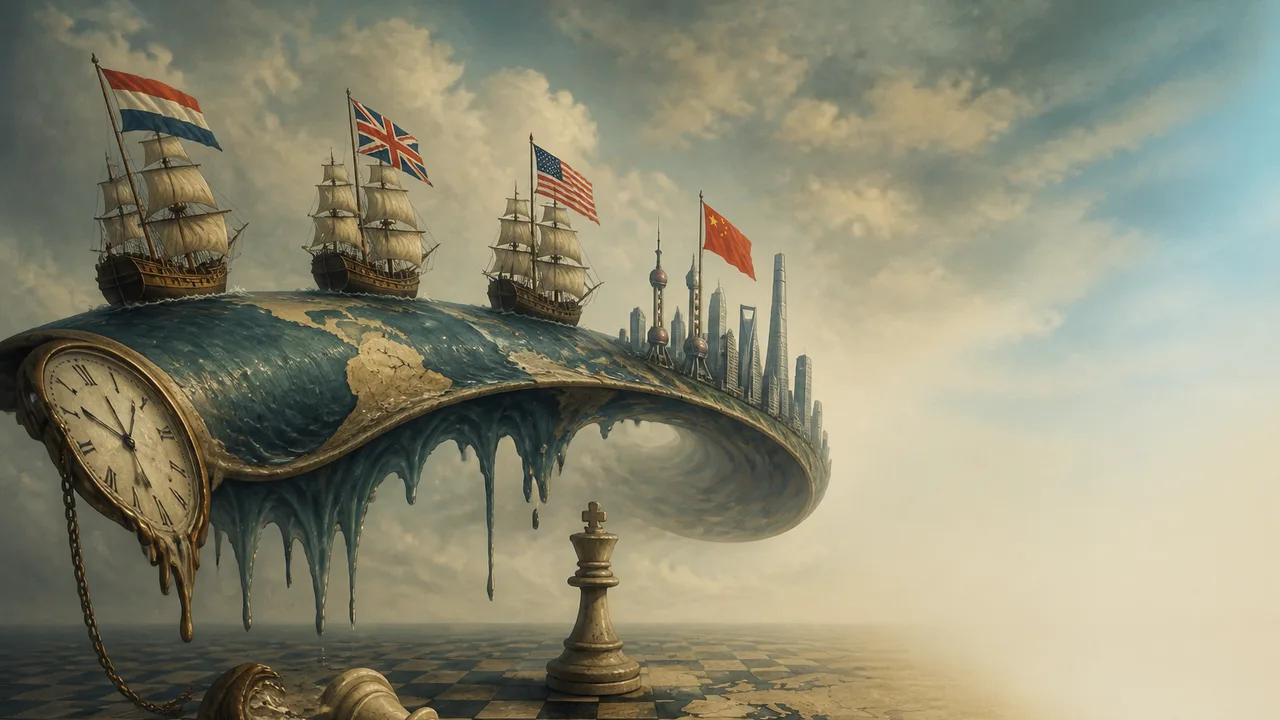
Photo: AI. Iolanthe Fenwick
Ray Dalio has spent a career reading patterns that most people dismiss as noise. As the founder of Bridgewater Associates, one of the world's largest hedge funds, he built his fortune on the premise that history repeats itself with enough regularity to be useful—not as prophecy, but as probability. His animated video series on the changing world order extends that premise beyond markets into something considerably more ambitious: a grand theory of how empires are born, mature, overextend, and collapse.
It is worth taking seriously, even where it invites skepticism.
The Clockwork of Civilizations
The core argument is straightforward. Dalio examined the major empires of the last five centuries—the Dutch, British, American, and Chinese among the most prominent—alongside their currencies, and identified overlapping cycles of dominance that last roughly 250 years, with transition periods of a decade or two between them.
He measures imperial power across eight metrics: education, inventiveness and technology development, competitiveness in global markets, economic output, share of world trade, military strength, the power of their financial center for capital markets, and the strength of their currency as a reserve currency. The elegance of the framework is that these aren't soft impressions—they're designed to be quantified, tracked over time, and compared across civilizations.
What Dalio finds, charted against historical data, is a recognizable shape. The metrics rise together and, eventually, fall together, each reinforcing the next on the way up and accelerating the decay on the way down.
The Anatomy of a Cycle
The sequence Dalio describes will feel familiar to anyone who has studied military history, even if they've never thought about it in these terms.
A major conflict—a war, usually—establishes a new dominant power. The exhausted losers have neither the will nor the capacity to challenge the victor. A period of relative peace follows, and with it, prosperity. People grow accustomed to stability. Credit expands. Investment flows. The empire's currency, because it lubricates so much of global trade, becomes the world's reserve currency, which enables even more borrowing, which inflates the cycle further.
Then the bubble bursts. It always does. The printing of money to manage the debt creates inflation and erodes living standards. Wealth, which never distributed itself evenly during the boom, becomes a source of acute social tension. Dalio describes what follows as some form of revolution to redistribute wealth, whether peaceful or, as history more commonly records, violent.
Meanwhile, a rival power has been quietly accumulating the early-stage metrics—better-educated populations, technological innovation, growing trade networks. When the dominant power is distracted by internal fracture, that rival tests the edges. External conflicts follow. And from those conflicts, a new order emerges.
Dalio's argument is not that this is inevitable in a deterministic sense, but that the pattern recurs with enough consistency to constitute something like a structural tendency. He is careful to frame the cycle as a typical sequence, not a guarantee.
What the Framework Gets Right
From a military history standpoint, the architecture of Dalio's model is hard to dismiss outright.
The sequencing he describes—post-war peace, credit expansion, wealth concentration, internal instability, external challenge—maps reasonably well onto what historians have documented across multiple transitions of global power. The decline of the Dutch Republic in the 18th century, progressively hollowed out by financial overextension and superseded by British naval and commercial dominance, fits the outline. So does the British experience after 1918: a victorious power that emerged from the First World War technically triumphant but economically wounded, its reserve currency role increasingly strained, its empire beginning a long managed retreat that would be completed—or rather, disorderly—by 1947.
The United States after 1945 is the cleanest example of a new order being constructed consciously from the wreckage of the old. Bretton Woods, the Marshall Plan, NATO—these were the architectural decisions of a dominant power that understood it was setting the terms of the next cycle. Whether American policymakers understood they were writing a script that would eventually play against them is a separate and more unsettling question.
Where the Model Deserves Scrutiny
The framework's strength—its compression of centuries into a legible pattern—is also its primary vulnerability.
History selected Dalio's cases. The empires he examines are the ones that rose high enough to be worth studying, which means the model is built on a sample of successes and failures that survived to be documented. Empires that declined for idiosyncratic reasons—plague, geographic catastrophe, a single catastrophic military defeat—may not fit the sequence as neatly, and their absence shapes the pattern as much as their inclusion would.
The 250-year cycle figure is also worth examining carefully. Cycles of that length are long enough to span many human generations and short enough to feel like meaningful units of analysis. But they are also loose enough to absorb a great deal of variation. A "transition period" of 10 to 20 years covers an enormous range of historical experience—a decade of Cold War tension looks nothing like the 20 years of grinding conflict that preceded the Peace of Westphalia.
There is also the question of agency. Dalio's model, by design, emphasizes structural forces: debt dynamics, wealth inequality, the mechanics of reserve currency status. These are real and powerful. But they can crowd out the role of individual decisions, leadership quality, and contingency. The United States did not have to mismanage its post-2001 military adventures. The British ruling class did not have to handle the interwar years the way it did. Structural pressure creates conditions; it does not write the script.
The US-China Question
Dalio does not pretend to be a disinterested scholar. His concern, stated plainly, is that most observers are too focused on short-cycle news to notice the longer-wave dynamics now underway. The subtext is visible: the United States shows several of the indicators his model associates with a declining empire—wealth concentration, political dysfunction, debt expansion, an eroding reserve currency advantage—while China shows several of the indicators associated with a rising one.
This is not a radical observation. It is, in various forms, the central geopolitical question of our era. What Dalio contributes is a framework that tries to make the comparison systematic rather than impressionistic.
Whether that framework is reliable enough to act on is where thoughtful people part ways. Economists who specialize in currency dynamics have questioned whether the dollar's reserve status is as fragile as the model implies—the euro's failure to displace it, the renminbi's limited international convertibility, and the absence of a credible alternative all complicate the narrative. Military strategists, meanwhile, note that nuclear deterrence has fundamentally altered the calculus of great-power conflict in ways that pre-1945 history cannot fully illuminate.
None of that makes Dalio wrong. It makes the question harder.
The Utility of the Long View
What the framework offers, stripped of any specific prediction, is a corrective to the tyranny of the present tense. Most policy discussions, most financial analysis, and most political commentary operate on timescales measured in quarters or electoral cycles. Dalio is asking his audience to zoom out far enough to see the shape of centuries.
That is a discipline worth practicing, regardless of whether every detail of his model holds up. The rise of great powers, the structural role of reserve currencies, the relationship between wealth inequality and political instability, the dynamics of post-war order-building—these are not abstractions. They are the operating conditions inside which specific decisions by specific people produce specific consequences.
The soldiers who fought at Waterloo, at the Somme, at Inchon, and in Fallujah were not thinking about 250-year cycles. They were thinking about the next hundred meters. But the policies that put them there were shaped, consciously or not, by exactly the kind of long-wave dynamics Dalio is describing.
Understanding the pattern does not guarantee you'll know what to do with it. But not understanding it seems considerably more dangerous.
More Like This
Unraveling Rome's Dodecahedron Mystery
Exploring the enigmatic Roman dodecahedron, its theories, and historical significance in modern archaeology.
FBI's Struggle Against Omega 7: A Tale of Terrorism and Intrigue
Explore the FBI's complex investigation of Omega 7, a Cuban exile terrorist group, amid community challenges and evolving tactics.
America's Economic Cycles: Reinvention or Stagnation?
Examining America's economic pivots every 80-90 years and their impact.

Sitting Bull: Warrior, Mystic, and Military Strategist
From Hunkpapa war chief to victor at Little Bighorn—the life of Sitting Bull reveals a leader whose complexity American history has rarely done justice.
Financial Crises Follow Patterns — But Not for Everyone
Kuran Francis maps four recurring patterns behind every major financial crisis. The framework is solid. What it leaves out is the story of who pays when the system breaks.
Why Galactic Empires Are Doomed to Collapse
Explore why galactic empires in sci-fi often fall apart. Discover the challenges of leadership, communication, and governance.
April 1865: How the Civil War's End Was Decided
The History Channel's documentary on April 1865 examines how decisions made in a single month determined whether the Civil War's end would bring peace or prolonged guerrilla conflict.
The Nine Days of Bismarck: A Battle That Changed Naval War
How nine days in May 1941 destroyed Germany's mightiest battleship, sank the Royal Navy's iconic HMS Hood, and ended the battleship era for good.