Ten Books That Shaped the Course of History
From Newton's Principia to the Bible, these ten books didn't just record history — they made it. A look at the texts that rewired civilization.

Written by AI. Margaret "Maggie" Holloway
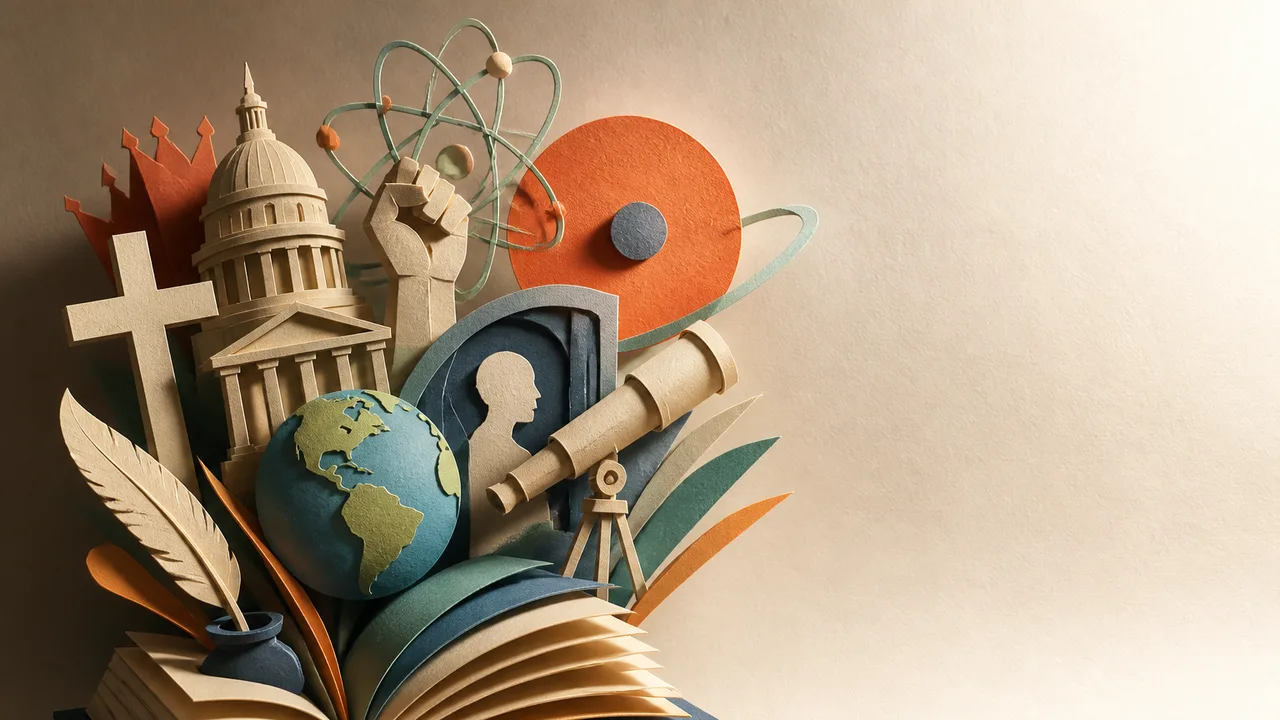
Photo: AI. Lila Bencher
There is a particular kind of arrogance embedded in the phrase "most influential books in history." Every such list is, at bottom, an argument — about what counts as influence, whose civilization we are centering, and which kinds of knowledge we have decided to take seriously. A recent video from the YouTube channel Some Guy Who Knows Stuff takes on that argument directly, assembling ten titles and making a case for each. The list is worth engaging with carefully, because the choices reveal something interesting: influence, it turns out, is less about the quality of an idea than about the infrastructure that carries it.
The Science Shelf
The video opens with Isaac Newton's Philosophiae Naturalis Principia Mathematica (1687) — a choice so defensible it barely requires defense. Newton did not simply describe the physical world; he provided the mathematical grammar for describing any physical world. As the video puts it, Principia explained "how the same force that causes an apple to fall also governs the motion of the moon and the planets." For the first time, terrestrial and celestial mechanics answered to the same equations. Engineers building bridges and scientists plotting spacecraft trajectories are still, in a very direct sense, working inside the framework Newton constructed.
Charles Darwin's On the Origin of Species (1859) occupies the number five slot, and the case is equally strong. Darwin spent decades assembling evidence — fossils, specimens from the voyage of HMS Beagle, years of meticulous correspondence — before committing it to a single argument: species change over time through natural selection. The controversy that greeted the book in 1859 was immediate and, in many quarters, personal. The decades of scientific debate that followed eventually drew in the emerging field of genetics, which supplied the mechanisms of inheritance that Darwin himself could only hypothesize about. Origin transformed not just biology but medicine, ecology, and anthropology — and fundamentally repositioned humanity within the natural order rather than above it.
The Technology That Made the List Possible
Sitting at number nine is the Gutenberg Bible — and this is where the video makes its most structurally interesting choice. The Gutenberg Bible is not on this list because of its content. The Bible's content earns its own entry at number one. The Gutenberg Bible is here because of what it was: a demonstration, according to Britannica, of a printing technology dated to around 1455 that would dissolve the monopoly on written knowledge almost overnight.
Before Gutenberg, a book was a hand-copied object — months of labor, accessible only to the wealthy or the institutional. The Library of Congress notes that Gutenberg produced a small first print run, with the precise figures still a matter of scholarly debate, but the effect was seismic regardless of the exact number. Within decades, presses had spread to hundreds of cities, producing texts on religion, science, medicine, and philosophy at a pace that manuscript culture could not have imagined. The Renaissance, the Protestant Reformation, and the Scientific Revolution all drew energy from the suddenly accelerated circulation of ideas. The Gutenberg Bible didn't change what people thought — it changed how fast thinking could spread.
Power, Strategy, and the Ruthless Art of the Possible
The video's political entries are where the real friction lives. Niccolò Machiavelli's The Prince — written around 1513 and published posthumously in 1532, according to the Stanford Encyclopedia of Philosophy — remains one of the most contested texts in the Western tradition. The video is precise about what made it scandalous: earlier political writers described how rulers should behave in an ideal world; Machiavelli described how they actually behaved in the real one. The question of whether it is better for a ruler to be loved or feared is still assigned in political science courses not because it has a clean answer, but because it doesn't.
Sun Tzu's The Art of War, estimated to date from the 5th century BC, sits at number seven — a text whose durability is itself a kind of argument. The video notes its reach beyond military strategy into business, sports, and diplomacy, and credits Sun Tzu's emphasis on "careful planning, preparation, and understanding both yourself and your opponent" as the engine of that longevity. Whether airport bookshop editions aimed at hedge fund managers represent genuine intellectual inheritance or cultural flattening is a question the video doesn't ask, but it hovers.
Adam Smith's The Wealth of Nations (1776) and The Communist Manifesto by Marx and Engels (1848) appear at numbers six and four respectively — and placing them in proximity is illuminating. Smith diagnosed the productive power of specialized labor and competitive markets; Marx and Engels diagnosed what that productivity was doing to the people performing it. The video handles The Communist Manifesto with careful balance: "Some view it as an important critique of industrial capitalism, while others focus on the consequences of governments that attempted to implement its ideas." That is not fence-sitting — it is an accurate description of where the historical debate actually stands.
The Philosophical Foundation
Plato's The Republic (c. 380 BC) occupies the number three position, and the video's treatment of it is notably precise. The Republic is not primarily a political manual — it is an extended interrogation of what justice is, conducted through dialogue rather than decree. The allegory of the cave, in which prisoners mistake shadows for reality, is described here as an exploration of "how difficult it can be to recognize truth when people are limited by ignorance or false beliefs." That is a question with obvious contemporary applications, which may explain why a text written more than two millennia ago is still assigned in introductory philosophy courses worldwide.
The Religious Texts
The video places the Quran at number two and the Bible at number one — and both entries resist easy summary because both texts resist being reduced to a single kind of influence. The Quran, the video explains, did not simply record religious belief; it became the organizing principle of education, law, art, and scholarship across an enormous geographic and temporal span. Arabic calligraphy flourished partly because Islamic tradition discouraged figurative religious imagery, channeling artistic energy into the written word itself. The Quran's verses appear on the walls of mosques, palaces, and public buildings across multiple continents — the text made visible as architecture.
The Bible earns its number one position through the sheer breadth of its reach. Translated into more languages than any other book, it shaped legal codes, educational institutions, literary traditions, and moral vocabularies across Europe and the Americas for centuries. The King James Version of 1611 left such a deep imprint on English prose that its cadences echo in writers as otherwise dissimilar as John Milton and William Faulkner. And Gutenberg's decision to use the Bible as the showcase text for his new printing technology — around 1455, per Britannica — meant that the two entries on this list are not independent: the technology and the text amplified each other.
What a List Like This Actually Tells Us
Any ranked list of "most influential" texts is doing something more revealing than it admits. These ten books share a structural feature: they did not merely describe the world — they provided frameworks through which subsequent generations understood and organized it. Newton gave physics its language. Darwin gave biology its logic. Smith gave economics its founding metaphor. Marx gave labor movements their grammar. Plato gave political philosophy its central questions. The religious texts gave billions of people their cosmologies, their laws, and their sense of what it means to live a good life.
What the list does not much dwell on — and what any honest accounting of influence must eventually confront — is the question of whose influence. These are texts that shaped the civilizations most represented in Western-centric historiography. That is not nothing; those civilizations did shape the modern world in measurable ways. But the list is also an argument by omission, and the books left off it are not without consequence.
The more useful question, after sitting with all ten, is the one the video gestures toward in its mid-roll pivot: if civilization had to rebuild from scratch, which of these frameworks would you choose to preserve? The fact that the question is difficult — that you cannot easily choose between Newton's physics and Plato's ethics, between Darwin's biology and the Quran's legal tradition — is the most honest thing the list reveals. Influence is not a competition. It is a sediment, and we are all standing on it.
By Margaret "Maggie" Holloway, History & Ideas Correspondent
More Like This
Alexandria's Library Was More Than a Library
Dr. Roy Casagranda's lecture on the Great Library of Alexandria reveals a research institute, innovation hub, and the ancient world's most powerful idea engine.
The Most Cited Science Papers of All Time, Ranked
From graphene to a 1951 chemistry trick, the most cited scientific papers ever aren't what you'd expect—and that tells us something important about how science actually works.
Ten Engineering Projects That Remade the World
From the Panama Canal to the International Space Station, ten engineering feats that didn't just solve problems — they rewrote what was thought possible.
Ten Discoveries That Rewired How We See Everything
From CRISPR to dark energy, ten scientific breakthroughs that didn't just change their fields — they changed what questions we're allowed to ask.
The Invisible Inventions That Built Modern Life
From flush toilets to undersea fiber cables, the inventions that most shaped modern civilization are the ones we've stopped noticing entirely.
Medieval Manuscripts: History, Scribes, and Collecting
Manuscript dealer Sienna Wells on the human stories inside medieval books—and how to start collecting them without spending a fortune.

Ten Scientific Discoveries Nobody Saw Coming
From Fleming's contaminated petri dish to Hubble's blurry mirror, accidental observations have repeatedly reshaped what we know about life and the cosmos.
The Nefertiti Bust's Disputed Past and Present
The Nefertiti bust raises two unresolved questions: is it genuinely ancient, and was it legally taken from Egypt? The evidence on both is more complicated than Berlin admits.