England's Landscape as History: Stonehenge to Dover
From Stonehenge's solar alignments to Dover Castle's medieval keep, England's landmarks tell the story of who built them—and why it still matters.

Written by AI. Margaret "Maggie" Holloway
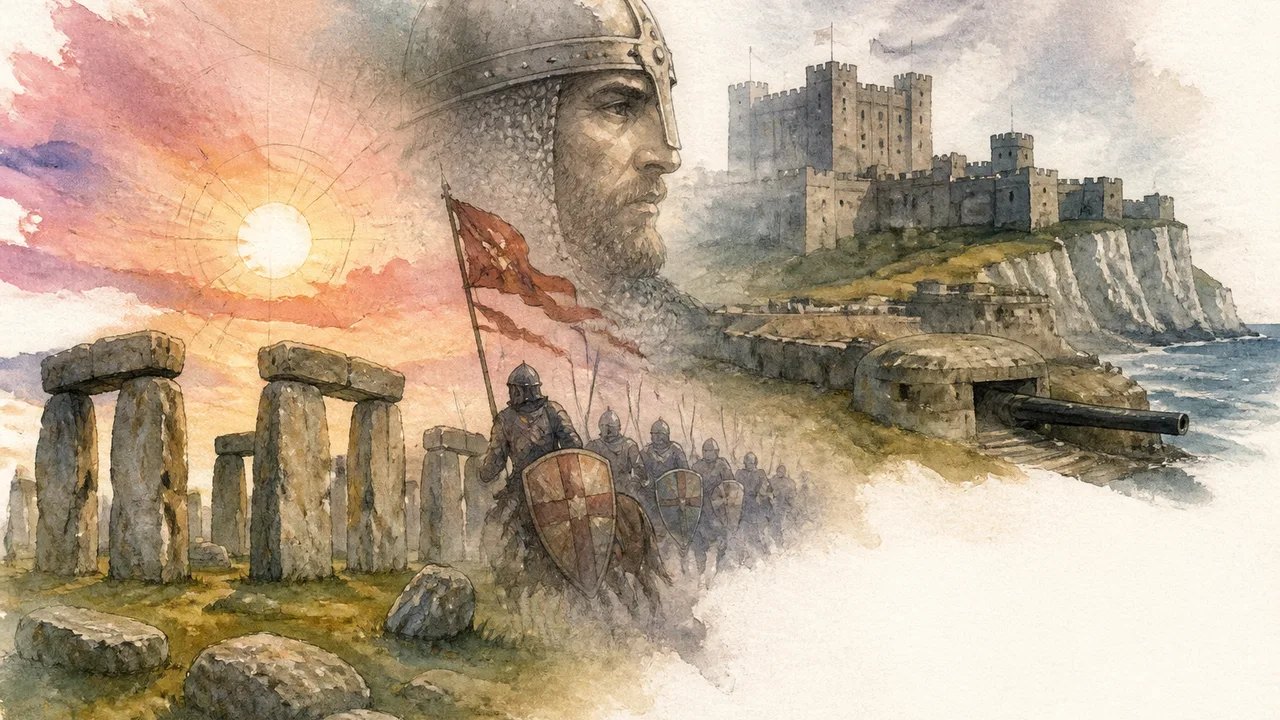
Photo: AI. Júlia Almeida
Drive the A303 southwest across Salisbury Plain on a clear morning and you will, at some point, simply stop talking. Whatever conversation was happening in the car evaporates. There it is, off to the left, exactly where it has been for roughly 4,500 years: Stonehenge. Generations of commuters and holidaymakers have filed past it in the same traffic jam, rubber-necking at the same stones, feeling the same wordless pull. That continuity of response is, when you think about it, the whole story.
Doc of the Day's road trip documentary through English Heritage sites uses that pull as its engine. The film moves chronologically through a succession of landmarks—Stonehenge, Old Sarum hillfort, the Battle of Hastings site, Dover Castle—treating each one less as a tourist attraction than as a chapter in an argument: that the English landscape is not scenery. It is a document. And like any document, it rewards close reading.
The Weight of Shared Purpose
The film opens at Stonehenge with the question that has nagged at archaeologists for two centuries: how, exactly, did anyone build it? According to English Heritage, the sarsen uprights weigh around 25 tons each—more, the film notes, than the individual blocks of the Giza pyramids. They were hauled from roughly 20 miles away. The smaller bluestones came from the Preseli Hills in South Wales, some 250 kilometres distant. The tools used to shape them—mortise joints carved into lintels with stone hammers, hundreds of which have been recovered from the surrounding area—represent, the film argues, thousands of hours of labour extracted from people who also had crops to tend and families to feed.
What the film does well here is resist the temptation to make Stonehenge feel alien. Curator Heather Sebire, giving a tour of the reconstructed Neolithic houses at the visitor centre, puts it plainly: "Thing you've got to remember is they were just like us. So, although they built this huge mysterious monument that we know as Stonehenge, they still needed somewhere to live. They needed to produce food. They needed to keep themselves and have a successful economy."
That framing—monument-builders as recognizable human beings with recognizable pressures—is useful. But it also smooths over the genuine mystery. The solar alignment is real: the site is oriented along a northeast-to-southwest axis, and at midsummer sunrise, light travels through the entrance and lands on what excavators call the altar stone. Sebire suggests the midwinter sunset may have mattered even more to people so dependent on seasonal weather. The alignment tells us these people were watching the sky with great precision. It does not tell us what they believed they were doing when they gathered here, or who was permitted to gather, or what the cost of exclusion from that gathering might have been. The archaeology of Stonehenge remains as much a record of what we don't know as of what we do.
A Hill That Refused to Be Abandoned
A few miles up the road from Stonehenge, Old Sarum presents a different kind of legibility. The Iron Age hillfort—position commanding, ditches deep, ramparts stacked—was built on a logic so sound that successive occupiers simply couldn't leave it alone. The Romans, who called it Sorbiodunum, recognised it as a node in their road network: three Roman roads converge here, one of which the film notes is still traceable and in use today. After the Romans came the Anglo-Saxons, and after them the Normans, who built a castle and a cathedral inside the Iron Age earthworks.
Old Sarum is a useful corrective to the idea that history moves in clean chapters. The Normans didn't erase the Iron Age; they built on top of it. The Romans didn't demolish Stonehenge; they deposited objects near it and moved on. Sites that were strategically or spiritually valuable tended to accumulate significance rather than shed it. That accumulation is visible in the layers of Old Sarum's soil, where Anglo-Saxon chapel foundations sit above Iron Age ramparts, and Norman stonework rises above both.
The Day England Changed
The film's centrepiece is October 14, 1066, and the field near Hastings where Harold Godwinson staked Anglo-Saxon England on a single engagement and lost. The setup is carefully reconstructed: Harold had just routed the Norwegian king Harald Hardrada at Stamford Bridge in Yorkshire, a victory achieved partly through surprise and speed. When William of Normandy landed on the south coast three days later, Harold moved south immediately rather than waiting for reinforcements—gambling that the tactic that had worked in the north would work again.
It didn't. William's forces, trapped south of Harold's position on Senlac Hill, attacked rather than waiting to be attacked. The fighting lasted for hours. At some point the Norman line appeared to break and retreat; Harold's men, sensing victory, charged downhill in pursuit. What followed may have been a deliberate tactical feint—the Normans wheeled, isolated the English who had left the ridge, and cut them down. Whether that manoeuvre was planned or improvised remains debated by historians, but the effect was a slow grinding attrition that eventually left Harold's army too thin to hold.
How Harold himself died is one of history's more enjoyably unresolved arguments. The film examines the Bayeux Tapestry panels carefully and honestly: the famous arrow-in-the-eye scene may be a 19th-century restoration error, with earlier restorers possibly replacing a spear with an arrow. Harold may have been killed by a Norman knight. The film declines to adjudicate, which is the correct call. We don't know.
What we do know is what came after. William built an abbey on the site as an act of calculated piety—thanksgiving to the God he credited with his victory, and a very large stone statement of his own authority. The field where Harold fell became, in the film's phrase, "the epitaph of Anglo-Saxon England."
A Castle That Never Stopped Working
Dover Castle, rising above the white cliffs at England's narrowest sea crossing, is where the film's argument about accumulation reaches its fullest expression. The site saw a Norman fortification in 1066, and the great stone keep was developed under Henry II, who reigned from 1154 to 1189. According to Dover Castle's historical records, the keep measures 30 metres square with walls up to 6 metres thick—dimensions designed to make it effectively siege-proof.
The film resists the ruins-as-emptiness cliché by showing the English Heritage restoration of the interior: whitewashed walls, hanging textiles, furniture, colour. Historian Marc Morris makes the point directly: "We still think of the Middle Ages as kind of a sepia-tinted, muddy, dung-coloured age because that's kind of the way that cinema sells it to us. And yet it was just a riot of colour."
Morris also offers a useful corrective on the castle-as-permanent-residence fantasy. Henry II had dozens of castles across England and the continent. At a place like Dover, even a spectacular one, the royal household might stay a week or two—but when it arrived, it arrived as a small town. Five hundred to a thousand people, horses requiring fodder, cooks, jesters, soldiers. The rest of the time, the castle ran on a skeleton crew.
Dover was different from most royal castles in one significant respect: its proximity to the continent meant it never really emptied. After the siege of 1216, when Louis VIII of France came close to taking it, Dover maintained a permanent garrison. That military function persisted for centuries, right through to the Cold War, when tunnels and bunkers beneath the castle were equipped to serve as a regional seat of government in the event of nuclear attack.
That last detail is the film's most quietly vertiginous. Stand in a medieval great hall imagining Henry II's dysfunctional court at feast, then consider that beneath your feet lies a bunker designed to house the surviving apparatus of a twentieth-century state after nuclear annihilation. The chalk under Dover has been hollowed out in layers: medieval, Napoleonic, Second World War, Cold War. The hill didn't choose those tenants. But it kept them all.
England's landscape has always been this: not a backdrop to history but its medium. The stones get moved, the ramparts get built over, the keeps get stripped to their walls—and then someone else arrives and decides this place, this particular arrangement of earth and chalk and elevation, is too useful to abandon. That instinct to return, to build on what's already there rather than start clean, may be the most English thing about England.
More Like This

Unveiling Rome's Gladiator Underworld
Explore the hidden world beneath ancient Rome's arenas, unveiling gladiator training, underground tunnels, and cultural practices.

Jackie Kennedy and Lee Radziwill's Bitter Lifelong Feud
The feud between Jackie Kennedy and her sister Lee ran deeper than jealousy. A look at the betrayals—plural—that made it permanent.
Digging for King John's Palace at Clipstone
Time Team excavates Clipstone, Nottinghamshire, hunting for King John's lost royal palace on the edge of Sherwood Forest. Here's what they found.

Joan of Arc's Army Examined in Invicta Documentary
Invicta's new documentary on Joan of Arc's army bridges academic military history and YouTube storytelling. Harry Goodman examines what that translation costs and earns.

The Science and Stories Behind Earth's Fiercest Winds
Explore the science of deadly winds, from hurricanes to tornadoes, and the people dedicated to understanding and surviving them.
How Tectonic Forces Shaped the European Continent
From 3-billion-year-old Norwegian rocks to the Alps still rising today, Europe's geological story is wilder than any human history we know.

Venice Is Sinking and Emptying at the Same Time
Venice faces two accelerating crises: rising seas and a vanishing population. Neither MOSE nor a €5 tourist fee comes close to solving either one.

Savannah's Urban Grid: A Utopia Built on Slavery
Savannah, Georgia was designed as an egalitarian utopia in 1733. What it became reveals how idealism and slavery shaped one of America's most walkable cities.