Venice Is Sinking and Emptying at the Same Time
Venice faces two accelerating crises: rising seas and a vanishing population. Neither MOSE nor a €5 tourist fee comes close to solving either one.

Written by AI. Margaret "Maggie" Holloway
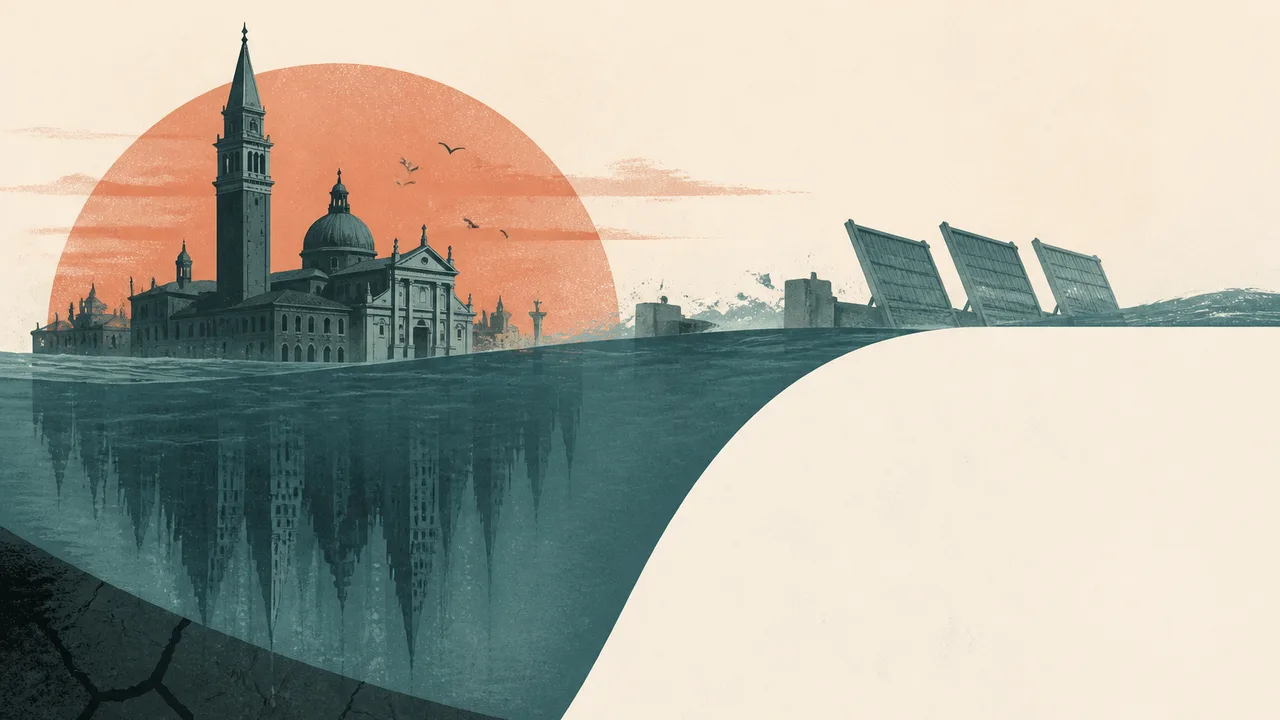
Photo: AI. Mika Sørensen
Venice shouldn't exist. That's not hyperbole — it's the foundational engineering fact of the place. A city conjured from a mosquito-infested lagoon, hammered into existence on wooden piles driven through soft clay, 1,600 years ago, by people who had no better options. The refugees of the collapsing Roman Empire — the Veneti, fleeing Huns and Goths and Lombards — looked at a swampy, tidally tortured stretch of the northern Adriatic and made a calculation: the sea that keeps enemies out can keep us alive.
They were right. For a thousand years, they were spectacularly right.
Now Venice sinks about 1/16 to 1/12 of an inch per year under its own weight — and the sea rises by nearly another 1/8 of an inch on top of that. A fingernail's worth of loss annually, compounding, accelerating. The Engineering the Impossible documentary on this crisis opens with that arithmetic and lets it sit. Because that's the thing about slow disasters: the numbers look manageable until suddenly they don't.
The Hole They Dug for Themselves
The modern acceleration of Venice's subsidence has a specific origin point, and it isn't climate change. It's the 1930s, and it's industrial ambition.
Groundwater was pumped from beneath the city for manufacturing and construction — cheap, convenient, catastrophic. Simultaneously, the lagoon was dredged to accommodate cargo ships and oil tankers. The lagoon's average depth, once about two feet, deepened to nearly three. Where tanker channels were cut, workers went down sixty feet. More water volume meant higher tidal push into the canals. The city dropped a few inches and never recovered them.
For decades, the response was essentially nothing. Then came November 4th, 1966.
The canals hit six feet four inches. Seawater surged into churches, piazzas, and living rooms across the city. Thousands fled. The damage to artworks and archives was incalculable — paintings, manuscripts, artifacts that had survived plagues and sieges and two world wars, ruined in twenty hours of standing water. The worst flood in Venice's recorded history. And suddenly, after a century and a half of neglect, the world gave a damn.
It took another four decades to act on that concern, and the act itself became its own scandal.
The Barrier That Corruption Built
MOSE — Modulo Sperimentale Elettromeccanico — is the engineering response to 1966. Three inlets connect Venice's lagoon to the Adriatic; MOSE guards all of them with massive hollow gates resting on the seafloor. When a dangerous tide approaches, compressed air fills the gates, tilting them upward at roughly 45 degrees. A wall rises from the sea. Each gate runs up to 97 feet tall — the tallest, as the documentary notes, more than half the height of the Leaning Tower of Pisa. The whole system takes about thirty minutes to raise.
When it works, it's remarkable. In 2022, a five-and-a-half foot surge bore down on the city. MOSE activated. The flood never arrived.
But MOSE cost six billion euros, nearly quadruple its original 1.6 billion euro budget, after the mayor of Venice was arrested in 2014 alongside dozens of others in a sprawling kickback scandal that delayed the project by more than a decade. The barrier was already expensive. Corruption made it ruinous.
And even the uncorrupted version has hard limits. MOSE can hold back a differential of about six and a half feet between the sea and the lagoon. Beyond that, water doesn't spill over — it crashes over, destroying infrastructure and seeping into homes. Since 2000, tides exceeding 4.6 feet — once rare — have occurred over a dozen times and counting. MOSE has closed more than 100 times since 2020. If sea levels rise more than two feet over the next 75 years, engineers project the system would need to close more than 300 times per year, effectively sealing the lagoon — killing its ecosystem, shutting the port, and trapping Venice's own sewage inside a stagnant, ammonia-laden basin.
"MOSE isn't a solution," the documentary concludes. "It buys us time, but it doesn't fix the problem."
That framing is precise. MOSE is a 6-billion-euro stopgap. The question it defers is what comes next.
The Invasion That Doesn't Wear Armor
Here is where Venice's story bifurcates into two crises that feel related but operate on entirely different logics.
Imagine a Venetian shopkeeper — call her a composite of the thousand or so residents who leave the historic center every year. She has watched her neighborhood's pharmacy close, then the butcher, then the grocery. In their place: souvenir shops selling plastic gondolas, pizza counters priced for tourists, apartments listed by the night. She hasn't left because of the water. She's left because the city no longer functions as a city for people who live in it.
Since the 1950s, the historic island center has lost more than 120,000 residents. The population that remains — roughly 27,000 people on the main islands — is outnumbered by the daily tourist influx. Experts broadly agree that Venice's daily visitor capacity is regularly exceeded by a significant margin, though estimates of what that sustainable limit actually is vary widely across studies. What's not in dispute: the city receives roughly 25 to 30 million visitors per year, with daily crowds frequently surpassing 80,000 people in a space built for a fraction of that.
The documentary makes the comparison explicit and harsh: "The last time Venice's population dropped this fast was after the 1630 plague killed a third of the city in a single year. Tourism is doing what the plague did."
Venice's response to this, as of 2024, has been a €5 entry fee for day-trippers on peak days, rising to €10 for late bookings. The city tested it on 29 days that year and collected 2.4 million euros — meaningful as a symbol, negligible as a policy instrument. It doesn't cap visitors. It doesn't reduce Airbnb listings. It doesn't bring the pharmacies back.
The water problem and the hollowing-out problem are not the same problem. They require different interventions, on different timescales, from different actors. The shopkeeper who left for the mainland because she couldn't afford rent won't return because MOSE held back a tide. And the engineer calibrating MOSE's closure threshold can't fix the fact that Venice has more tourist beds in its historic center than it has residents. What both crises share is a clock — and the clock on both is running faster than the response.
Four Futures, None of Them Easy
A recent study by an international team of oceanographers led by Piero Lionello of the University of Salento, published in Scientific Reports, mapped four possible trajectories for Venice across the next three centuries. The documentary presents them in escalating order of intervention and cost.
The first is continuation: keep MOSE operating, let the lagoon stay open most of the time, close the gates as needed. This works up to roughly four feet of sea rise. Beyond that, the closure frequency becomes ecologically untenable.
The second is ring dykes — circular walls roughly ten feet high around the most critical islands, isolating Venice from the lagoon's tidal swings. Cost estimates range from 500 million to 4.5 billion euros, with ongoing operational expenses on top. Protection extends up to about twenty feet of sea rise, but the lagoon relationship that defines Venice's character would be permanently severed.
The third is a super levee: a massive sloping earthwork along the outer barrier islands that seals the entire lagoon from the Adriatic. At sixteen feet tall with a footprint extending hundreds of feet at its base, it could theoretically handle more than thirty-three feet of sea rise. It would also make Venice a landlocked city behind an earthen wall.
The fourth option is the one nobody wants to say aloud. Total retreat. Relocate residents. Dismantle or transport the monuments. Accept that nature, given enough time and enough warming, wins.
The documentary doesn't pretend any of these is clean. It ends with the question it started with — how long does she have left? — and then immediately replaces it with the harder one: "Do you think future generations will blame us for not saving Venice? Or for trying to save it the wrong way?"
That's not a rhetorical exit. That's the actual dilemma. Because saving Venice's stones while its residents leave is one kind of failure. And saving Venice's resident population while its stones drown is another. The city that the Veneti refugees built out of sheer refusal to be erased — the city that rebuilt its own bell tower, stone by stone, after it collapsed in 1902 — is now caught between two different definitions of what it means to survive.
Your great-grandparents saw Venice flood roughly seven times a year. You'll see it flood over a hundred times. Whether your grandchildren see it at all may depend less on the height of the sea walls than on whether anyone decides, soon, what exactly is worth saving there.
More Like This
California's Channel Islands Hold 13,000 Years of History
From pygmy mammoths to the Lone Woman of San Nicolas, California's Channel Islands preserve one of North America's deepest human records — if we bother to look.
How the Brooklyn Bridge Got Built Against All Odds
The Brooklyn Bridge's construction killed its designer, crippled its chief engineer, and buried a doomsday bunker in its foundations. Here's what it actually took.
Unveiling Rome's Gladiator Underworld
Explore the hidden world beneath ancient Rome's arenas, unveiling gladiator training, underground tunnels, and cultural practices.
Seine-Nord Europe Canal: Building Through the Somme
France's €7.3bn Seine-Nord Europe Canal will link its waterways to Rotterdam and Antwerp—but it's being dug through ground that never finished burying its dead.
Baiae: The Sunken Pleasure City of Ancient Rome
Beneath the Bay of Naples lie the ruins of Baiae, Rome's most scandalous resort. New 3D scanning reveals what volcanic geology buried and the sea swallowed.
Egypt's New Delta Project: Green Miracle or Mirage?
Egypt is engineering a new Nile in the desert. But satellite data, groundwater depletion, and a troubling history raise urgent questions about who this is really for.
Savannah's Urban Grid: A Utopia Built on Slavery
Savannah, Georgia was designed as an egalitarian utopia in 1733. What it became reveals how idealism and slavery shaped one of America's most walkable cities.
Ten Engineering Projects That Remade the World
From the Panama Canal to the International Space Station, ten engineering feats that didn't just solve problems — they rewrote what was thought possible.