Ten Engineering Projects That Remade the World
From the Panama Canal to the International Space Station, ten engineering feats that didn't just solve problems — they rewrote what was thought possible.

Written by AI. Margaret "Maggie" Holloway
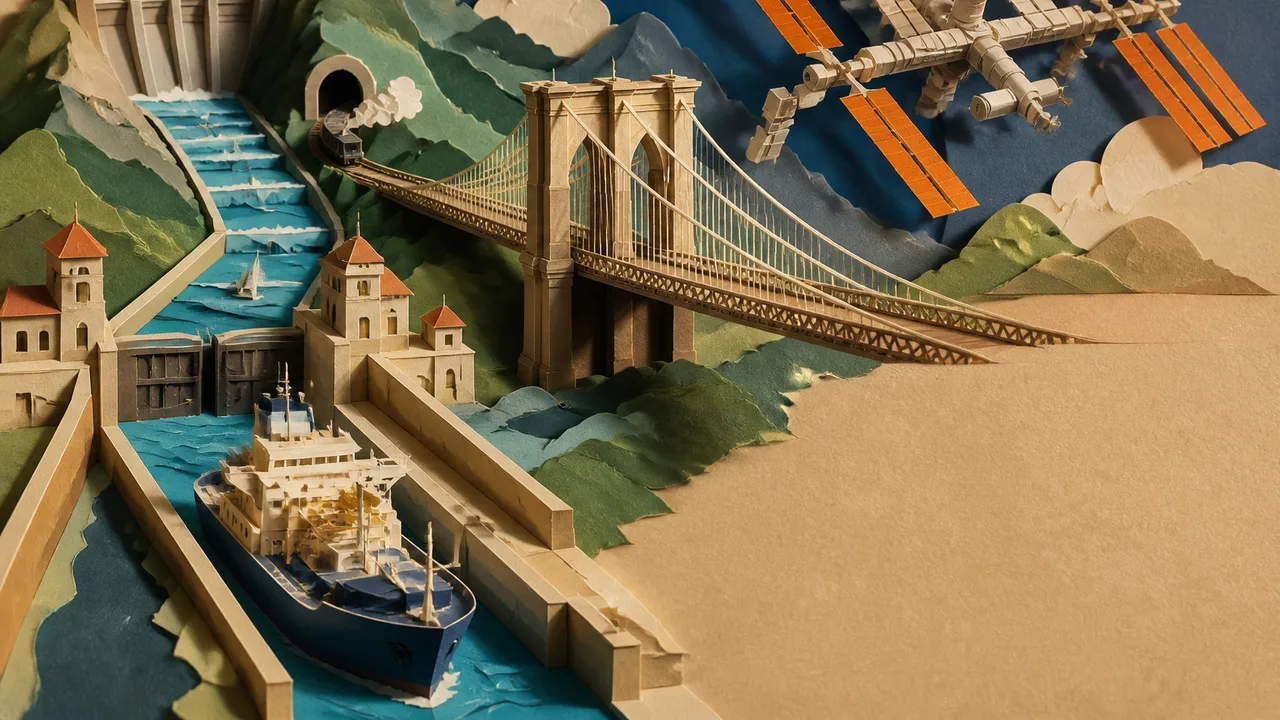
Photo: AI. Lila Bencher
There is a version of engineering history that reads like a trophy case — a list of superlatives arranged in descending order of impressiveness. Tallest. Longest. Deepest. Most expensive. A recent video from the YouTube channel Some Guy Who Knows Stuff runs through ten of the most significant engineering achievements ever completed, and on the surface it is exactly that: a countdown, a listicle in motion. But sit with the details long enough and something else comes into focus. These projects are not just feats of technical ingenuity. They are documents. Each one records what a particular society believed was possible, who it was willing to sacrifice to get there, and what problems it considered worth solving at all.
That last question is the one worth holding.
The Bodies in the Blueprint
Start with the Panama Canal, because the Canal starts with a catastrophe that tends to get smoothed over in celebratory retellings. Ferdinand de Lesseps — fresh off the Suez Canal and brimming with confidence — arrived in Panama in the 1880s convinced that what had worked in the Egyptian desert would work in the Central American jungle. It did not. Tropical rains flooded excavation sites. Hillsides collapsed without warning. And malaria and yellow fever tore through the workforce with a brutality the French had not remotely planned for. Estimates of the death toll during the French effort range from roughly 5,600 to more than 22,000 workers, according to historical analyses compiled by Factually.co — a range so wide it tells its own story about how carefully those lives were counted at the time.
When the United States took over in 1904, the engineering plan changed entirely. Out went the sea-level canal; in came the lock system that lifted ships more than 25 meters above sea level into an artificial lake. Crucially, so did Dr. William Gorgas, whose systematic campaign to drain standing water and eliminate mosquito breeding grounds effectively conquered the diseases that had destroyed the French effort. The video makes the point cleanly: "Controlling disease became just as important as moving earth." That is worth pausing on. The engineering solution to the Panama Canal was not only a lock system — it was a public health campaign. The project only became possible once someone decided that the workers' survival was a precondition for success, not an afterthought.
That shift in thinking was not universal or inevitable. It was a choice.
Who Gets Named, Who Gets Counted
The Brooklyn Bridge has a better-known human story, partly because its protagonists left records. John Augustus Roebling proposed the bridge, died in a construction accident before it began in earnest, and his son Washington took over only to be incapacitated by decompression sickness — caisson disease — contracted while working in the underwater foundations. What followed is one of the stranger and more remarkable episodes in engineering history: Washington Roebling directed construction from his apartment window through a telescope, while his wife Emily served as the operational link between him and the site. She studied engineering principles, carried detailed technical instructions, and oversaw the work at nearly every stage. When the bridge opened in 1883, Emily Roebling was the first person to cross it.
The video names her. That matters. She occupies the same sentence as the steam shovels and the caissons, which is where she belongs. The contrast with the transcontinental railroad is instructive: the video acknowledges that "thousands of Chinese laborers played a vital role" in pushing the Central Pacific through the Sierra Nevada, while also noting they "endured harsh conditions." The conditions were not incidental. Chinese workers were paid less than their white counterparts, housed separately, and given the most dangerous assignments — including the work with nitroglycerin in the mountain tunnels. Their names, with few exceptions, were not recorded. The Golden Spike ceremony at Promontory Summit in 1869 has been photographed and celebrated; the men who made the railroad possible are largely anonymous. Infrastructure reveals values. The question of who gets named in the official story is itself a form of engineering — of narrative, of memory.
The Problem of Scale
Some of these projects are notable less for what they built than for the specific sub-problem they had to solve to build anything at all. The Hoover Dam could not begin until engineers figured out how to move the Colorado River — which meant blasting four diversion tunnels into the canyon walls and rerouting an entire river before a single cubic meter of dam concrete was poured. The concrete itself presented another problem: if poured as a single mass, it would have taken well over a century to cool and would have cracked from its own internal heat in the process. The solution was to pour the dam in separate interlocking sections threaded with cooling pipes. The finished structure stood over 220 meters tall and created what was at the time the largest reservoir in the United States.
The Channel Tunnel, which opened in 1994 after construction began in 1988, solved its central problem — boring beneath one of the world's busiest shipping lanes — through a combination of geological luck and extraordinary precision. Tunnel boring machines from Britain and France worked simultaneously toward each other through a stable chalk marl layer beneath the seabed. When they finally broke through the separating wall in 1990, the two bores differed in alignment by only a few centimeters. The video describes it as "a remarkable achievement in modern surveying and precision engineering," which is an understatement. Hitting your target after that distance, from opposite directions, through a medium you cannot directly observe, is the kind of thing that sounds impossible until it happens.
The Machines We Built to Ask Questions
The Large Hadron Collider occupies a different category from everything else on this list. Every other project here was built to do something — move ships, generate power, carry passengers, support people in orbit. The LHC was built to find out. Stretching 27 kilometers underground beneath the French-Swiss border, it uses thousands of superconducting magnets to accelerate particles to nearly the speed of light and then collide them with extraordinary precision. The engineering challenges were formidable: the vacuum inside the beam tubes is more complete than the vacuum of outer space, and even minute alignment errors would compromise the experiments. In 2012, the collider confirmed the existence of the Higgs boson — one of the most significant discoveries in modern particle physics — and it continues to operate today.
There is something philosophically distinct about building a machine this large and this precise not to cross an ocean or power a city, but to understand the universe at the scale of its smallest constituents. It is engineering in service of pure inquiry. Whether that represents a different order of ambition or simply a different category of problem is a question the video does not pause on — but it is worth asking.
The Station That Should Not Exist
The International Space Station, which the video places at the top of its list, is in some ways the most improbable structure humans have ever built. Assembly began in 1998. The station was constructed in orbit, piece by piece, by astronauts from multiple countries working in spacesuits, through spacewalks, using robotic systems — each module launched separately and connected with precision that admitted no margin for error. It travels at roughly 28,000 kilometers per hour. Its orbit decays continuously and must be regularly corrected. It recycles its own air and water. It has been continuously inhabited since November 2000.
The video frames the ISS as the culmination of collaborative engineering ambition, and in structural terms that is accurate. What it does not dwell on is the political dimension: the station was built by countries that were, within living memory, in direct geopolitical competition with each other over the exact same territory — low Earth orbit. That the engineering partnership required to build the ISS became possible is itself a historical fact, not a given.
The Saturn V rocket that made the Apollo program possible — confirmed by NASA to have stood approximately 111 meters tall, making it one of the most powerful launch vehicles ever flown — carried astronauts to the moon on computing power that a modern smartphone would dwarf. The Apollo guidance computer navigated 400,000 kilometers with less processing capacity than the device most readers are holding right now. That gap between the ambition of the mission and the modesty of the tools is perhaps the most disorienting detail in this entire catalog.
Engineering, at its most consequential, is not about having the right tools. It is about deciding what is worth building badly enough to figure out the tools as you go.
The ISS is currently helping prepare the next generation of missions to the moon and eventually Mars. Which means the question is already being asked again: what problem is worth solving? The answers will tell us as much about who we are as any structure we manage to put up.
More Like This
Unveiling Rome's Gladiator Underworld
Explore the hidden world beneath ancient Rome's arenas, unveiling gladiator training, underground tunnels, and cultural practices.
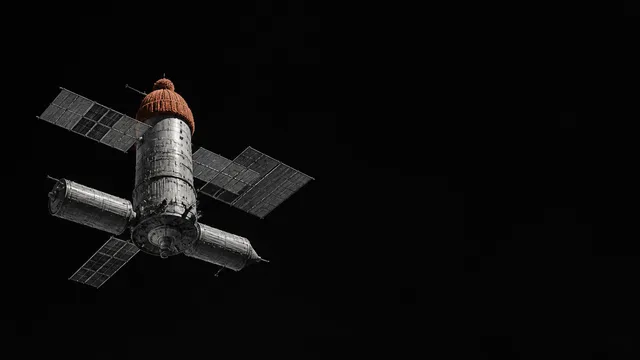
Space Stations Beyond the ISS: A Forgotten History
From a Cold War spy base to a Soviet ice rescue to China's chicken-wing oven in orbit — the real history of space stations is wilder than you think.

Artemis 2 Carried America's 250th Birthday to the Moon
NASA's Artemis 2 mission carried "America 250" markings to lunar orbit, blending national celebration with the next chapter of deep space exploration.
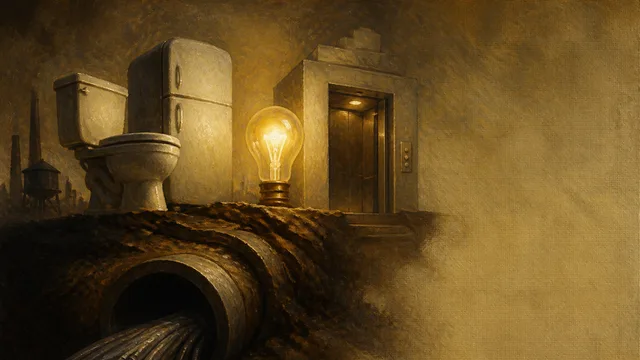
The Invisible Inventions That Built Modern Life
From flush toilets to undersea fiber cables, the inventions that most shaped modern civilization are the ones we've stopped noticing entirely.
Hampton Roads Bridge-Tunnel: Engineering Marvel Revisited
Explore the expansion of the Hampton Roads Bridge-Tunnel, a pioneering infrastructure project in Virginia, featuring advanced engineering techniques.

The Science and Stories Behind Earth's Fiercest Winds
Explore the science of deadly winds, from hurricanes to tornadoes, and the people dedicated to understanding and surviving them.
Savannah's Urban Grid: A Utopia Built on Slavery
Savannah, Georgia was designed as an egalitarian utopia in 1733. What it became reveals how idealism and slavery shaped one of America's most walkable cities.
How William Penn's 1682 Grid Still Shapes Philadelphia
From Penn's Quaker grid to Ed Bacon's urban renewal, Daniel Steiner's video traces how Philadelphia's original plan survived — and who it cost along the way.