Antimatter Rockets: The Energy Economics of Interstellar Travel
Antimatter propulsion promises interstellar travel, but its staggering energy production costs reveal a deeper lesson about civilizational-scale infrastructure investment.

Written by AI. Olivia Meng
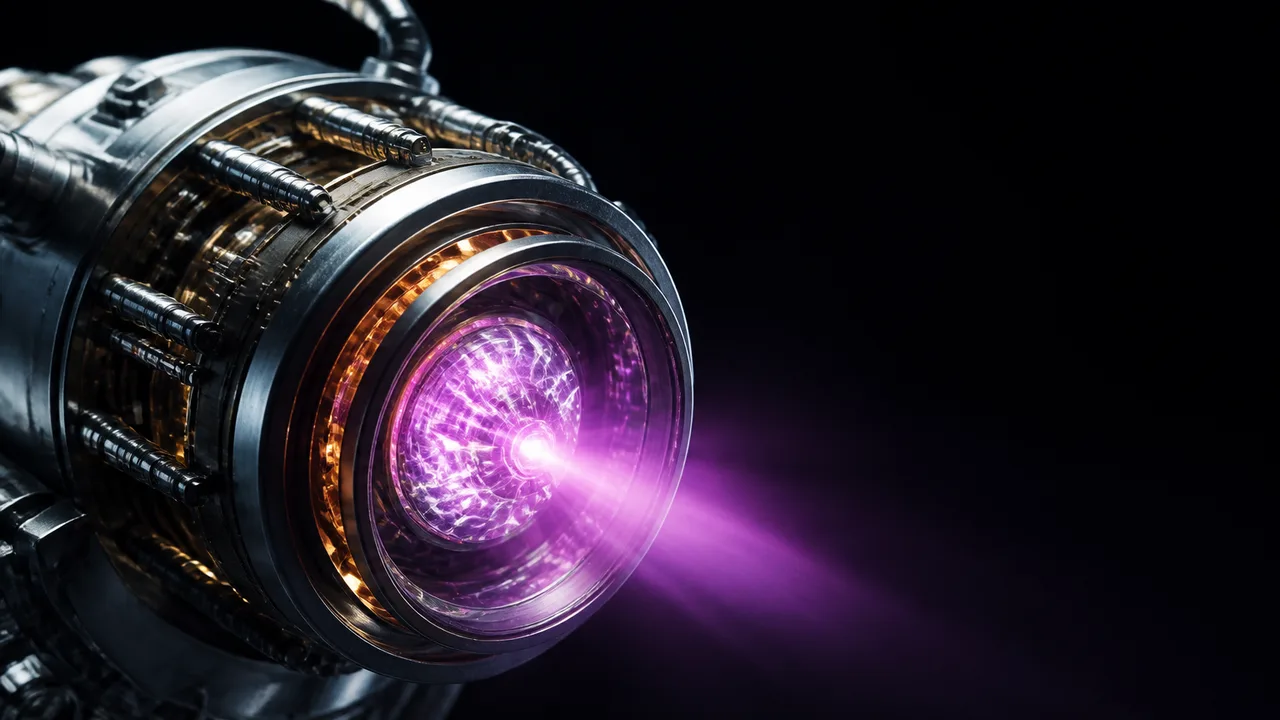
Photo: AI. Pippa Whitfield
When Elon Musk mentioned, almost as an aside, a future where humanity spends "trillions of trillions of dollars" manufacturing antimatter to reach other stars, the remark landed as it was probably intended — as a gesture toward cosmic ambition. What it actually describes, if you work through the energy arithmetic, is something more structurally interesting: the most extreme energy investment problem ever seriously proposed by engineers.
That's the framing I kept returning to while watching Scott Manley's recent breakdown of antimatter propulsion. Manley is a reliable guide through the physics — patient, precise, with genuine enthusiasm for the engineering constraints that science fiction prefers to skip. But the part of his analysis that stayed with me isn't the scale of the exhaust velocities or the elegance of the beam core engine. It's the number buried in the production section: current antimatter manufacturing converts less than one-millionth of the energy input into stored antimatter.
For anyone who thinks about energy systems, that figure reframes everything that follows.
The EROI Problem at Civilizational Scale
Energy return on investment — EROI — is the ratio of energy you get out of a system to the energy you put in to build and run it. It's the lens through which we evaluate fossil fuels (historically very high EROI, declining), renewables (moderate and improving), and emerging technologies. An EROI below 1:1 means you are destroying energy, not harvesting it. You're running a deficit.
Antimatter production, today, runs an EROI so far below 1:1 that the comparison barely registers. As Manley notes, particle accelerators blast protons into targets, and conservation laws require that any new matter particle produced be accompanied by its antimatter counterpart — that's how you make antiprotons and positrons. The process works. It's just that the energy you recover in the form of capturable antimatter is a vanishingly small fraction of what you burned to accelerate those protons in the first place.
Manley frames this as a manufacturing challenge to be solved over centuries. That's a reasonable read. But it's worth sitting with what it means in the interim: antimatter's theoretical energy density — half a gram annihilating with regular matter yields the equivalent of a 20-kiloton nuclear weapon — is a property of the reaction, not of the production chain. When you account for the full supply chain, the actual EROI of an antimatter-powered mission looks nothing like the headline number. "Energy density" as usually cited describes only one side of the ledger.
This is not a reason to dismiss the concept. It is a reason to be precise about what problem is actually being solved. The interstellar propulsion challenge isn't primarily about finding a fuel with high energy density — antimatter already has that. It's about whether civilization can ever manufacture that fuel at a thermodynamic profit. The next-generation propulsion landscape is full of concepts that look transformative until you model the full energy system; antimatter sits at the far end of that spectrum.
What the Physics Actually Allows
Set aside production for a moment and the engineering is genuinely striking.
Eugene Sänger — whose propulsion work spanned from the late 1920s through his 1953 photon rocket paper — imagined a spacecraft driven by reflected annihilation photons. The vision was elegant and, as Manley explains, essentially unworkable. Antimatter annihilation between protons and antiprotons doesn't produce a clean beam of photons you can bounce off a mirror. It produces a chaotic shower: gamma rays, neutrinos, and a class of short-lived particles called pions. Neutrinos don't interact with matter in any practically useful way. Gamma rays carry enormous energy but are brutally difficult to redirect. The annihilation products, in other words, actively resist being turned into thrust.
What saves the concept is pion physics. A fraction of the pions produced carry electric charge, and charged pions — constrained by the weak nuclear force — decay slowly enough (on the order of tens of nanoseconds, though exact lifetimes vary with particle energy and relativistic effects) to travel meaningful distances before disappearing. Electromagnetic fields can grab those charged pions and direct them. The result is a "beam core" engine with an exhaust velocity approaching one-third the speed of light. That's a specific impulse no other known propulsion concept can approach.
The engineering required to exploit this is, as Manley puts it, asking "civilization level commitment of resources." A 2003 JPL design study by engineer Robert Frisbee described one plausible beam core spacecraft: roughly 400,000 tons total mass, carrying approximately 165,000 tons of antimatter, stretching 700 kilometers — most of that length being radiators to shed the waste heat from gamma ray absorption. Mission parameters and mass figures vary across versions of the study depending on the assumed mission profile, but the rough orders of magnitude are consistent. The payload: 100 tons of science instruments. The acceleration: 0.01 G. The mission duration to the nearest star, one-way: around 50 years. And that, Manley notes, is just the upper stage of a four-stage system.
There is a ladder of less ambitious antimatter applications below the beam core concept. At the bottom sits the antimatter thermal rocket — spray antihydrogen onto a tungsten block, use the heat to expand hydrogen propellant — which Manley describes as "a slightly better nuclear thermal rocket." Not a ringing endorsement, but potentially useful for near-term missions where you need nuclear performance without the criticality headaches. In between lie antimatter-catalyzed fission and fusion pulse concepts, where small quantities of antimatter trigger subcritical fission reactions in targets that don't require weapons-grade material to achieve criticality. One microgram of antimatter, in theory, could initiate a small fusion pulse. That's the scalability argument for antimatter catalysis: you get nuclear-level energy release without needing a critical mass of fissile material, which is precisely what limits the minimum warhead size in conventional Orion-style pulse propulsion.
Antiproton harvesting from natural sources adds another layer of speculative engineering. Cosmic rays striking Earth's atmosphere generate antiparticles, some of which are trapped in the Van Allen belts — estimates suggest roughly 25 nanograms per day are naturally produced and capturable near Earth. Saturn has been proposed in speculative engineering literature as a potentially richer harvesting site, since its rings increase the surface area over which cosmic rays scatter; that hypothesis hasn't been experimentally confirmed but is considered physically plausible. Even at Saturn, the yields would remain negligible relative to mission requirements.
The Longer Parallel
Here is where I find myself less interested in the propulsion engineering per se than in what it reveals about how we think — or fail to think — about infrastructure that operates on civilizational timescales.
Manley is characteristically direct about the temporal stakes: "travel to other stars requires civilization level commitment of resources." He means this as context-setting, a way of establishing that we shouldn't expect antimatter rockets next decade or even next century. But that framing carries a consequence he doesn't press on: civilizational-scale infrastructure commitment requires political and institutional continuity that human societies have rarely demonstrated.
We are, right now, in the middle of a infrastructure challenge that also requires multi-decade continuity — decarbonizing energy systems, building transmission grids across national and regional boundaries, sustaining investment in technologies whose payoffs arrive on timescales longer than electoral cycles. The gap between what the engineering requires and what political systems can sustain is, at the moment, the central problem of climate and energy transition. We know what needs to be built. We cannot seem to maintain the commitment to build it.
Antimatter propulsion sits at the far end of this same problem, scaled up by centuries. The Frisbee design was a speculative 2003 engineering study for a ship that might fly "centuries or possibly millennia down the line," as Manley notes. What institutional form maintains the research priority, the funding continuity, the accumulated expertise across that span? No democracy or corporation currently operates on those horizons. The few institutions that approach it — scientific traditions, university systems, certain religious organizations — do so by largely decoupling from short-term political accountability.
The antimatter rocket is not a near-term energy story. But the question it raises — how does a civilization make and sustain energy infrastructure investments whose returns are measured in centuries — is one we need to be able to answer on much shorter timescales than interstellar travel requires. We're not yet good at 30-year grid planning. We need to get there before the 3,000-year version becomes relevant.
More Like This

How the Asteroid Impact Ended the Dinosaur Era
Explore the catastrophic asteroid impact that ended the dinosaurs, its immediate aftermath, and the long-term environmental changes.
Subcritical Reactors: Nuclear Power's Safety Fix?
A new generation of subcritical reactors promises to make nuclear meltdowns physically impossible. But can they deliver on cost, scale, and timeline?

Nuclear's New Fuel Has 11,000 Empty Holes
Inside the nuclear fuel supply chain scramble — from Piketon, Ohio to Saskatchewan — and why the six-to-seven-year timeline deserves your skepticism.

Why a Theory of Everything Is Centuries Away
Fermilab physicist Don Lincoln says a theory of everything is at least 100 years away—and his reasoning is harder to dismiss than it sounds.
PocketCube Satellites: Earth Observation for $30K
Satellites small enough to hold in your hand can now image Earth at 6–12m resolution. But who controls the data—and who bears the cost of what orbits above us?

Understanding the Real Risk of Brain-Eating Amoebas
Explore the facts and myths surrounding brain-eating amoebas. How real is the threat, and can climate change affect its spread?

Fusion Energy Is No Longer Just a Physics Problem
Fusion reactors have cleared their core scientific hurdle. What remains are hard engineering challenges—and a tight race against the clock and other clean energy sources.

Where Sunburn Catches You Off Guard
Shade, cold weather, and clear water offer less UV protection than most people assume. Here's what the science actually says about when sunburn risk is highest.