Next-Generation Space Propulsion Technologies Explained
From ion engines to nuclear rockets and laser beams, here's a clear-eyed look at the propulsion technologies that could take humanity beyond Earth orbit.

Written by AI. Priya Sharma
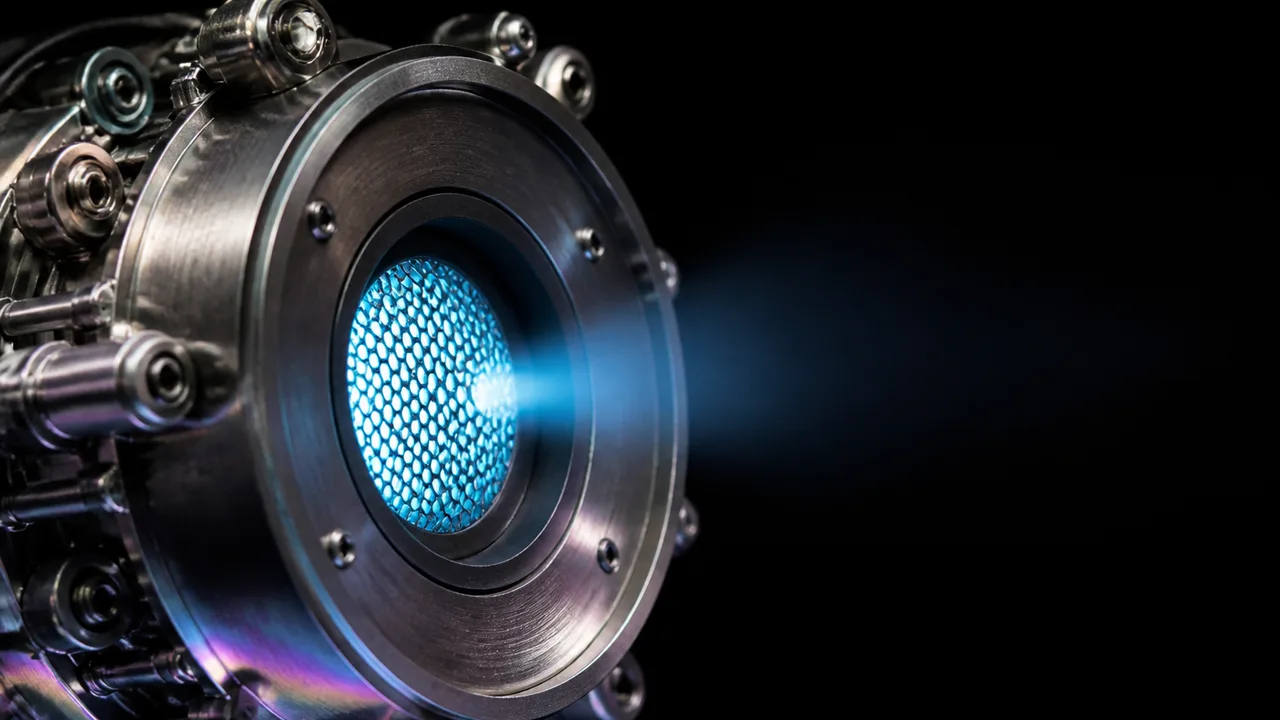
Photo: AI. Pippa Whitfield
Robert Goddard's first liquid-fueled rocket cleared 12.5 meters of Massachusetts farmland in 1926. It was over in seconds, witnessed by almost no one, and changed everything. A century later, chemical rockets have carried humans to the moon and probes to the edge of the solar system — and they have also revealed, with increasing clarity, exactly where they stop being useful.
That ceiling is the subject of a recent Astrum video hosted by Alex McColgan, which walks through the spectrum of propulsion technologies currently under development, from near-term engineering solutions to concepts that remain, for now, stubbornly theoretical. It's a useful map of a genuinely complicated terrain, and the core tension it surfaces is worth sitting with: every technology that solves one propulsion problem tends to introduce another.
The Fundamental Trade-off
Chemical rockets are not subtle. The Falcon 9, to take a well-documented example, weighs 549,054 kg at launch. Of that, 395,700 kg is fuel. The rocket itself — the engines, the structure, the payload — is the minority passenger. This is a consequence of what engineers call specific impulse: a measure of thrust per unit of propellant, essentially a spacecraft's fuel economy. Chemical rockets top out at around 500 seconds of specific impulse. They are, as McColgan puts it, "like lightning fast sports cars with really bad mileage."
Ion thrusters invert this problem almost completely. By accelerating noble gases like xenon or krypton through electric or magnetic fields to speeds approaching 140,000 km/h, they achieve specific impulse figures up to ten times higher than chemical engines. NASA has used them on missions to the asteroid belt; SpaceX employs them on Starlink satellites. The efficiency is genuine.
The catch is thrust. An ion thruster generates roughly the force you'd feel from a piece of paper resting on your hand. It can take days to accelerate a spacecraft to 90 km/h. "Electric thrusters are good in marathons, not sprints," McColgan notes — which means they cannot launch from Earth's surface, cannot respond quickly to obstacles, and cannot move the kind of mass a crewed Mars mission would require in any reasonable time frame.
Neither technology, then, is adequate for where humanity wants to go. Chemical rockets have the force but not the endurance. Ion thrusters have the endurance but not the force. The search for something that combines both has produced a field of proposals that range from the eminently practical to the genuinely speculative.
The Near-Term Candidates
Nuclear thermal propulsion sits closest to the realistic end of that spectrum. The concept is not new — NASA's Project Orion in the 1960s proposed riding repeated nuclear detonations into orbit, a scheme that was abandoned, as McColgan dryly observes, because "that would have been quite the radioactive mess." The current iteration is more restrained: use a nuclear reactor to heat a liquid propellant, converting it to expanding gas and expelling it at roughly twice the efficiency of a chemical rocket. A separate approach, nuclear electric propulsion, uses the reactor to generate electricity for ion thrusters, providing more immediate power than solar panels alone.
NASA is targeting nuclear propulsion for crewed Mars missions in the 2030s, with the goal of halving current projected transit times. That matters for reasons beyond mere convenience. A six-month trip to Mars already exposes astronauts to approximately 60% of the radiation limit recommended for their entire careers. Round-trip missions in some planning scenarios stretch to two or three years. Faster transit means less cumulative radiation exposure — though nuclear propulsion introduces its own radiation considerations, particularly if engines are fired near a planetary atmosphere, where irradiated propellant could cause environmental problems over time.
The space elevator concept occupies a different niche entirely: it doesn't propel spacecraft through space so much as it dramatically lowers the cost of getting things into orbit in the first place. Japanese construction firm Obayashi has outlined plans for a 96,000-km carbon nanotube cable anchored to a geostationary counterweight, capable of lifting 100-ton payloads. Construction is projected to begin in 2030, with completion by 2050. The engineering challenges — cable tension, debris avoidance, the question of what happens if something severs a tether dangling from orbit — are substantial, and the timeline should be treated with appropriate skepticism. But the underlying physics is sound, and the potential reduction in launch costs would alter the economics of space exploration significantly.
Solar sails are perhaps the most poetic of the near-viable technologies. Photons carry momentum, and a sufficiently large, sufficiently light surface can accumulate that momentum into meaningful acceleration. NASA's Advanced Composite Solar Sail System, launched in 2024, deployed a 9x9 meter square sail from a CubeSat form factor. The deployment wasn't flawless — one arm bent slightly, causing the craft to tumble — but the experiment continues to generate useful data. Future designs could scale to sails 45 meters on a side. For unmanned deep-space missions where time is less critical than cost, sailing on sunlight has a genuine appeal: no propellant, no fuel mass, just geometry and patience.
The Physics-First Problems
Beamed propulsion — using ground-based lasers or electron beams to push or power a spacecraft — is where the conversation becomes more interesting and the uncertainties more profound. The appeal is logical: if you can't carry your energy source with you, transmit it. Solar panels become useless at interstellar distances (at Jupiter, Juno's enormous panels already receive 25 times less light than they would in Earth orbit), but a laser pointed from Earth's orbit has no such constraint.
Researchers Jeffrey Greason and Kerit Rukh published calculations in 2024 in Acta Astronautica suggesting that an electron beam could accelerate a Voyager-sized probe to 10% of the speed of light. At that velocity, the 4.25-light-year trip to Proxima Centauri — which would take over 81,000 years at current ion thruster speeds — comes down to roughly 40 years. The practical obstacles are real but, crucially, they are engineering problems rather than physics violations: beam divergence over interstellar distances, thermal management for a craft being continuously blasted by high-energy particles, tracking precision as the probe moves further away. The 2016 Breakthrough Starshot project attempted to fund a prototype implementation using a kilometer-scale ground-based laser array; it stalled due to cost, not concept.
The warp drive discussion deserves more careful treatment than it usually receives. McColgan covers the 2021 case of NASA scientist Harold White, who claimed to have detected a real warp bubble — a region where space itself contracts ahead of a craft and expands behind it, theoretically enabling faster-than-light travel without violating relativity. Subsequent review established that White had not produced experimental evidence of a warp bubble; he had observed characteristics of a Casimir cavity that bore mathematical resemblance to warp bubble calculations "if you squint," as McColgan summarizes. The warp drive concept itself, first formalized by physicist Miguel Alcubierre in 1994, remains theoretically coherent but requires exotic negative-energy matter that has never been observed and may not exist — and some models suggest the energy requirements exceed the total positive energy content of the observable universe. The honest position on warp drives is that they are currently a mathematical framework in search of physics, not an engineering problem in search of funding.
What the Landscape Actually Shows
Taken together, these technologies reveal something about the structure of the problem itself. Getting off Earth's surface is a brute-force challenge that chemical rockets handle reasonably well. Moving efficiently through the solar system requires a different tool entirely. Reaching other stars — even the nearest one — demands either a fundamental shift in energy delivery or a willingness to accept that the first interstellar probes will be tiny, unmanned, and traveling for decades.
The layering of solutions across these different regimes is not a sign that the field is confused; it's a sign that the distances involved are genuinely hostile to any single approach. Mars is roughly 225 million kilometers away at its closest. Proxima Centauri is 40 trillion. No thruster built for one of those problems is suited to the other.
What has changed, and what makes this moment genuinely different from the optimistic projections of fifty years ago, is that several of these technologies are no longer purely theoretical. Nuclear propulsion has a credible development path and a named target mission. Solar sails have flown. Ion thrusters are operational on satellites orbiting Earth right now. The gap between "concept" and "hardware" has narrowed — unevenly, but meaningfully.
The question that none of this quite answers is the human one: which of these timelines actually accommodates crewed missions beyond Mars, and what is the political and financial commitment required to close the gap between forty-year travel times and something a human being might survive?
More Like This

Crafting Supercars: The Science Behind Speed and Style
Explore how supercars like Alfa Romeo 4C and Aston Martin Vanquish are meticulously crafted using cutting-edge materials and precision engineering.
Subcritical Reactors: Nuclear Power's Safety Fix?
A new generation of subcritical reactors promises to make nuclear meltdowns physically impossible. But can they deliver on cost, scale, and timeline?
NASA's Nuclear Mars Spacecraft: What SR-1 Freedom Means
NASA approved SR-1 Freedom, a nuclear electric spacecraft targeting a 2028 launch. Here's what the mission actually tests—and what it doesn't solve.

How Fractals Moved From Math Curiosity to Tech
Fractals aren't just beautiful—they're inside your smartphone antenna, your microchip cooling system, and your eye exam. Here's how the math became engineering.
Soyuz 5 Debuts, NASA Budget Fights Back
Russia's Soyuz 5 flew its first suborbital test, NASA's budget faces bipartisan pushback, and China opens Tiangong to Pakistan. A lot happened in one week.
Blue Origin New Glenn Explodes in Florida Test
Blue Origin's New Glenn rocket exploded during a static fire test at Kennedy Space Center. Here's what we know—and what's still an open question.
Primordial Black Holes as Dark Matter Candidates
After decades of failed WIMP searches, physicists are turning to primordial black holes as a serious dark matter candidate. Here's what the evidence actually shows.
Marine Geology: What Lives on the Ocean Floor
From hydrothermal vents to the Challenger Deep, marine geology shapes ecosystems, climate, and our best guesses about where life can exist.