The Hidden Math Holding Climate Science Together
Dialect's video on the covariant derivative explains the math quietly powering climate models, ice sheet measurements, and atmospheric science.

Written by AI. Olivia Meng
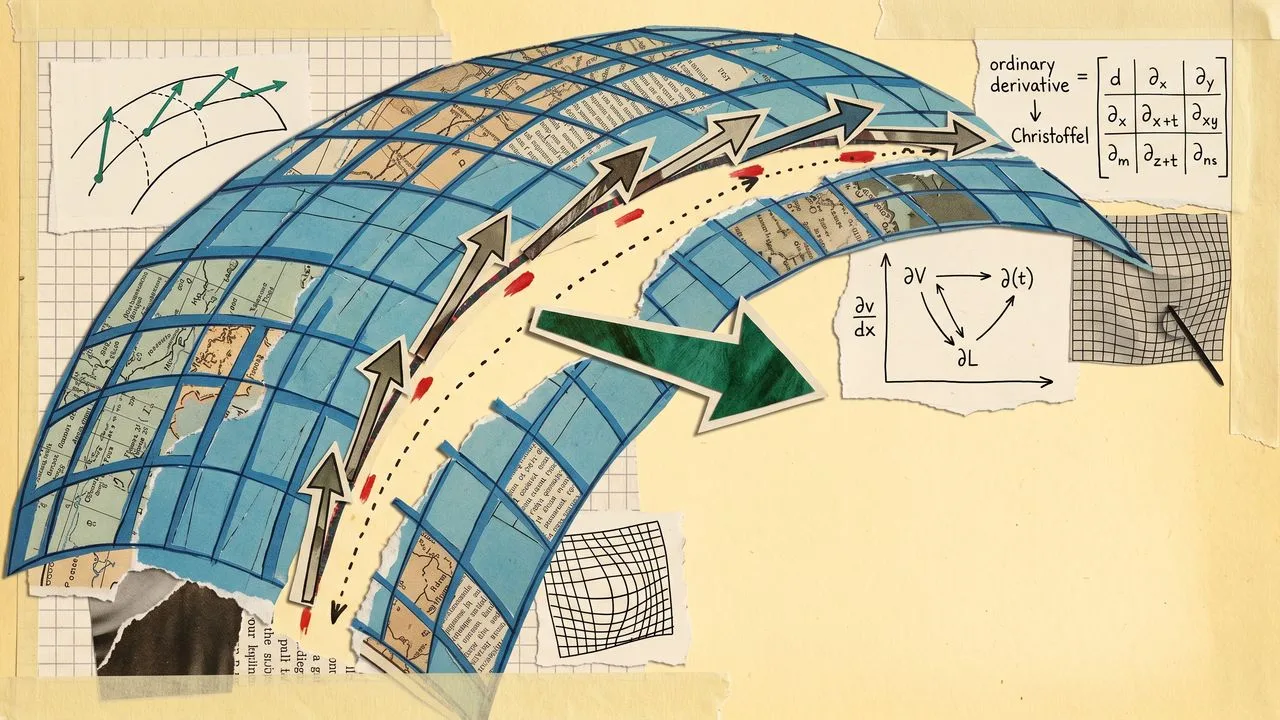
Photo: AI. Wren Sugimoto
Every few months I end up down a mathematics rabbit hole that has nothing to do with my assignment queue and everything to do with why climate science actually works. Last week it was a 22-minute YouTube video from the channel Dialect, titled Mastering Differential Geometry with the Covariant Derivative. I watched it because I'd spent the previous afternoon reading about how geodetic satellite measurements track ice sheet loss in Greenland — measurements that depend, at a foundational level, on doing calculus in curved coordinate systems without letting the curvature of those coordinates contaminate your results. The covariant derivative is precisely the tool that makes that possible. I figured I should understand it better than I do.
I came away thinking the video deserves a wider audience than the general relativity enthusiasts it's nominally aimed at. Not because the physics is irrelevant — it isn't — but because the mathematical problem Dialect is solving shows up everywhere we try to measure a changing world on a curved planet.
The problem, stated plainly
Here is the core issue. Suppose you're tracking how some quantity — wind velocity, ocean current, the displacement of an ice sheet — changes from one point to another on the Earth's surface. You assign coordinates to do the tracking. But the Earth is curved, so any coordinate system you choose will itself be curving and stretching as you move around. This creates an immediate accounting problem: when your measurement changes between two points, how much of that change is real — a genuine change in the physical quantity — and how much is an artifact of your coordinate system bending underneath you?
Dialect frames this cleanly early in the video. Imagine a vector sitting on a surface that doesn't change at all when you displace it. Its ordinary Euclidean derivative is zero. But assign it a coordinate system that varies smoothly from point to point, and suddenly the vector's components look different at the two locations, even though the vector itself hasn't moved. "From within the perspective of this variable coordinate system," the video notes, "it's the vector itself that appears to change."
So now you have two derivatives in play: the one you get from inside the changing reference frame, and the one that tracks what's actually happening on the manifold — the surface itself. The second one is the covariant derivative. It's the version that doesn't lie to you.
This is not a minor technical distinction. It is the distinction between measuring something real and measuring your own measuring system.
What the formalism actually does
The Dialect video works through the machinery with unusual patience, building from curvilinear coordinates and basis vectors up through the chain rule to the full expression for the covariant derivative. The key move is recognizing that when a vector is expressed in curvilinear coordinates, you're looking at a product of two things that both vary across the manifold: the vector's components and the basis vectors themselves. Differentiate a product and you get two terms. The first term captures how the components change; the second captures how the basis vectors change. That second term is the correction — the piece that distinguishes a covariant derivative from a naive coordinate derivative.
The correction is expressed using Christoffel symbols, which the video describes as "little signposts across the manifold telling you how the coordinate curves are changing there." The metaphor earns its keep. Christoffel symbols encode, at every point, the local geometry of your coordinate system — how fast the basis vectors are rotating and stretching. Plug them in and you can subtract out the coordinate artifact, leaving only the genuine geometric change.
The worked example uses polar coordinates, with a vector whose radial component is zero and whose angular component grows with the angle, displaced along a circle of constant radius. The ordinary coordinate derivative gives one answer; the covariant derivative gives a different one, with an additional term in the radial direction that accounts for the centripetal curvature of the angular coordinate curves. The difference between those two answers is exactly the kind of thing that would corrupt a measurement if you didn't account for it.
The choices embedded in the tool
Here is where I find myself most interested — and where the video, through no fault of its own, leaves the most unsaid.
The covariant derivative as Dialect presents it is built on specific mathematical choices. The version most commonly used in physics — the Levi-Civita connection — is defined by two constraints: it must be compatible with the metric (it preserves lengths and angles under parallel transport) and it must have zero torsion (it treats coordinate directions symmetrically). The Fundamental Theorem of Riemannian Geometry guarantees that given both constraints together, a unique connection exists. But those constraints are starting assumptions, not logical necessities. You could, in principle, work with a connection that has nonzero torsion. Some researchers in modified gravity theories do exactly that. The standard formalism made a choice that turned out to be extraordinarily productive — but it was a choice.
I find this worth pausing on, because it applies far beyond differential geometry. The mathematical tools we use in climate science are also the product of choices: which variables to track, which processes to parameterize, which scales to resolve and which to average over. Those choices are made by scientists working at particular moments with particular computational constraints and particular theoretical commitments. The tools that feel most natural — that feel like they're simply describing reality — are often the ones where the scaffolding of their construction has been most thoroughly hidden.
The covariant derivative, once you understand it, feels inevitable. That feeling is something the formalism produced. The distinction matters, because the history of science is full of cases where "inevitable" tools turned out to encode assumptions that needed revisiting.
Why this matters beyond general relativity
Dialect is building toward general relativity, and the video is explicit about it: the covariant derivative is the prerequisite for the geodesic equation and the Riemannian curvature tensor, which in turn are the mathematical language of spacetime geometry. In GR, the curvature of spacetime — caused by the distribution of energy and momentum — shapes the paths that matter and light follow; what we experience as gravity is the geometry of that curvature in action.
But the same mathematical structure appears in climate science in ways that rarely get acknowledged in public-facing coverage. Numerical weather prediction and global climate models work on the surface of a sphere, which means every differential operator in those models is, at some level, a covariant operator. The spherical harmonic decompositions used in atmospheric modeling are a way of handling the fact that your coordinate system is curved. Geodetic measurements of ice mass loss — derived from GRACE satellite gravity data and GPS observations — require coordinate-independent calculations to separate the signal from the noise. Ocean circulation models that track heat transport around the globe are doing, under the hood, exactly the kind of vector calculus on curved surfaces that Dialect is explaining.
None of this means you need to watch a differential geometry series to understand climate change. You don't. But it does mean that the abstract mathematics being carefully explained in videos like this one is not merely theoretical scaffolding waiting for a physical application. In the systems I cover every day, it's already load-bearing.
The covariant derivative is, as Dialect says, "nothing more than the ordinary derivative" — just one that takes seriously the difference between the map and the territory. Given that the territory is a warming planet and the maps we use to measure it are built from exactly this mathematics, that distinction seems worth understanding.
More Like This
Rethinking Cosmic Acceleration: A Local Illusion?
Exploring the debate on whether the universe's acceleration is a local phenomenon, challenging the concept of dark energy.

Could Life on Earth Have Arrived via Asteroids?
Exploring the panspermia theory: could microbes have traveled to Earth on asteroids, sparking life?

Is Physics Really in Charge? Ellis vs. Carroll Explained
George Ellis argues physics doesn't decide outcomes—context does. Here's why his debate with Sean Carroll's reductionism is more consequential than it sounds.

Why Linear Algebra Is the Secret Language of AI
How machine learning actually works: IBM's Fangfang Lee breaks down the math that turns cat photos into numbers computers can understand.
The Math Trick Behind Physics' Greatest Hits
Discover how Taylor series simplifies complex physics, connecting math, sine, and Euler's formula with ease.

Unraveling Time and Reality with Sean Carroll
Explore time, black holes, and reality with Sean Carroll, as science and philosophy intertwine in our understanding of the universe.
Solar Cycle 25 Was Twice as Strong as Predicted
Solar cycle 25 peaked at nearly double forecast levels. Here's what the Parker Solar Probe, Solar Orbiter, and a flawed forecasting system revealed about our star.
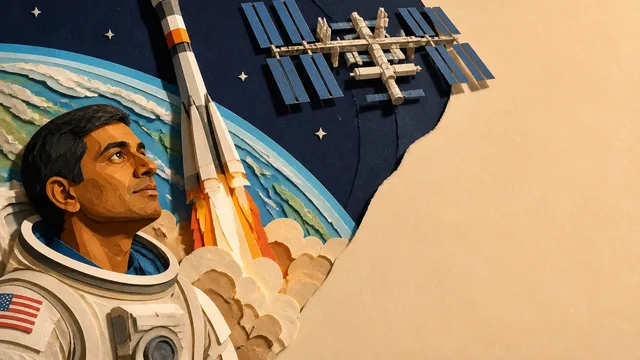
Anil Menon Reaches the ISS on His First Spaceflight
NASA astronaut Anil Menon launched to the ISS on July 14 aboard Soyuz MS-29. His eight-month mission raises questions about what space cooperation looks like next.