Seine-Nord Europe Canal: Building Through the Somme
France's €7.3bn Seine-Nord Europe Canal will link its waterways to Rotterdam and Antwerp—but it's being dug through ground that never finished burying its dead.

Written by AI. James Morrison
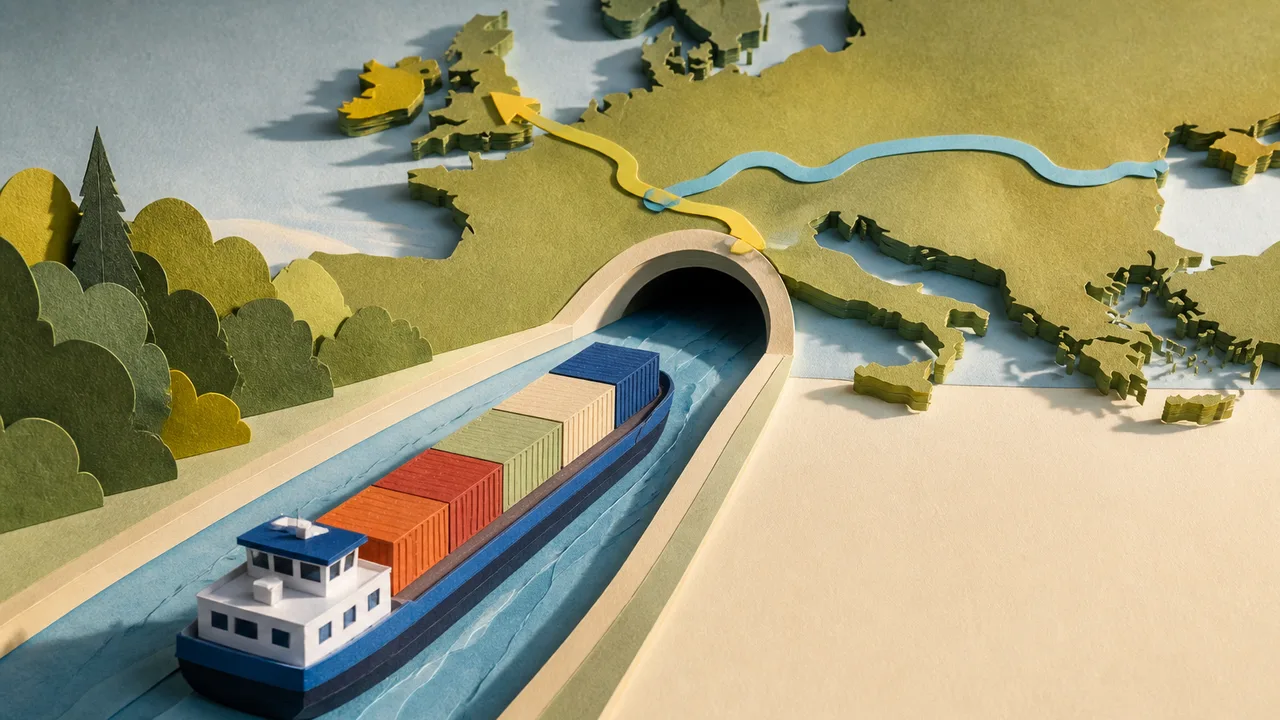
Photo: AI. Lila Bencher
The Canal du Nord started life as a peacetime ambition. Engineers broke ground in 1908 on a 95-kilometer waterway that would thread through the chalk valleys of northern France and finally connect the Seine basin to the industrial ports of the north. The men who dug it—laborers from France, Belgium, Spain, and Portugal, working with steam-powered excavators and wheelbarrows—made solid progress in the years before 1914. Then the guns opened at Liège, and the work stopped.
The same valleys those workers had been excavating became, within weeks, the first killing ground of a war that would take four years to end and generations to comprehend. Many of the laborers who had been shifting French soil for a canal were conscripted into armies that fought, bled, and died in those same fields. The Canal du Nord sat unfinished—a muddy scar through a landscape that was about to accumulate scars beyond counting. It would not open until 1965. By then, the ground it passed through had been a battlefield twice, a cemetery countless times over, and a working farm again. The canal's half-century construction timeline, which The B1M's recent documentary on the project treats as a historical curiosity, is actually the through-line for everything happening in northern France today.
France is now digging again. The Seine-Nord Europe Canal—107 kilometers long, 54 meters wide, budgeted at €7.3 billion—will replace the Canal du Nord entirely, running roughly parallel to it through the same departments of Oise and Hauts-de-France that witnessed both world wars. It will accommodate vessels carrying up to 4,500 tons, more than seven times the capacity of what currently squeezes through the old canal. Half the funding comes from the EU, the rest from the French government and the regions and departments the waterway will traverse. Construction began in earnest in 2022, with a target completion date of 2032.
The engineering case for the project is straightforward and well-documented. According to Eurostat data on EU inland waterway freight—figures for 2024 are still being finalized—the continent moves goods via water at a scale most people would not guess: hundreds of millions of tons annually, predominantly through the Netherlands, Germany, and Belgium, all of which cluster around the port complex anchored by Rotterdam and Antwerp. France, despite holding roughly 8,500 kilometers of navigable waterways by French government classification (Germany's network is comparable depending on whether one counts maintained commercial routes versus all navigable water, so no clean superlative applies here), remains poorly connected to that northern system. The SNEC changes that by linking directly into the Scheldt-Seine river link, making it a load-bearing component of the EU's Trans-European Transport Network.
The engineering required to build it is genuinely complex. Seven locks will manage the elevation changes along the route. Two of them will have drops exceeding 25 meters—a depth that SNEC's developers describe as the deepest for conventional canal locks built in Europe, though that claim invites scrutiny alongside other deep-lock infrastructure on the continent and should be treated as project-stated rather than independently verified. The largest lock runs 197 meters long and 12.5 meters wide. Lockage time—the window from when a vessel enters to when it exits, having risen or fallen with the water level—cannot exceed 15 minutes. To achieve that without simply dumping massive volumes of water into the river system, each deep lock will have a set of cascading basins off to the side, connected to the lock chamber by pumps and culverts that recycle the water rather than discharge it.
The project team at Egis, the main contractor, has been validating these designs through physical scale models before committing to full construction—testing perforated floor slabs, measuring flow rates through sensors, experimenting with valve configurations. Alongside that physical modeling runs a digital one: a connected data environment carrying over a terabyte of project data, accessible to some 250 people across departments. An Egis engineer explains the stakes plainly: "The federated model is very easy to understand the project. So it's very important for this project to manage the BIM and to manage the 3D model and to manage the data because it is the first time for 250 persons to collaborate inside." The payoff, according to the project team, has been a 40 percent improvement in productivity and a 60 percent reduction in model generation time.
Sixty-two road and rail crossings have to be integrated into the design. Several bridges are already complete. One was assembled on the south bank of an existing canal and then launched across the water on cables and winches before its prefabricated concrete deck slabs arrived by barge—using the old waterway to build the new one, a logic that runs through the entire construction strategy. Ten construction quays distributed along the route are designed to keep as much heavy material as possible off roads and on water.
The canal's most architecturally ambitious element is the Pont Canal de la Somme—a 1.3-kilometer aqueduct that will carry the waterway over the Somme Valley rather than through it. The project describes it as the longest canal viaduct in Europe upon completion; that superlative is their claim, and it awaits independent verification. The rationale for the elevated crossing is partly ecological: the Somme Valley carries protected habitats that a ground-level cut would compromise. But there is a reason the word "ecological" feels insufficient when you stand in that valley.
The Somme absorbed the largest single-day casualty toll in British military history on July 1, 1916—nearly 57,500 British soldiers killed, wounded, or missing before nightfall. The battle ran for four and a half months. The ground did not give up its dead then, and it has not finished giving them up since. Farmers in Picardy and Hauts-de-France still turn up ordnance, equipment, and human remains in their fields every plowing season—a grim enough regularity that it has acquired a name: the Iron Harvest. The Commonwealth War Graves Commission, whose network of cemeteries and memorials in France and Belgium commemorates the dead of both world wars across all theaters globally, has documented well over 600,000 identified Commonwealth burials in France and Belgium alone. The roughly 100,000 soldiers whose remains were never recovered—whose names appear on the Thiepval Memorial and its counterparts—are somewhere in this ground. Some of them are almost certainly in the path of the SNEC's excavators.
SNEC's project leadership recognized this before the first machine moved. The Société du Canal Seine-Nord Europe has been coordinating with the Commonwealth War Graves Commission on systematic exploratory operations ahead of construction—locating remains in advance, ensuring they receive proper identification procedures and burial in expanded cemeteries nearby rather than being disturbed and reinterred without ceremony. The project has also been designated Europe's largest preventative archaeological initiative from its inception, with discoveries ranging across millennia to the Paleolithic era. This is not incidental to the engineering story. It is the condition under which all the engineering happens.
There is something that deserves more than a policy acknowledgment in the fact that the deepest locks being bored into this landscape—chambers large enough to swallow a 197-meter vessel—are going into soil that the Canal du Nord's original laborers first disturbed in 1908, that armies reconstituted into killing ground in 1916, that farmers and archaeologists and CWGC teams have been negotiating with ever since. The canal project is not the first time human ambition has arrived in this valley with large machinery and a completion date. It is, by one count, the fourth.
SNEC has committed 1,200 hectares to biodiversity mitigation—wildlife crossings, 60-odd wetland and pond restoration sites, new tree planting. The organization reports that some species have already returned to the corridor since construction began. Whether the ecological ledger ultimately balances is a question that 2032 will not fully answer; these things take longer than construction timelines.
What The B1M's documentary captures well, even if it doesn't linger on it, is the scale of coordination required to build infrastructure on ground this layered. The federated digital model, the physical lock models, the construction quays, the viaduct over the valley—all of it represents an attempt to impose order on a landscape that has resisted tidy outcomes for more than a century.
The SNEC's project managers are working toward a completion date. The CWGC's teams are working toward a different kind of accounting. Both are operating in the same valley, in the same years, on the same ground. The canal that finally opens in 2032—if it opens on schedule, which large infrastructure projects rarely do—will be the latest layer on soil that has absorbed the ambitions of engineers, the sacrifice of soldiers, and the slow patience of farmers for generations. The question the Somme has always posed, to everyone who has come to it with plans, is whether this time the ground will cooperate.
James Morrison is Buzzrag's military history correspondent.
More Like This
How Alexander the Great Weaponized the Catapult
Alexander's engineers turned catapults into city-destroying machines—and the siege of Tyre shows exactly what that meant for the people living inside those walls.

Unraveling Rome's Dodecahedron Mystery
Exploring the enigmatic Roman dodecahedron, its theories, and historical significance in modern archaeology.
The Odyssey of Reunion's Coastal Road Megaproject
Reunion's new coastal road faces engineering challenges, environmental concerns, and public opposition, revealing deeper tensions.
France's Thunder Boat: One Ship, Every Mission
France's BPC Thunder Boat is a 22,000-ton amphibious assault ship that functions as a seaport, hospital, helicopter carrier, and command center—all at once.
Inside the Emma Maersk: How the World Sails
The Emma Maersk carries what the documentary estimates as half a billion dollars of cargo across 13,000km. Here's what that actually takes.

FBI's Struggle Against Omega 7: A Tale of Terrorism and Intrigue
Explore the FBI's complex investigation of Omega 7, a Cuban exile terrorist group, amid community challenges and evolving tactics.

Mapping the Universe: Discovery, Hierarchy, and Dark Energy
How cosmology's greatest breakthroughs were shaped by institutional power, anonymous labor, and the recurring human failure to act on what the evidence clearly shows.
How Rome Conquered Greece: Strategy Over Strength
Rome didn't overpower Greece—it outmaneuvered it. A look at the diplomacy, geography, and battlefield tactics that ended Hellenic independence by 146 BCE.