How the Brooklyn Bridge Got Built Against All Odds
The Brooklyn Bridge's construction killed its designer, crippled its chief engineer, and buried a doomsday bunker in its foundations. Here's what it actually took.

Written by AI. Margaret "Maggie" Holloway
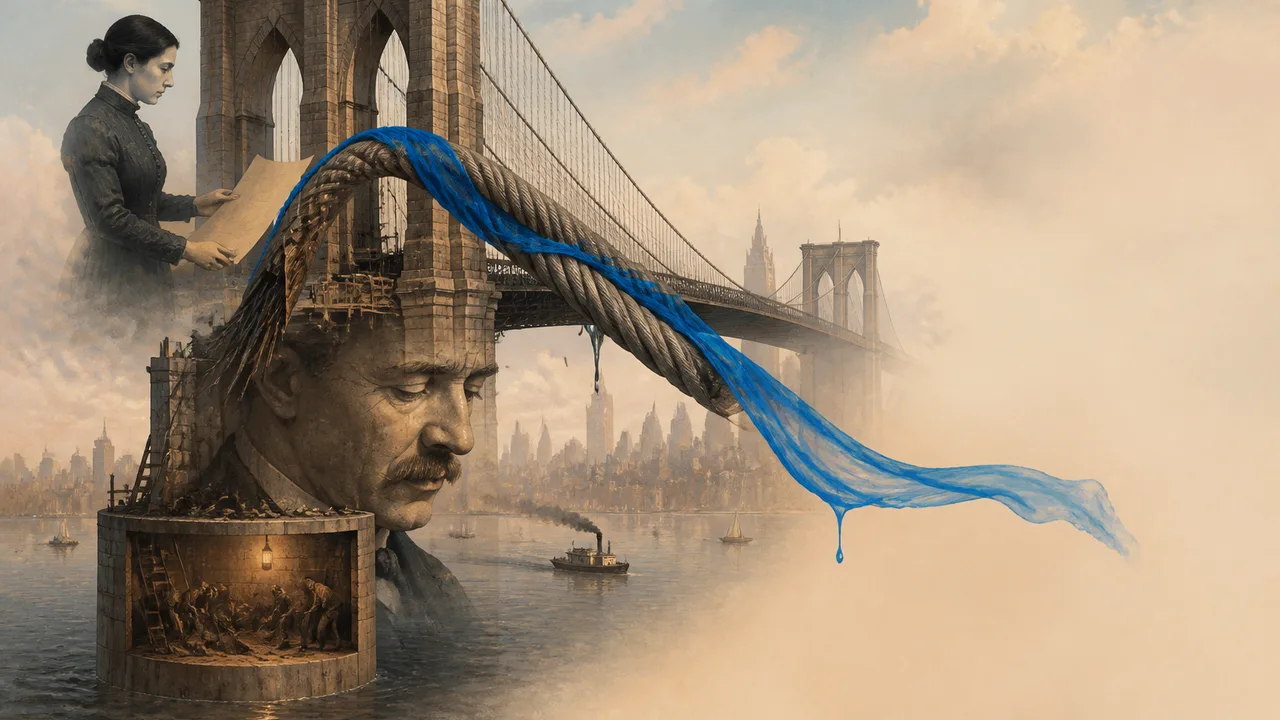
Photo: AI. Iolanthe Fenwick
The part of the Brooklyn Bridge that should impress you isn't the part you can see.
The cables, the towers, the Gothic arches — those are the monument. But the real story is buried under the East River, in the dark, in the pressure, in the blood. It's the story of what it cost to build something that had no business being built at all.
The Problem No One Had Solved
In 1869, New York and Brooklyn were separate cities connected by ferry. More than 130,000 people crossed the East River every day, and the ferries were, as the Engineering The Impossible video puts it bluntly, "a disaster." Fog shut them down. Ice shut them down. In winter, you could be stranded on the wrong side for weeks.
A bridge was the obvious answer. But the East River is nearly 1,600 feet wide and one of the busiest shipping channels on the Eastern Seaboard. You couldn't fill it with stone supports — you'd turn the water into an obstacle course for every vessel in the harbor. The only viable design was a suspension bridge: two towers, cables stretched between them, the channel left clear.
There was a problem with that, too. In 1870, suspension bridges had a documented habit of falling down.
John Roebling — German immigrant, engineer, 63 years old, and already the most accomplished suspension bridge builder in America — said he could do it anyway. His design called for steel cables, something no one had used for a major bridge. Every previous suspension structure relied on iron. Iron was proven. Iron was, Roebling calculated, also going to snap over a span this long. Steel had twice the tensile strength. The math was on his side.
In June 1869, the federal government approved the plan. Three weeks later, Roebling was standing on a Brooklyn ferry slip surveying the site when an incoming boat crushed his foot against the pilings. He refused medical treatment and tried to manage the wound himself. Twenty-four days later, tetanus killed him.
He never saw a single stone laid.
Inside the Hell Box
His son Washington, 32 years old and a Civil War veteran, took over. And almost immediately, he encountered the problem his father had underestimated: the riverbed.
Beneath the East River there was no bedrock waiting conveniently near the surface. There were layers of silt, clay, and glacial deposits. On the Brooklyn side, the foundation required digging 44 feet down to bedrock. On the Manhattan side, workers went 78 feet — the depth of a seven-story building, going down — and still hadn't hit rock.
To excavate underwater at that depth with 1870s technology, Washington Roebling used pneumatic caissons: enormous timber chambers, open at the bottom, sealed at the top, pumped full of compressed air to hold the river back. Workers descended through iron airlocks, waited for the pressure to equalize, then dropped into the chamber below.
What they found there was not a comfortable working environment. The air pressure reached 35 pounds per square inch — equivalent to what a scuba diver experiences at 78 feet underwater. Except scuba divers don't work eight-hour shifts. Calcium lamps hissed in the dim heat. The temperature hovered around 80 degrees. Workers stripped to the waist and shoveled muck while icy water lapped at their feet. They blasted boulders with dynamite. Inside a pressurized wooden box. The pay was $2 a day — around $50 in today's money.
The video's narration calls this situation "either madness or brilliance," which is generous. It was both, simultaneously, and the people absorbing the cost of that ambiguity were the workers.
When men resurfaced, particularly if they ascended too quickly, nitrogen bubbles formed in their blood and lodged in their joints, their muscles, their spinal cords. They bent double and couldn't straighten. The condition — now called decompression sickness, then called "caisson disease" or "the bends" — was not understood. Doctors prescribed ginger ale, cold showers, and leeches. None of it worked. Official records counted 20 to 30 deaths from caisson disease; the actual toll was likely closer to 100. Turnover was so extreme that most workers lasted a single shift before refusing to return.
In the spring of 1872, Washington Roebling himself ascended too quickly after fighting an underground fire, once reportedly staying below for nearly 24 hours. His body broke. He was carried home at 35 years old, half blind, voiceless, and in constant pain. He never returned to the construction site.
The Person the Plaques Left Out
For the next eleven years, Washington Roebling watched his bridge being built through a telescope from a window in Brooklyn Heights. The brain of the project, trapped in a body that could no longer reach it.
His wife stepped in.
Emily Warren Roebling had no engineering credentials. She was 28 years old in 1872, in a country where women couldn't vote. What she had was exceptional intelligence, relentless capability, and a husband who could no longer speak for himself. She relayed his technical instructions to the construction crews, defended his engineering decisions to the board of directors, and effectively ran the project's daily operations for over a decade.
The official story, for most of the following century, was that Washington Roebling built the Brooklyn Bridge. His name was on the plaques. Emily got a footnote. There is now a small inscription on the bridge acknowledging her contribution — small being the operative word.
Her erasure from the record isn't incidental. It's a structural feature of how institutional histories get written, favoring the named authority over the person doing the daily work of keeping that authority functional.
The Fraud in the Cables
The towers rose — over 270 feet above the waterline, taller than anything in New York City except the spire of Trinity Church. Workers hoisted granite and limestone blocks by steam-powered pulley for four years. The project burned through its original $5 million budget and required the city to secure an additional $8 million from the state legislature.
Then came the cables — and the fraud.
The steel wire supplier, J. Lloyd Haigh, was swapping out inspected wire batches at a South Brooklyn warehouse and delivering defective, brittle material instead. By the time Washington Roebling's engineers caught him, 221 tons of substandard steel had already been spun into the main cables. You cannot un-spin a suspension cable. Once the wires are bundled, tensioned, wrapped, and locked, they are permanent. Removing them would mean dismantling the bridge.
Roebling's solution was to add 150 extra wires to each cable and have Haigh pay for every one of them. The defective steel has been inside those cables ever since — for well over a century now, holding up a bridge that crosses more than 100,000 vehicles a day.
Opening Day, and the Day Everything Went Wrong
The bridge opened on May 24th, 1883 — thirteen years and $15.5 million after construction began. It was called the New York and Brooklyn Bridge at the time; the name Brooklyn Bridge wouldn't become official until 1915. An estimated 150,000 people crossed it on opening day. President Chester A. Arthur walked the full length. The papers called it the eighth wonder of the world.
Six days later, the celebration turned fatal. Roughly 20,000 people packed the pedestrian promenade when someone tripped. Someone screamed. The crowd — compressed on a narrow elevated walkway with no room to absorb a panic — surged. Twelve people were crushed against the iron railings or trampled on the stairs. Thirty-five more were seriously injured. Public confidence collapsed. People stopped using the bridge.
P.T. Barnum had a grievance with the city — it had refused to let his circus parade across the bridge earlier that year — and he had been waiting. On May 17th, 1884, he led 21 elephants across the Brooklyn Bridge, with Jumbo, the most famous elephant alive, bringing up the rear. The crowd watched. The bridge held. The city, which had needed a structural engineer to restore its trust in a structural engineering achievement, was ultimately persuaded by an elephant named Jumbo. The fear dissolved, the crowds returned, and there is something in that transaction — spectacle solving what evidence couldn't — that says more about public infrastructure and public confidence than any load-bearing calculation.
What's Still Down There
The bridge's stone anchorages — the massive granite blocks at each end that hold the cables under tension — contain vaulted chambers. For decades, the city leased them as wine cellars. Champagne and imported wine were stored inside the foundations of the Brooklyn Bridge, under an inscription that read: "Who loveth not wine, women, and song, he remaineth a fool his whole life long."
In 2006, workers exploring one of those chambers found something sealed off and forgotten. HISTORY (history.com) has reported the find directly: inside the anchorage, workers discovered a fallout shelter stocked with water drums, medical supplies, and survival crackers dated to 1957 and 1962. Someone, during the Cold War, had quietly provisioned the Brooklyn Bridge as a refuge from nuclear attack — and then the knowledge of it was simply lost.
A bridge built on top of a wine cellar built on top of a doomsday bunker, spanning a river that 130,000 people once crossed by ferry because there was no other way. The Brooklyn Bridge is not just a structure. It's a document — of ambition, of suffering, of institutional erasure, of fraud absorbed and compensated for, of the particular American faith that the impossible thing can be forced into existence if enough people are willing to pay the price.
Most of them, of course, were not the people who got the plaques.
More Like This
California's Hidden Underground: Caves, Tunnels, and Buried History
From a buried Gold Rush city to survival tunnels built by Chinese immigrants, California's underground holds layers of geology, history, and forgotten infrastructure.

Unveiling Rome's Gladiator Underworld
Explore the hidden world beneath ancient Rome's arenas, unveiling gladiator training, underground tunnels, and cultural practices.
Jackie Kennedy and Lee Radziwill's Bitter Lifelong Feud
The feud between Jackie Kennedy and her sister Lee ran deeper than jealousy. A look at the betrayals—plural—that made it permanent.
Amsterdam's Gable Stones: History Hiding in Plain Sight
Before street addresses, Amsterdam used carved stone tablets to navigate the city. Fourth Place explores what gable stones reveal about the people history forgot.
Hampton Roads Bridge-Tunnel: Engineering Marvel Revisited
Explore the expansion of the Hampton Roads Bridge-Tunnel, a pioneering infrastructure project in Virginia, featuring advanced engineering techniques.

The Science and Stories Behind Earth's Fiercest Winds
Explore the science of deadly winds, from hurricanes to tornadoes, and the people dedicated to understanding and surviving them.

How Times Square Became a Billboard for Itself
Times Square's wall-to-wall advertising wasn't inevitable. It was built by specific people, specific decisions, and one very consequential zoning law.
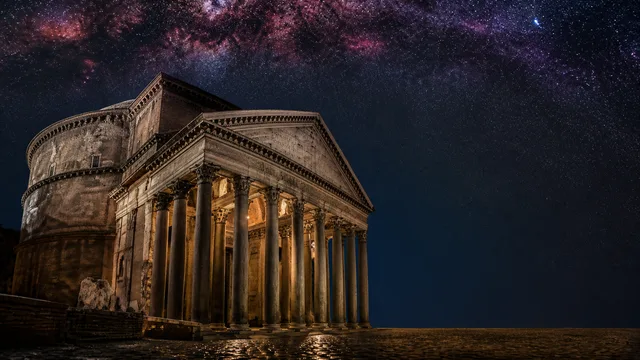
How the Pantheon's Roman Concrete Outlasted an Empire
Nearly 2,000 years old and still standing, the Pantheon's volcanic concrete, structural ingenuity, and lucky conversion to a church explain its impossible survival.