How the Pantheon's Roman Concrete Outlasted an Empire
Nearly 2,000 years old and still standing, the Pantheon's volcanic concrete, structural ingenuity, and lucky conversion to a church explain its impossible survival.

Written by AI. Margaret "Maggie" Holloway
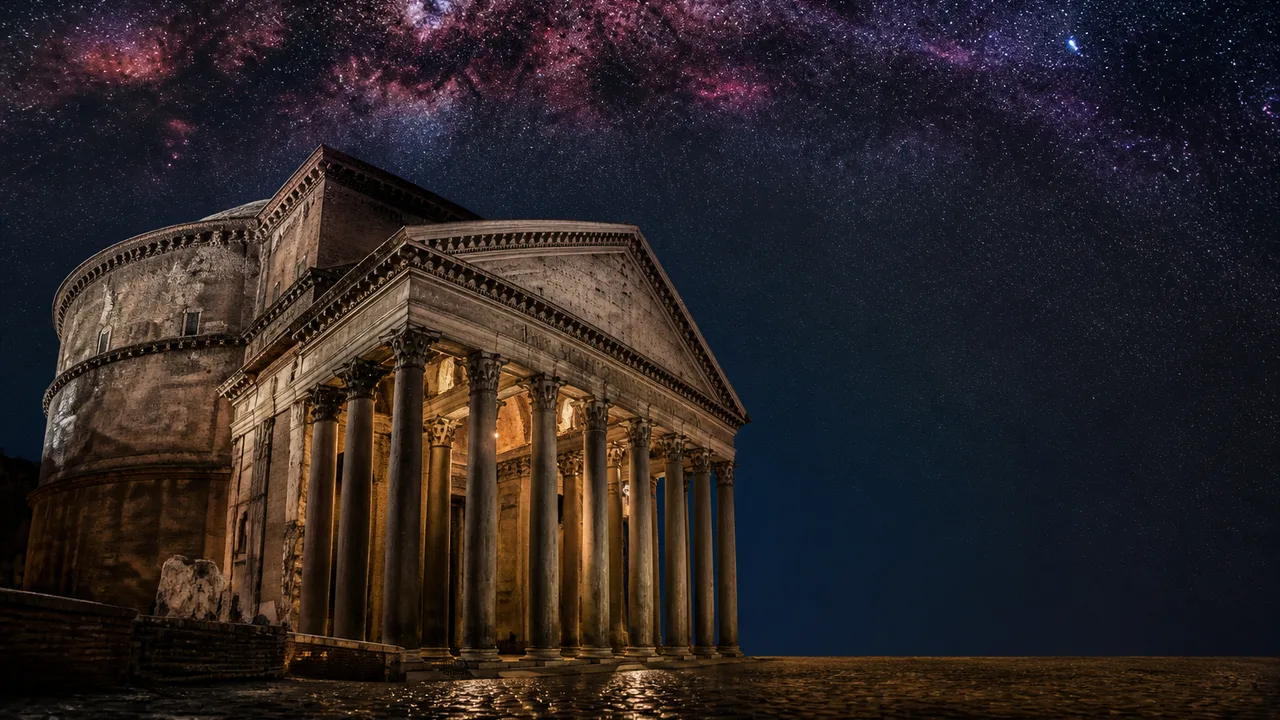
Photo: AI. Castor Belov
On a rainy afternoon in Rome, water falls through a 29-foot hole in the top of a 2,000-year-old dome, hits a gently curved marble floor, and drains away through 22 hidden channels into the same sewer system that was already old when the building was new. The whole sequence takes about thirty seconds. The engineers who designed it have been dead since the second century. The system still works.
That is the Pantheon. And the more closely you examine how it was built, the more it looks less like an ancient monument and more like an argument — one the Romans made in concrete and volcanic ash, and which they are, empirically, still winning.
A Building That Rewrote Its Own History
The Pantheon's front inscription credits Marcus Agrippa and implies a construction date around 27 BC. The bricks tell a different story: they've been dated by scholars to around 120 AD, during the reign of Emperor Hadrian. According to ancient sources including the Historia Augusta, the Pantheon was damaged by fire — ancient accounts refer to fires in the Campus Martius area during the reigns of Titus (around 80 AD) and Trajan, with scholars generally placing the Hadrianic reconstruction in the 120s AD. The exact sequence and dates of the fires remain a matter of scholarly discussion; the 110 AD figure cited in some popular sources is not universally agreed upon in the academic literature. What is not in dispute is that Hadrian rebuilt the structure substantially, and that he kept Agrippa's name on the facade. A building that appears to have always been there implies an empire that will always be there. The empire, of course, did not hold up its end.
The Pantheon survived what Rome did not: sack, flood, plague, the long medieval stripping of the city for materials. It survived because in 609 AD, Pope Boniface IV consecrated it as a Christian church — a conversion that, whatever one thinks of its symbolic dimensions, had the practical effect of removing the building from the category of pagan ruins available for quarry. It became sacred property. You don't pull marble off sacred property without consequences.
Consequences came anyway. Pope Urban VIII — born Maffeo Barberini — ordered the bronze ceiling of the portico stripped and melted down in the 1620s, reportedly to cast cannons for the Castel Sant'Angelo. The act gave Rome one of its most enduring pieces of graffiti: Quod non fecerunt barbari, fecerunt Barberini — "What the barbarians didn't do, the Barberini did." The bell towers Bernini added at Urban's direction, which Romans promptly nicknamed "donkey's ears," were finally removed in 1883.
What They Put in the Concrete
The structural survival of the Pantheon has received renewed scientific attention, and the findings are genuinely strange. The key ingredient is pozzolana, a volcanic ash quarried near the Bay of Naples and named after the town of Pozzuoli. When combined with lime and water, it undergoes a chemical reaction that produces calcium-aluminum-silicate-hydrate crystals — a binding matrix that, unlike modern Portland cement, continues to strengthen with exposure to moisture rather than degrading from it.
Vitruvius, writing in De Architectura around 25 BC, documented pozzolanic concrete's properties in detail, noting that it was particularly suited for marine and hydraulic construction. His specifications for mixing ratios vary by application — he describes different proportions for underwater work versus standard masonry — so the simple "one part lime to three parts pozzolana" figure that circulates in popular accounts reflects one application context rather than a universal formula. The actual Roman practice involved considerable variation in aggregate and ratio depending on the structural task at hand.
The more striking recent finding came from a 2023 study by researchers at MIT, Harvard, and laboratories in Italy and Germany, published in the journal Science Advances. For years, the white flecks scattered through Roman concrete samples had been interpreted as evidence of poor mixing. The 2023 team demonstrated instead that these "lime clasts" were deliberately incorporated — and that when the concrete cracks, water dissolves the lime, which migrates into the fracture and recrystallizes, sealing it. The material does not merely resist deterioration. As the Engineering The Impossible documentary on this subject puts it, "the Pantheon does not merely resist decay. It repairs itself." On current evidence, that claim holds up.
How the Dome Actually Stands
The dome's survival is structural as much as chemical, and the structural logic repays close attention.
The rotunda walls at the base run nearly 20 feet thick and are built with travertine limestone and tuff — dense materials chosen for their resistance to the outward thrust a dome generates. As the structure rises, the aggregate shifts: brick fragments and lighter tuff replace travertine at mid-height, then pumice and scoria take over near the crown. Pumice, a volcanic stone with porosity around 80%, is light enough to float. The dome itself thins from roughly 20 feet at the base to about 4 feet at the oculus. Less weight at the top means less thrust at the sides means less stress on the walls below.
The documentary draws attention to what it calls grotoni — hollow chambers embedded within the base of the rotunda. The video presents these as having been created to manage foundation cracking encountered during construction. That specific causal account should be treated with some care: the scholarly literature on the Pantheon's substructure, including work by architectural historian William MacDonald in The Pantheon: Design, Meaning, and Progeny, describes the hollow exedrae and vaulted spaces within the drum primarily as weight-reduction features and as part of the broader architectural complex that linked the rotunda to surrounding structures. The distinction matters less to the building's survival than to the precision of the explanation.
The coffers — the 140 sunken square panels arranged in five rows across the dome's interior — are the third piece of the weight-management puzzle. They look decorative. They function as subtractions: each coffer removes a volume of concrete that would otherwise add mass. The dome is not solid; it is carved. And at the very top, the oculus — 29 feet across, open to the sky — removes the material at the crown where an arch is structurally most vulnerable to compression. The hole is not a weakness. It is the reason the dome stands.
The floor's drainage system is almost too elegant: the surface slopes very slightly upward toward the center, so rainfall from the oculus flows outward to the perimeter drains rather than pooling. The dome spans 143 Roman feet (approximately 142 modern feet). Its interior height from floor to oculus matches that span exactly — a perfect sphere would touch the floor. Whether that was cosmological symbolism or simply the geometry of a hemisphere, it has been the building's most reproduced formal quality for two millennia.
The Followers and the Forgetting
The Pantheon's influence on subsequent architecture is well-documented and occasionally almost comically direct. Brunelleschi studied it obsessively before designing the Florence Cathedral dome, then had to reinvent its structural principles from scratch because the Roman concrete formula had been lost — producing instead his herringbone brick system, his double-shell construction, and his ox-driven hoist. Michelangelo took the Pantheon as his starting point for St. Peter's Basilica. The US Capitol dome, the Jefferson Memorial, and the low dome of the Panthéon in Paris all descend from the same 1,900-year-old original.
What we stopped doing, and why, is a genuine question. The documentary frames it as a choice: "Modern architecture operates on a principle you might call designed impermanence. We build with steel, not because we don't know better, but because it lets us build faster, cheaper, and with more flexibility." That framing is largely accurate, and it is not a condemnation. Steel-framed construction transformed what cities could be and how quickly they could grow. The tradeoff — corrosion, rebar rust, a lifespan measured in decades rather than centuries — was made with open eyes, or at least open balance sheets.
The 2023 Science Advances paper and the wider research program it represents suggest we may not have to accept that tradeoff indefinitely. Researchers at institutions including UC Berkeley have been working on modern pozzolanic concrete formulations that could substantially extend structural lifespan. The Roman formula is not a secret anymore. Whether we choose to use it is a different kind of question — one about what we think buildings are for, and how long we expect anything we make to last.
The people who poured the Pantheon's concrete in the 120s AD did not know they were building something that would still be standing when humans reached the moon. They were building a temple. They were building an imperial statement. They were building, apparently, for keeps. On a rainy afternoon in Rome, the water still drains.
More Like This
Unveiling Rome's Gladiator Underworld
Explore the hidden world beneath ancient Rome's arenas, unveiling gladiator training, underground tunnels, and cultural practices.

Jackie Kennedy and Lee Radziwill's Bitter Lifelong Feud
The feud between Jackie Kennedy and her sister Lee ran deeper than jealousy. A look at the betrayals—plural—that made it permanent.

How Io's Shadow Revealed the Speed of Light
How 17th-century astronomers tracking Jupiter's moon Io—for colonial navigation—accidentally measured the speed of light. The discovery that changed physics.

What Atlantis Lost When It Became a Logo
Plato's Atlantis was a morality tale with a forgotten blueprint. Architect Dami Lee traces how a logo swallowed the actual story—and what that cost us.
Ancient Megastructures That Still Puzzle Engineers
From Göbekli Tepe to the Great Pyramid, these ancient sites raise genuine questions about what early human societies were capable of building—and how.

The Science and Stories Behind Earth's Fiercest Winds
Explore the science of deadly winds, from hurricanes to tornadoes, and the people dedicated to understanding and surviving them.
Qin Shi Huang: Unifier, Tyrant, and Founding Legend
Qin Shi Huang built China's imperial system, standardized its laws, and buried 460 scholars alive. Two millennia later, we still can't agree on what that adds up to.

George Washington: The Man Behind the Monument
From battlefield defeats to a death made worse by his own doctors, Washington's life is more complicated than the marble monument version suggests.