Egypt's New Delta Project: Green Miracle or Mirage?
Egypt is engineering a new Nile in the desert. But satellite data, groundwater depletion, and a troubling history raise urgent questions about who this is really for.

Written by AI. Sofia Ramirez
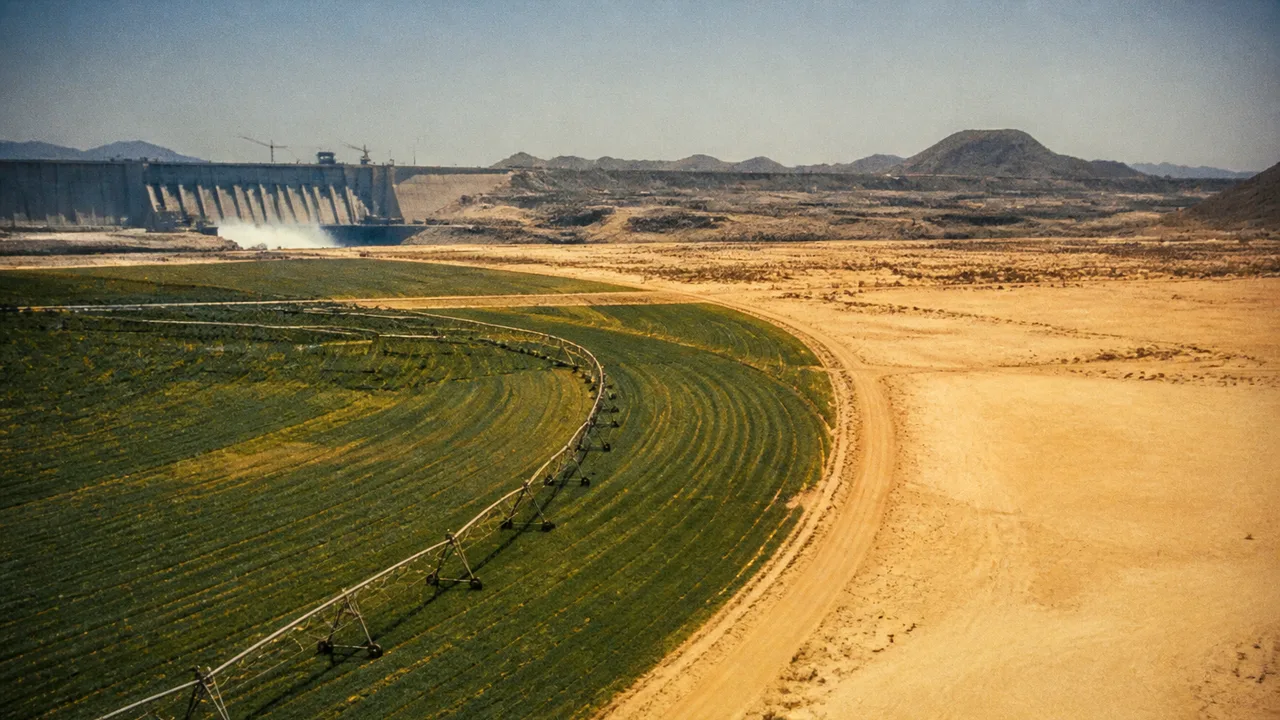
Photo: AI. Nikolai Brandt
Picture a smallholder in the Western Desert — say, a woman whose family settled there in the early 2000s, lured by government promises tied to the Toshka project, Egypt's last great desert-greening scheme. She didn't end up in a luxury compound. She ended up on a plot of marginal land with irregular water access, trying to grow something from soil that the state had declared the future of Egyptian agriculture. Now, twenty-odd years later, crop circles are appearing on the horizon — those perfect green discs you can see from satellite imagery, up to a kilometer in diameter. Foreign-backed agribusinesses growing tomatoes and fruits for export. And somewhere under her feet, an aquifer that took thousands of years to fill is being drawn down faster than anyone is publicly saying.
I keep coming back to her, or someone like her, when I read about Egypt's New Delta Project. Because that's the story that keeps getting cropped out of the frame.
The engineering case for the New Delta is genuinely impressive. Egypt is moving treated wastewater through a 170-kilometer canal system — the Al-Hamam — lifting it 100 meters uphill through 13 pumping stations, running it underground through ten pipes each three meters wide for 22 kilometers to limit evaporation losses, and then cleaning it at a treatment facility that spans 320,000 square meters and produces 7.5 million cubic meters of treated water per day. The B1M describes that facility as "the world's largest water treatment facility," and by current accounts, that claim holds up. Satellite images confirm what the engineers are saying: hundreds of new fields have appeared in a landscape that was rock and sand a decade ago. As of 2024, over 3,300 acres have been reclaimed. This is real. The green is actually there.
The question is what's underneath it.
To understand why Egypt is attempting this at all, you need to sit with the compounding disasters that got it here. The Aswan High Dam, which opened in 1970, was an engineering triumph that quietly sabotaged the agricultural system it was meant to protect. Before the dam, the Nile flooded annually, carrying nutrient-rich silt from the Ethiopian Highlands down through Egypt, renewing soil that had sustained civilization for millennia. The pyramids, in one reading, were modeled on the mounds of earth that appeared first as floodwaters receded — the river writing its own calendar. After 1970, that calendar went silent. Egypt now imports roughly a million tons of artificial fertilizer per year to substitute for silt it used to receive for free.
Then came the Grand Ethiopian Renaissance Dam, which began full operations in 2025 and is the largest dam in Africa, generating 5.15 gigawatts of electricity for a country that has long suffered severe power shortages. For Ethiopia, it is, straightforwardly, a national achievement. For Egypt, which draws 97% of its freshwater from the Nile, it represents a structural threat to water security that no amount of engineering ingenuity fully neutralizes. The B1M cites a projection that Egypt could lose around 3 billion cubic meters of water annually — roughly 5% of current supply — by 2055. That figure reflects modeling consistent with Nile Basin hydrological analyses, though the specific projection has not been codified in any binding treaty, and the range of estimates in the literature is wide. More alarming figures circulate: the video mentions that over the next century, upstream damming could eventually affect up to 85% of Egypt's water. That number reflects extreme long-term modeling scenarios and should be read as a warning about trajectory, not an imminent forecast.
What is not in dispute is that Egypt is increasingly water-stressed, that its population has doubled from roughly 60 million in 1990 to 120 million today, and that it has simultaneously lost farmland to urbanization along the Nile — where 95% of Egyptians still live, packed into a fertile strip that makes up a tiny fraction of the country's total land area. Specific land-tenure policies, urban expansion decisions made by successive governments, and agricultural subsidies that favored certain crops and certain land-owners drove that squeeze as much as raw demographic numbers. It is not simply a story of too many people.
The result of all of this: Egypt is consistently among the world's top two or three wheat importers, buying 12 to 13 million tons per year. When Russia invaded Ukraine in February 2022, and 82% of Egypt's imported wheat suddenly came from an active war zone, the price of aish — bread, which in Arabic also means "life" — spiked hard. People felt it immediately.
The New Delta Project, announced by President Sisi in 2018, is the response: transform 9,200 square kilometers of desert — roughly the size of Hawaii — into productive farmland, increasing Egypt's cultivated area by more than a third. The ambition is not in question. But the B1M is right to note that "this isn't plan A or plan B, it's not even plan C," and that history matters here.
The Toshka project is the most instructive precedent. Launched in the late 1990s as "the project of the century," it proposed diverting Nile water into the Western Desert via a vast canal network to create new agricultural settlements. The Sheikh Zayed Canal, Toshka's main artery, did reach substantial operational capacity — the infrastructure itself was not simply abandoned. But the agricultural revolution it was supposed to catalyze never materialized. The settlers who were supposed to populate the New Valley never came in meaningful numbers, or came and left. The land that was supposed to grow Egypt's food future sat largely idle. What followed in the desert-city playbook — New Cairo, the 6th of October City, the new administrative capital — replicated the same pattern in a different register: built at scale, built with ambition, but not built for the people the project was nominally about. The density was wrong, the affordability was absent, and what filled the vacuum was investment-grade real estate for buyers who mostly don't live there.
The people who were promised transformation by Toshka — smallholders and rural families who were told the desert could be home — are not, as far as I can find in the public record, the same people who ended up in those luxury compounds. That gap between the stated beneficiary and the actual beneficiary is the pattern I want to name directly, because it's the same pattern that shadows the New Delta now.
Here is where the current data gets uncomfortable. Much of the water actually irrigating the New Delta's crop circles right now is not coming from the Al-Hamam system, which is not yet complete. It is coming from non-renewable groundwater — aquifers that accumulated over geological timescales and cannot be meaningfully replenished. Research using satellite-based gravity measurements, including work drawing on NASA's GRACE (Gravity Recovery and Climate Experiment) satellite data, has tracked accelerating groundwater depletion across North Africa's Western Desert. The B1M's video cites findings that the rate of depletion under the Western Desert has roughly doubled over the last twelve years. I want to be transparent that I cannot verify the precise doubling figure from publicly available sources independent of the video's framing — but the directional finding, that depletion is accelerating in ways that the New Delta's irrigation demand will intensify, is consistent with GRACE-based research published in peer-reviewed hydrology literature. This is not a minor caveat. If the New Delta's early green is being purchased with fossil water, then what appears to be a solution is partly deferring the crisis.
And then there's the crop question. The New Delta is being planted primarily with cash crops for export: tomatoes, fruits, nuts. Not wheat. The government's stated rationale is coherent — higher-value exports generate foreign currency, which can then pay for imported staple food. It's a logical argument. It's also an argument that places Egyptian food security in the hands of global commodity markets and exchange rate fluctuations, rather than domestic supply. Whether that trade-off is acceptable depends entirely on whose risk tolerance you're consulting. The smallholder family in the Western Desert, the urban worker spending 40% of income on food, and the export-agriculture investor are not looking at this equation from the same position.
I find myself returning to a line from the B1M's video: "there's a real track record of extraordinary mega builds that definitely deliver on scale, but perhaps don't do as much as they could do in terms of transformational change."
Perhaps is doing a lot of work in that sentence. The Toshka project didn't just fall short of transformational change. It made specific promises to specific people — rural Egyptians who were told the desert frontier was their future — and those promises evaporated while the canal infrastructure stood largely empty. That's not an infrastructure failure. That's a distributional failure. It's the difference between a project that didn't work and a project that worked for someone else.
The New Delta could be different. The engineering is more sophisticated, the water recycling logic is sounder, and the satellite evidence of actual cultivation is real. But the aquifer drawdown, the incomplete canal, and the export-crop model are not engineering problems. They are choices — about whose water security counts, whose hunger is urgent, and whose landscape is available for transformation.
Somewhere in the Western Desert, those crop circles are growing. Someone is watching them from a distance, sitting on land she was also told was the future. I'd like to know what she thinks the circles are for.
More Like This
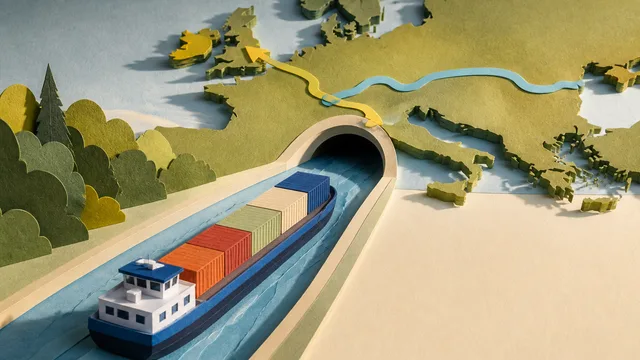
Seine-Nord Europe Canal: Building Through the Somme
France's €7.3bn Seine-Nord Europe Canal will link its waterways to Rotterdam and Antwerp—but it's being dug through ground that never finished burying its dead.
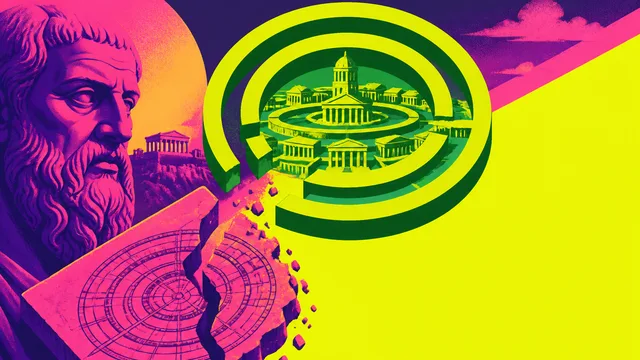
What Atlantis Lost When It Became a Logo
Plato's Atlantis was a morality tale with a forgotten blueprint. Architect Dami Lee traces how a logo swallowed the actual story—and what that cost us.
Exploring Black Holes and Asteroids with StarTalk
Neil deGrasse Tyson delves into black holes, asteroids, and more in StarTalk's latest Cosmic Queries episode with Chuck Nice.
China's Greater Bay Area and the Cost of Megacity Growth
China's Greater Bay Area megacity project promises an economic future — but farmers losing ancestral land tell a story American Main Streets already know.
A Stonehenge Precursor Found Under a Housing Estate
A 5,000-year-old solar structure found near Stonehenge raises sharp questions about prehistoric astronomy—and how Britain treats unprotected heritage sites.
Who Owns the Sky? The Human Cost of Giant Telescopes
From Mauna Kea protests to the Columbia Seven, the race to build the world's biggest telescopes carries human costs science documentaries rarely pause to name.
California's Hidden Underground: Caves, Tunnels, and Buried History
From a buried Gold Rush city to survival tunnels built by Chinese immigrants, California's underground holds layers of geology, history, and forgotten infrastructure.
Neil Armstrong: The Reluctant Hero of Apollo 11
Neil Armstrong flew 78 combat missions, survived two near-fatal crashes, and walked on the moon—then spent the rest of his life insisting it was all just luck.