Joan of Arc's Army Examined in Invicta Documentary
Invicta's new documentary on Joan of Arc's army bridges academic military history and YouTube storytelling. Harry Goodman examines what that translation costs and earns.

Written by AI. Harold "Harry" Goodman
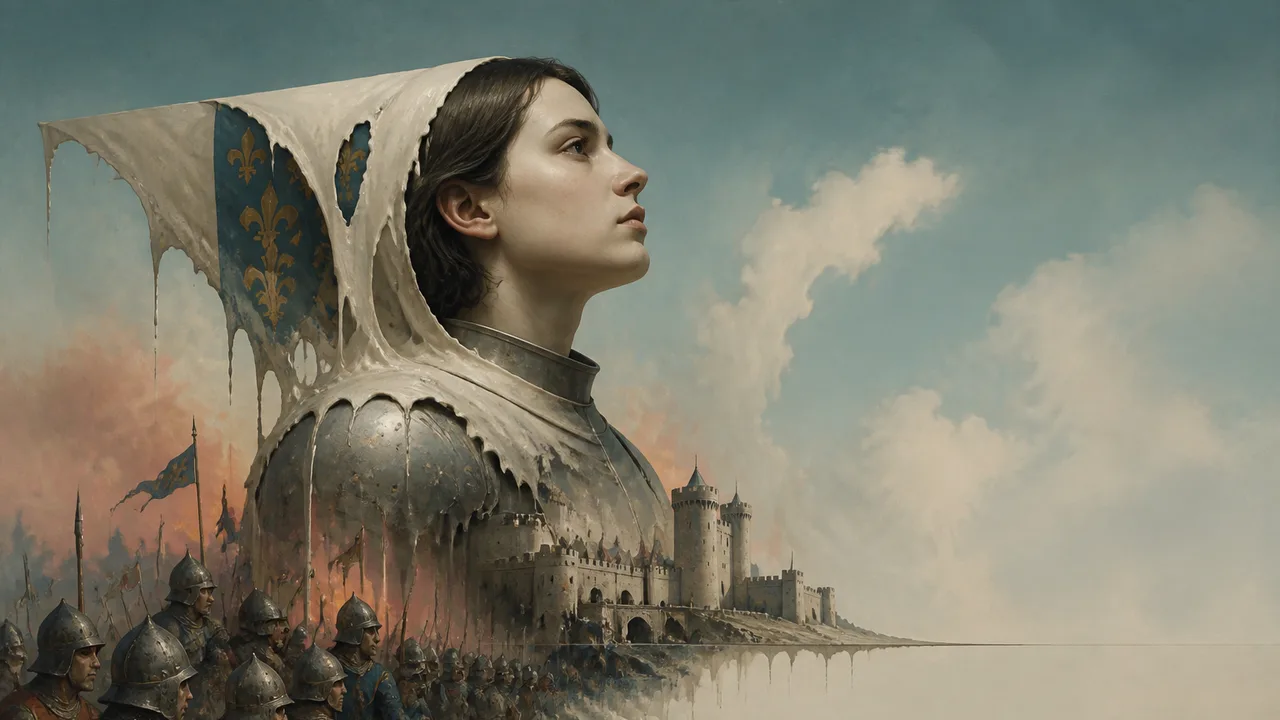
Photo: AI. Iolanthe Fenwick
There is a particular kind of courage required to open a story about Joan of Arc by admitting you barely have the sources to tell it properly. Invicta's new documentary — True Size: Army of Joan of Arc (c.1430) — does exactly that, and it's the most honest thing the film does. "So much ink was spilled about Joan's beliefs, her meteoric rise, her role as an inspirational leader," the narration concedes early on, "and the injustice of her trial and execution after she was captured by the English. But that left little remaining for the details of the army she was given."
That admission is also the documentary's structural problem and its most interesting creative bet. What Invicta is attempting here is not a biography and not quite a battle re-enactment — it is something closer to institutional military history, with a folk saint at its center. The question worth sitting with is whether audio-visual documentary, deployed on YouTube at a 34-minute runtime, is actually the right vessel for that argument.
The Translation Problem
The film draws on solid scholarship: Kelly DeVries' Joan of Arc: A Military Leader (The History Press, 1999), Philippe Gaillard's Joan of Arc's Army: French Armies Under Charles VII, 1415-53 (Osprey Publishing, 2024), and Clifford Rogers' work on military revolution in the Hundred Years War, among others. These are not pop-history paperbacks. DeVries in particular has spent a career pushing back against the hagiographic Joan — the mystical teenager who somehow bent the arc of history through sheer divine favor — in favor of a more forensic account of what she actually did tactically and what kind of army she was doing it with.
That is a genuinely difficult argument to make, and it requires the audience to hold complexity. The banner system that organized the pre-war French host — vassals calling on vassals, banners scaling from handfuls to thousands, the whole apparatus assembled ad hoc each time the crown needed it — is not easy to convey without a diagram or twenty minutes of patient explanation. Invicta gives it roughly six, and the narration moves briskly. What you lose is the texture of how strange that system was: an army that had no permanent existence, conjured from obligation and then dispersed. What you gain is momentum.
By 1429, that system had been ground down by a century of war and plague. The old feudal structures had degraded. Middle-class soldiers who could equip themselves were filling gaps left by depleted noble households. Disbanded mercenary companies were being absorbed whole. The film's phrase for the resulting force — "each one was its own bespoke entity" — is the right phrase, but the documentary doesn't quite let that strangeness breathe. It states the complexity and then moves on. On the page, a historian like DeVries can spend a chapter unpacking what "bespoke" meant in practice. In thirty-four minutes of video, you are always a few seconds from the next visual. The form is not always a friend to the argument.
To be fair: Invicta knows this. The film collaborates with History Adventures — a channel run by a presenter named Alina who films on historical sites and uses techniques like sand painting for visual storytelling — and the documentary explicitly shuttles between the two channels' approaches. Invicta handles the institutional and military analysis; History Adventures handles the human and emotional register. The seam is visible, but the logic is sound. You cannot do everything in one voice.
What the Storytelling Actually Does
The segment where History Adventures takes over for Joan's origin story is, frankly, the more interesting piece of audio craft. Alina's narration from Domrémy carries a different weight: "Joan said that from the age of 13, she began to hear voices. Saint Michael appeared to her, sometimes Gabriel, along with Saint Catherine and Saint Margaret." And then the contextualizing move that I find genuinely useful: her contemporaries, the segment notes, "argued not about whether the visions were real, but about who sent them, God or the devil." That is the right frame. It places the listener inside the epistemic world of the 15th century rather than above it, and it's a small masterpiece of historical narration — the kind of thing that takes real discipline to write because it requires you to suppress your own modern reflexiveness.
The film also reproduces a letter written after Orléans by Joan's contemporary, a French knight identified in the documentary's narration as Perceval de Vlennvillia — a spelling I note here from the documentary's own text, with the caveat that medieval name transliterations vary considerably across sources — who wrote to the Duke of Milan. The passage is extraordinary:
"She was born on the night of the Lord's Epiphany when all people joyfully praised the deeds of Christ. The whole village was seized by an unexplained joy. And not knowing that the maiden had been born, they ran back and forth asking each other what had happened."
History Adventures presents this not as truth but as testimony — evidence of what Joan's victory became in the telling, how quickly the legend metastasized. The roosters crowing for two hours. The inexplicable village joy. It is hagiography being assembled in real time, and the documentary is shrewd enough to present it as such. That is harder to do in video than it sounds. The temptation is to play the music swells and let the audience feel the miracle. Instead, the narration holds its analytical ground: "Do you understand what this kind of description meant to a medieval person?" It's a direct address, a bit pedagogical, but it earns the question.
What Orléans Actually Looked Like
The siege itself — which, according to Encyclopædia Britannica, ran from October 12, 1428, to May 8, 1429, roughly seven months in total — is where the film's structural choice pays off most clearly. Because Invicta has spent the first half establishing what a late medieval army actually was and wasn't, the battle coverage carries real weight. When Joan's initial force of around 500 men slips through the gaps in the English siege works to join the roughly 4,000 defenders under Count Jean de Dunois (the Bastard of Orléans) and his deputy La Hire, the listener understands what that force actually represented: not an army in any modern sense, but a patchwork — citizens with weapons, professionals from disbanded companies, crossbowmen, cannoneers, even rocket troops — held together by morale that had been near collapse for months.
The storming of Saint Loup on May 4th and the subsequent assault on Les Tourelles are covered with granular attention: the 1,500-man charge on the eastern fort, the English garrison's crossbow and handgun fire, Joan's arrival mid-battle despite having been excluded from the initial planning. The assault on Les Tourelles the following day is even more vivid — a full day of fighting, cannons dragged from the city, waves of men against entrenched positions. Joan took an arrow through a joint in her plate armor, penetrating between neck and shoulder. She fought on.
None of this is new information to anyone who has read DeVries. What the documentary does is sequence it — and sequencing, in audio storytelling, is everything. The shape of the siege, rendered in compressed but careful narration, does the work that a military history monograph does more slowly: it argues that Orléans was not won by miracle. It was won by artillery, by a commander willing to press when her seniors hesitated, and by the particular social physics of a demoralized garrison that needed a story to hold itself together. Joan provided the story. The army provided the siege train.
What This Kind of Bridge Work Does and Doesn't Settle
There is something genuinely interesting about watching a YouTube channel work from Osprey Publishing and academic journals, and then asking whether the medium can hold the argument. My instinct — and I hold it lightly — is that Invicta gets further than most. The film is serious without being inaccessible, analytically honest about its source limitations, and smart enough to know when to hand the narration to a collaborator better suited to the emotional register.
What it can't fully resolve is the tension at the center of the story. The documentary wants to demystify Joan's army — to show that it was cobbled together, under-documented, and organized around a series of improbable human decisions rather than divine mandate. But the story of Orléans, told well, keeps generating the feeling of miracle. The winds on the Loire. The English siege line with its gaps. A 17-year-old with no military training who twice walked back onto a battlefield after being wounded, and each time the line held.
You can explain the mechanisms. You cannot quite explain away the shape of it.
Invicta's True Size: Army of Joan of Arc (c.1430) is available on the Invicta YouTube channel. The companion full documentary on Joan of Arc is available from History Adventures.
More Like This
Middle Platonism's Hidden Role in Western Esotericism
ESOTERICA's new crowdfunded seminar argues Middle Platonism built the foundations of Hermeticism, Gnosticism, and early Christian theology. Here's what that means.
Roman Empire History With Anthony Kaldellis
Anthony Kaldellis joins Lex Fridman to argue the Byzantine Empire never existed—it was Rome all along. A historian makes the case across 2,200 years.
The Battle of Verdun: Attrition, Leadership, and 300,000 Dead
Ten months, 300,000 dead, and less than five miles of ground changed hands. Epic History's Verdun series examines what that arithmetic actually meant.
The Teutonic Knights Built a Medieval Corporate State
The Teutonic Knights weren't holy warriors — they were medieval operators who built a sovereign state on contract law, grain prices, and systematic erasure of native Prussian culture.

Bookpilled's Vintage SFF Deep Dive Is Worth Hearing
Bookpilled's 28-minute tour of 20 obscure sci-fi and fantasy books is provisional criticism done out loud — and that's exactly what makes it worth your time.
Did the Minoans Inspire the Atlantis Legend?
Archaeological and geological evidence connects Plato's Atlantis to the Minoan civilization and the catastrophic Bronze Age eruption of Thera (Santorini).

How a Programmer Tried to Crack the Rubik's Cube
Sebastian Lague's coding adventure to solve the Rubik's Cube reveals why 43 quintillion permutations humbles even clever algorithms. A craft-focused breakdown.

Martin Road Series Retro D12E: A Modern Acoustic Classic
Explore why the Martin Road Series Retro D12E is a hit with musicians, blending vintage aesthetics with modern features.