The Teutonic Knights Built a Medieval Corporate State
The Teutonic Knights weren't holy warriors — they were medieval operators who built a sovereign state on contract law, grain prices, and systematic erasure of native Prussian culture.

Written by AI. Margaret "Maggie" Holloway
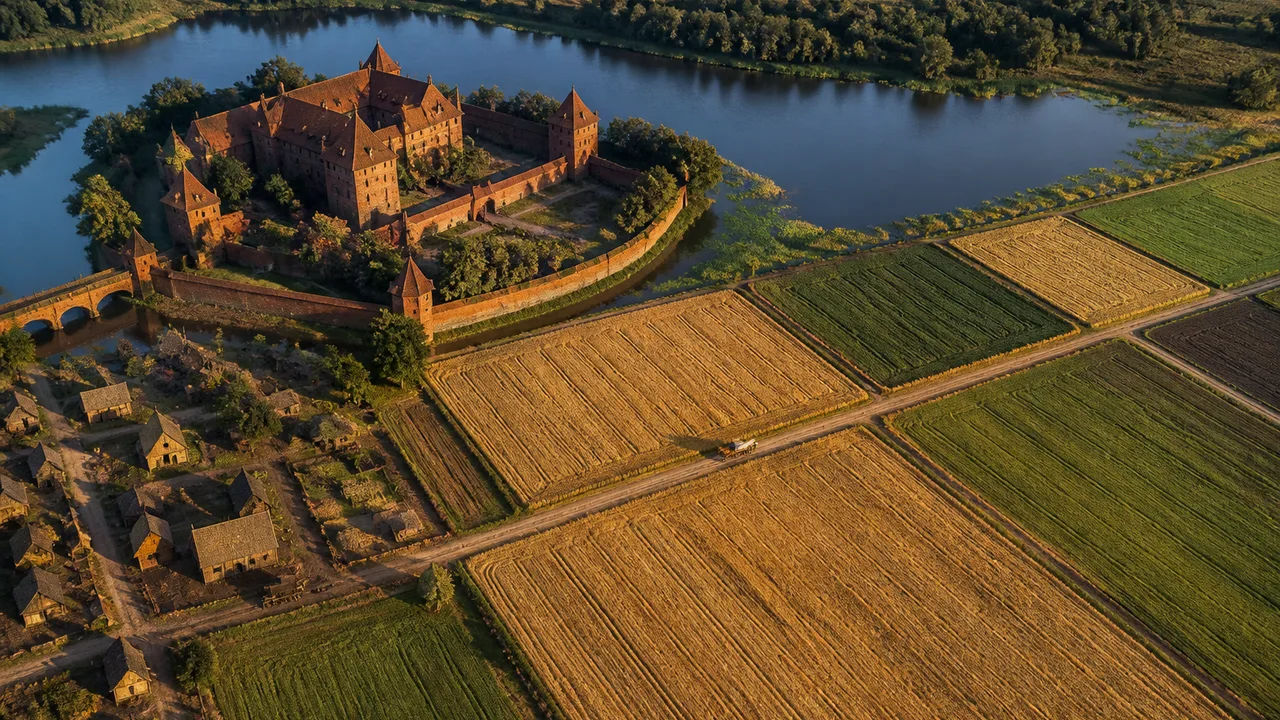
Photo: AI. Rio Sanchez
Jacques de Molay burned on a small island in the Seine in March 1314 and, according to legend, cursed the king of France and the pope with his last breath. It was a magnificent exit. It was also, measured in any currency that actually matters to institutional survival, a catastrophic one. He had trusted God to protect his order's gold from a broke monarch's accountants. He was wrong.
A YouTube documentary from the channel Ancestral, running nearly ninety-four minutes, opens with that fire and uses it as a lens — not to tell the story of the Templars, but to illuminate the order that watched from the north and drew a very different lesson. "Ideas do not turn back cavalry," the narration states. "Prayers do not fund garrisons. But land. Land does not vanish." That single proposition is the spine of everything that followed: the rise, the expansion, the atrocity, and the strange afterlife of the Teutonic Knights.
The documentary, drawing primarily on William Urban's The Teutonic Knights: A Military History, Eric Christiansen's The Northern Crusades, and Stephen Turnbull's Tannenberg 1410, builds a portrait of an institution that has been systematically underexamined in popular history — partly because its legacy is uncomfortable to romanticize, and partly because its methods were too mundane to mythologize.
The Bedpan Origins of a Sovereign State
The origin story the Ancestral documentary tells is deliberately un-heroic. In 1190, at the siege of Acre during the Third Crusade, German-speaking troops were dying in disproportionate numbers — ignored by French and English commanders and without any dedicated medical infrastructure. A handful of merchants from Lübeck and Bremen solved the problem the way merchants do: they pulled a sail off a cargo ship, strung it between poles, and opened a field hospital. No divine vision. No founding knight. The order's DNA, from its first day, was logistics.
That origin carried forward. The Teutonic Knights' subsequent rise owed almost nothing to martial glory and almost everything to bureaucratic genius. Grand Master Hermann von Salza, elected in 1209, was a minor Thuringian noble who spent two decades making himself indispensable to the two most powerful and mutually hostile figures in Christendom: Holy Roman Emperor Frederick II and the papacy. The documentary describes him riding the fault line between them — brokering ceasefires, carrying sealed letters, crossing the Alps in winter so many times that his knees were reportedly ruined by 1230 — and collecting, from each camp, a quiet stream of privileges, charters, and land grants in exchange.
He was not collecting souls. He was building a portfolio.
The masterpiece came in 1226. Conrad of Masovia, a Polish duke with an unsolvable border problem — pagan Prussian tribes burning his villages and dragging his peasants north in chains — offered the order a strip of frontier land called Chełmno in exchange for acting as his border guards. Von Salza accepted the offer publicly. Then he rode to Rimini, where Emperor Frederick was wintering, and secured the Golden Bull of Rimini: a document that granted the order not just Chełmno but every acre it might ever conquer from the Prussians, with full sovereign rights — the right to mint coins, collect taxes, hold markets, judge capital cases — answerable only to the emperor and pope, both of whom were conveniently far away and unlikely to come north and check.
Conrad thought he had hired bouncers. He had handed the keys of his duchy to men who would one day govern his great-grandchildren.
Conquer, Build, Colonize, Tax, Repeat
The colonization algorithm the order developed over the next fifty years is, as the documentary frames it, almost forensically modern in its logic. A military column crossed the Vistula each spring, found high ground above a river, and established a fortified position. Masons followed, replacing wood with fired brick — red brick Ordensburg fortresses on a standardized square plan, four high walls, no decoration, no softness. Then recruiters fanned out across German-speaking Europe with an offer that peasants in 13th-century Germany had never heard before: your own land, free of the old feudal obligations, governed by the Kulm Law of 1233. Two hides per family. Six years without tax. The right to inherit. The right to leave.
They came by thousands. Farmers, smiths, weavers, Dutch dike builders. They drained the swamps around the lower Vistula and cleared the Prussian forests. The order controlled the grain trade, the amber monopolies, the mills, the ports. More profit funded more knights. More knights took more land. More land brought more settlers. More settlers generated more tax. By 1255, on a hill above the mouth of the Pregel River, the order founded Königsberg — the city we now know as Kaliningrad.
The native Prussian tribes — the Pomesanians, Pogesanians, Sambians, Natangians — fought back for fifty years with the terrain they knew: ambushes in the black forests, disappearances into deep swamps, raids at the spring thaw when the knights couldn't ride. They nearly drove the order back into the sea during the Great Prussian Uprising of 1260. The order's answer was the Reisen — winter raids, when frozen rivers turned swamps into cavalry ground — and a strategy Peter of Dusburg, the order's own chronicler, described with what the documentary calls "something close to pride": don't defeat the warriors, remove the tribe. Burn the villages. Kill the livestock. Destroy the seed for next year's planting. Famine as policy.
The documentary does not flinch from Dusburg's accounts: chieftains hanged from trees and run through while still kicking, a noble named Oktum placed inside his own armor and roasted over coals. These passages exist in the Chronica Terrae Prussiae, written around 1326, as success reports.
By 1283, it was over. Two generations. The last native Prussian speaker would die around 1700. The people had become German or become nothing.
What the documentary is careful to note — and what the Ancestral framing deserves credit for foregrounding — is the problem with the surviving record: it is entirely the order's own. Prussian culture was oral. The men with the brick castles and the quills wrote the only version that survived. We know the names of some Prussian war leaders — Henrik Monte, Glappa, Diwanus, Auctume — only because the war lasted long enough that the order had to learn them. Their own telling of these events is gone.
The War Tourism Industry and Its Market Problem
By the 14th century, the order had refined its most lucrative product: the Reisen as entertainment for European nobility. Lithuania, the last pagan kingdom on the continent, was the destination. The order's chancery produced formal invitations to every royal court in Europe. Come north. Earn your crusading indulgence. Eat at the honor table. Bring home a story.
It worked. Jean le Maingre, future Marshal Boucicaut of France, came twice. Henry of Derby — the future King Henry IV of England — came in 1390 and again in 1392, with 300 men, his own physician, a minstrel, a pet bear cub, and six pounds of sugar for the wine. The household accounts of his trip survive at the Public Record Office at Kew, reading, as the documentary observes, like a luxury travel itinerary.
The entire model rested on one assumption: Lithuania had to stay pagan. When Grand Duke Jogaila married the Polish Queen Jadwiga in February 1386, converted to Catholicism, and baptized the Lithuanian population, the product had no market.
The order's reaction stripped away every pretense. They did not celebrate. They did not retire. Their diplomats immediately fanned out across Europe arguing the conversion was fraudulent — producing false witnesses, paying for sermons, lobbying the Curia. For 150 years they had claimed the war was about souls. Now they kept fighting for the land underneath those souls. The cross, it turned out, had always been a cover. The real target was a contiguous map.
Grunwald and the Geography of Overconfidence
The Battle of Grunwald on July 15, 1410, is where institutional arrogance cashed its final check. Grand Master Ulrich von Jungingen marched 27,000 men out of Marienburg to meet a Polish-Lithuanian army of perhaps 39,000. Ulrich had grown up on Reisen campaigns where Teutonic cavalry broke tribal levies like dry sticks. He genuinely could not process what he was facing: a coalition state the size of France and Germany combined, led by a king who had been patient for decades and a grand duke, Vytautas, who had once been a hostage inside Marienburg's own walls, escaped disguised as a serving woman, and spent the intervening years studying precisely how to destroy the order.
When the Lithuanian right wing appeared to collapse and flee, von Jungingen read it as vindication. His senior commander Kuno von Lichtenstein rode up to warn him it was a feigned retreat — the Mongol tactic that had destroyed the Hungarians at Mohi in 1241. Ulrich dismissed him. He gave the order for a general advance.
The Lithuanian cavalry wheeled on a horn signal. Polish reserves came out of dead ground on the flank. Tatar archers fired from forty paces into horses mired in marsh. By sunset, 203 brother knights were dead, including Ulrich himself. Eight thousand soldiers killed. Fourteen thousand taken prisoner. The order had lost every level of command in a single afternoon.
What saved them was not a knight from a famous family. It was Heinrich von Plauen, a castle administrator from a minor Saxon house, who had missed the battle because he'd been left guarding the southwestern frontier. When the news reached him on July 16, he made a decision alone within an hour: pulled his garrison, marched north, and arrived at Marienburg three days before the Polish vanguard. He then did something that explains exactly who he was. He ordered the entire city of Marienburg burned — the wharves, the warehouses, the merchant houses, the church — to clear the field of fire around the walls. The town was an asset. The castle was the company. Assets could be liquidated.
He held the castle for eight weeks until the Polish army, wracked by dysentery and shrinking as the Lithuanian contingents left for the harvest, finally broke camp in September 1410. Von Plauen had saved the order. His reward, three years later, was arrest in his own chambers while eating breakfast, deposed by knights who couldn't forgive him for being their social inferior. He died in 1429, his name unrecorded on the order's commemoration roll.
The documentary's narration lands this detail without editorial comment, which is the correct choice. The pettiness speaks for itself.
Dissolution as Survival Strategy
The epilogue the documentary traces is, in retrospect, the most revealing chapter. The sovereign Teutonic state lasted 240 years after its founding at Rimini. It ended not in battle but in a market square in Krakow in April 1525, when Grand Master Albert of Brandenburg-Ansbach knelt before the King of Poland on a red carpet, swore fealty as a Lutheran duke, and stood up as the first Duke of Prussia. He had visited Luther in Wittenberg two years earlier and received straightforward advice: throw off the vows, take the land for yourself, become a hereditary prince.
Albert had looked at his inheritance — an empty treasury, fewer than 200 remaining brothers, a state vassalized by its oldest enemy — and concluded the monastic form was finished. He kept the substance and discarded the wrapper.
That duchy, through the Hohenzollern inheritance, became the Kingdom of Prussia in 1701, then the engine of a unified German empire in 1871. The black cross the order had carried into the Prussian forests in 1231 was painted on the wings of German aircraft in two world wars.
"The Templars chose martyrdom and got a legend," the Ancestral narration observes. "The Teutonic Knights chose conversion and got something stranger. They got the future."
That line is true, and it raises a question the documentary gestures toward without fully resolving: what exactly should we call what they built? A crusading order that was never primarily religious. A colonial enterprise before colonialism had a name. A corporate state that rebranded itself into a nation. The Teutonic Knights resist every clean category, which is probably why they've been left to the footnotes. The categories we'd need to fully describe them are ones we'd rather not apply to the Middle Ages.
More Like This
Jackie Kennedy and Lee Radziwill's Bitter Lifelong Feud
The feud between Jackie Kennedy and her sister Lee ran deeper than jealousy. A look at the betrayals—plural—that made it permanent.
Attila the Hun: Scourge of God or Economic Strategist?
Attila never sacked Rome—yet he's history's ultimate barbarian. The real story is stranger, and more familiar, than the legend.
1938: The Year the World Chose Not to See
From Munich to the Yellow River, 1938 was the year crisis became catastrophe. What the decisions of that year still ask us to reckon with.

The WWII Flying Boat Still Fighting Wildfires Today
The Martin Mars water bomber—a WWII relic with a 60m wingspan—is fighting Mexico's worst wildfires in 30 years. Here's how it actually works.
How Medieval Castles Were Built to Signal Power
Medieval castles were never just fortresses. A look at how 500 years of castle design reveals architecture as political propaganda, arms race, and identity myth.
How Roman Soldiers Survived Winter in Germania
Roman legionaries in Germania weren't built for the cold—but they survived it anyway. Here's what that survival actually looked like, and what it cost them.
The Invisible Inventions That Built Modern Life
From flush toilets to undersea fiber cables, the inventions that most shaped modern civilization are the ones we've stopped noticing entirely.
How William Penn's 1682 Grid Still Shapes Philadelphia
From Penn's Quaker grid to Ed Bacon's urban renewal, Daniel Steiner's video traces how Philadelphia's original plan survived — and who it cost along the way.