Medieval Knights: The Gap Between Code and Conduct
Medieval knights lived by a strict code of chivalry—and routinely broke it. A look at the real training, politics, and moral failures behind the armor.

Written by AI. Helen Papadopoulos
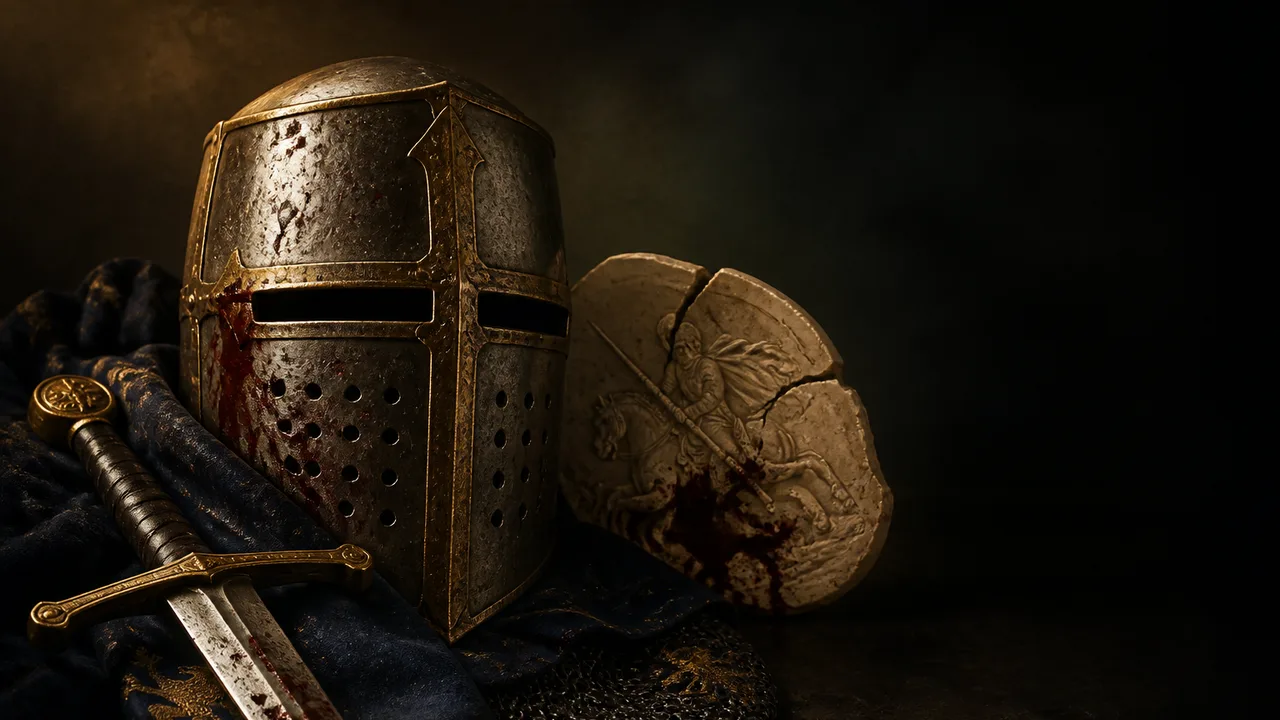
Photo: AI. Liora Goldstein
In 1379, a knight named Sir John Arundel persuaded a group of nuns to let him shelter at their convent. What followed was not hospitality repaid. Arundel and his men looted the nunnery, kidnapped several nuns, stormed a nearby church to seize a newly married bride, and eventually threw their captives overboard at sea. Arundel was a knight. He was also, by any measure, a monster.
The temptation when you encounter a story like this is to treat it as exceptional—a rogue knight, a bad apple, an anomaly in an otherwise honorable tradition. History Exposé's recent video on medieval knighthood, narrated by James C., doesn't quite let that narrative stand. What emerges from the material instead is something more uncomfortable: a portrait of a class whose ideals and realities were in chronic, documented tension, and whose social power made accountability largely optional.
Servant, Warrior, Gentleman—In That Order
The etymology alone complicates the romance. The English word knight traces back to the Old English cniht—meaning boy—which itself appears to descend from the German Knecht, meaning servant. There is something quietly revealing about a title that carries servitude in its bones even as the popular imagination clothes it in glory and plate armor. Knights were, at root, a military service class—useful to lords and monarchs precisely because they were skilled, expensive, and controllable through the feudal system of land and loyalty.
Their roots, the video suggests, may extend even further back. Roman equites—the second-highest property class in the Roman empire, the mounted men who occupied a rank between senatorial aristocracy and common citizen—appear to have supplied a structural template. The parallel isn't coincidental. Medieval European society was busy inheriting, adapting, and sometimes distorting classical precedents across every institution it built.
Knighthood, then, was never purely a medieval invention. It was a medieval repackaging: ancient hierarchies of property and mounted warfare, wrapped in Christian ceremony and given a new name.
The Making of a Knight
The path was long and deliberately grinding. Most boys who would eventually become knights began their training around age seven, entering a castle household as a page. For roughly six years, they learned mock combat, horsemanship, stable work, and the rudiments of hunting. The comfort of those years varied considerably by birth: sons of high nobility might train at the royal court, while boys from more modest families received their education from local knights-at-arms.
The transition to squire in the early teens was marked by a religious oath sworn on a consecrated sword—a detail that tells you something about how thoroughly the Church had colonized the institution. A squire's duties were, to be direct, those of a well-trained personal attendant: cleaning swords, polishing armor, managing horses, serving at table, filling cups. The academic curriculum expanded too—Latin literacy, music, dance, and an intensive study of chivalric codes and customs.
What the video captures well is the financial dimension that modern romanticizations tend to elide. Not every squire became a knight. Some failed training outright. Others—and this is the part that tends to get left out of the Arthurian mythology—simply couldn't afford the costs of knighthood and spent their lives in permanent squirehood, serving knights as a career rather than a stepping stone. The dream was calibrated to exclude as much as to reward.
For those who did make the leap, the dubbing ceremony was theatrical and deliberately solemn: a night of prayer in a chapel, sword resting on the altar, followed by the ritual kneeling before a king or knight who tapped each shoulder with a blade. It was designed to feel transformative. Whether the man who rose was actually transformed is a different question.
The Chivalric Code as Damage Control
Here is where the material gets genuinely interesting. The code of chivalry—forbidding knights from beating priests, stealing livestock, harming women, committing arson, kidnapping, robbing, or hurting innocents—reads less like an aspirational moral philosophy and more like a list assembled in response to documented behavior. Rules, as any historian knows, tend to describe what people are actually doing.
The evidence suggests the code was as much corrective as ideal. Saint Bernard de Clairvaux, co-founder of the Knights Templar and one of the most influential churchmen of the twelfth century, apparently reached his limit. According to the video, Bernard "decreed that knights served the devil, not God, and publicly called for reform." That a co-founder of the most famous knightly order in Christendom felt compelled to make that statement is worth sitting with.
The response to Bernard's call was essentially: noted, but these men are militarily indispensable. Knights constituted the bulk of medieval cavalry. Their ability to control a horse using only knees and feet while managing weapons and shield was a technical skill that took years to develop and couldn't be replicated on short notice. The church needed them. Lords needed them. The math of military necessity overrode the math of moral accountability.
That calculus also governed what happened when knights were captured in battle. Common soldiers—archers, infantrymen—were frequently killed on capture. Knights were housed comfortably and ransomed back to their own side. This was not sentimentality; it was economics. A live knight had extractable value. A dead one did not.
The Gap That Wouldn't Close
The private lives of knights, the video notes without particular moralizing, frequently contradicted their public code. Celibacy outside marriage was mandated; affairs, mistresses, and the use of brothels were common. "Knights projected an image of honor and restraint, while their private lives often told a very different story." This isn't a revelation—it's a structural feature of any moral system administered by powerful people who face limited consequences for violating it.
What makes the knightly case interesting isn't the hypocrisy itself, which is fairly universal across human institutions, but the specific machinery that enabled it. Ransom economics protected knights from battlefield justice. Church dependence on their military service protected them from ecclesiastical discipline. Feudal land tenure protected their families from downward mobility. The chivalric code was, in this reading, less a set of internalized values than a public relations architecture—a framework that allowed the class to maintain legitimacy while behaving more or less as it wished.
Gunpowder and the End of the Performance
The decline of knighthood is conventionally attributed to the rise of gunpowder, cannons, and professional standing armies in the late Middle Ages. That's accurate as far as it goes. Mounted warriors in plate armor become considerably less valuable when a trained infantryman with a firearm can kill them from distance without years of horsemanship training. The tactical monopoly collapsed.
But the social decline arguably preceded the military one. By the time Holy Roman Emperor Maximilian I—active in the late fifteenth and early sixteenth centuries—was earning his posthumous designation as "the last knight," the role had already become more ceremonial than essential. Knights persisted in name while professional armies absorbed their function.
What remained was legend, and legend has done extraordinary work. The Arthurian cycle—with its Round Table, its Guinevere, its Excalibur—has almost certainly done more to sustain the popular image of knighthood than any historical account. As the video points out, King Arthur functions as "the platonic ideal of a great and chivalrous knight," and that ideal has proven remarkably durable. The title of knight survives today in many monarchies, now conferred for achievements in arts, charity, and public service rather than battlefield performance—and, finally, conferred upon women as well, though typically under the designation dame rather than sir.
The question the material quietly raises but doesn't quite settle is whether the modern ceremonial knighthood has shed the old problems or simply updated them. Prestige still flows from the same narrow institutional sources. The honors system in Britain, for instance, has attracted persistent criticism for rewarding establishment figures and donors over genuinely transformative contributors. The mechanisms have changed; the tendency to use honorific titles as currency for the already powerful has proven somewhat stickier.
Sir John Arundel threw women into the sea. The institution that produced him eventually became one that honors Judi Dench. That is genuine change. Whether it represents the resolution of something structural, or merely its current form, is a harder call.
By Helen Papadopoulos, Ancient World Correspondent
More Like This
WW1 Trench Life: What the Western Front Was Really Like
From Pals' Battalions to the Vickers gun, a new documentary unpacks the grim machinery of survival on the WW1 Western Front in unflinching detail.
How Rome Conquered Greece: Strategy Over Strength
Rome didn't overpower Greece—it outmaneuvered it. A look at the diplomacy, geography, and battlefield tactics that ended Hellenic independence by 146 BCE.
The Teutonic Knights Built a Medieval Corporate State
The Teutonic Knights weren't holy warriors — they were medieval operators who built a sovereign state on contract law, grain prices, and systematic erasure of native Prussian culture.
Secret Societies: Power, Myth, and Who Gets to Write History
From the Carbonari to Skull and Bones, ten secret societies reveal how influence actually works — and who gets to decide what's real.
Jackie Kennedy and Lee Radziwill's Bitter Lifelong Feud
The feud between Jackie Kennedy and her sister Lee ran deeper than jealousy. A look at the betrayals—plural—that made it permanent.
Reimagining Chivalry: From Knights to Modern Narratives
Explore how chivalric ideals have evolved from medieval knights to modern concepts of equality and partnership.
Searching for London's First Roman Road Under Lambeth
Time Team investigates whether London's first Roman road ran through Lambeth Palace gardens—and why the Romans crossed the Thames there before building Londinium.

Total War: Warhammer 40K Battle Gameplay Breakdown
New gameplay footage from the PC Games Show reveals Total War: Warhammer 40,000's cover system, unit cards, planet generation, and campaign structure.