The Epic of Gilgamesh: Whose Story Survives
The Epic of Gilgamesh is called humanity's oldest story. But whose story is it really? A look at who the archive kept and who it discarded.

Written by AI. Sofia Ramirez
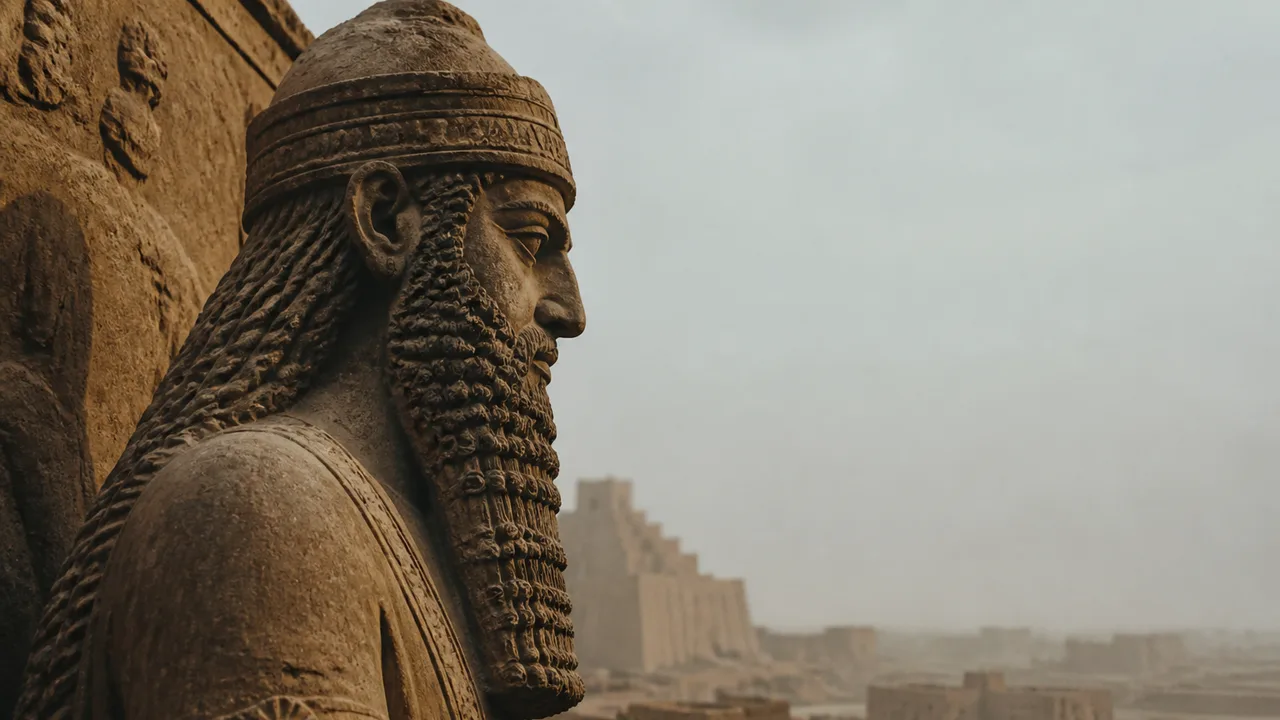
The oldest story humanity wrote down is not, technically, about all of humanity. It's about a king.
That's not a knock on the poem. The Epic of Gilgamesh is staggering — a roughly 4,000-year-old Mesopotamian narrative about friendship, grief, the terror of death, and the long losing war against it. According to Wikipedia, the literary history of the epic begins with five Sumerian poems about Gilgamesh, king of Uruk, and the text that reached us was compiled into its Standard Babylonian form by a scholar-scribe named Sin-leqi-unninni. Study.com describes it as the oldest known epic poem, written in cuneiform on clay tablets. It has outlasted every empire that handled it.
But if you want to understand why this poem survived, and what it was doing in the world when it circulated, you can't just read it as a meditation on mortality. You have to read it as a document produced by power, about power, and — this is the part that tends to get soft-pedaled in the lit-class version — in service of power.
The Man the Gods Made to Check the King
The story opens with Gilgamesh behaving badly. According to the National Endowment for the Humanities, Mesopotamian depictions of kings dating back to 3500 BCE glorified rulers and linked them to the divine — and Gilgamesh is no exception. He's described as two-thirds god, one-third man, and he's using that status to oppress his own city. The people of Uruk cry out to the gods. So the gods create a counterweight: Enkidu.
Enkidu is everything Gilgamesh isn't. He's wild, raised among animals, outside the city and its hierarchies. He doesn't know what bread is. He runs with gazelles. The Annenberg Learner resource describes him as a figure who needs to be tamed — and the instrument of that taming is Shamhat, a temple worker sent from Uruk specifically to civilize him.
This is where the poem's power dynamics get interesting, and where most mainstream retellings go quiet.
Shamhat does something extraordinary. She introduces Enkidu to human society — food, clothing, language, belonging. She is, in a very real sense, the engine of his transformation and therefore of the entire plot. Without her, Enkidu never enters Uruk. Without Enkidu, Gilgamesh has no equal, no friend, no reason to change. The whole arc of the story runs through her.
The poem names her. It sees her work. And then it largely moves on.
Enkidu's fate is starker. He arrives in Uruk as a people's champion — literally created to restrain royal excess. He and Gilgamesh fight, become friends, and then the two of them go off on adventures together: killing the monster Humbaba to harvest cedar from a protected forest, slaying the Bull of Heaven. According to the Annenberg Learner, it's when Gilgamesh arrives to cut down that great forest to build the gates of Uruk that Humbaba fights them to the death. The labor of that cedar harvest — who dragged it back, who shaped it, who built those famous walls — is invisible in the text.
Then the gods decide that someone must be punished for the killing of Humbaba, and for the Bull of Heaven. They choose Enkidu. He dies slowly, cursing his fate, and Gilgamesh falls apart.
Read that sequence carefully: the wild man, the outsider, the one created to check elite power, is useful to the story until he isn't. Then he's gone, and his death becomes the vehicle for the king's emotional journey.
The Tablet Problem (And What It Reveals)
Here's what makes the Gilgamesh archive genuinely fascinating from a historical standpoint: we don't have a complete text. According to the Medium piece by Aminu Musa Ambursa, archaeologists continue to unearth new fragments of the epic, hiding in museum collections or buried in ancient ruins — some filling in missing scenes, others showing how the story shifted as it traveled from culture to culture.
What we have is a poem that was copied, revised, and redistributed across centuries and civilizations. It passed through Sumerian, Akkadian, Babylonian, and Assyrian hands. The Wikipedia entry on the Epic notes that the Standard Babylonian version compiled by Sin-leqi-unninni represents one major recension, though scholarly consensus on his precise dating remains unsettled. Each iteration is a choice about what to keep.
What the archive preserved is the king's grief. What it let go — or never quite held — were the names of the people who made Uruk possible: the workers, the farmers, the women like Shamhat who performed the labor of civilization-building and got, at best, a supporting role in the poem about it.
This is not an accident of survival. It's a pattern.
Who Gets to Be Immortal
The poem's most famous argument is about mortality — and Study.com captures it cleanly: despite everything Gilgamesh endures in his search for eternal life, he loses his chance at physical immortality. What remains is his name, inscribed in the memory of Uruk and its walls. The city becomes his monument. His legacy outlives his body.
This is a genuinely moving idea. It's also, if you hold it up to the light, a political one.
Think about who that lesson is aimed at. If you're the king — if you built the walls, if your name is already on every monument — the poem's consolation costs you nothing. Legacies built on stone are mostly available to people who had stone to build with.
But if you're the worker who hauled that cedar, the scribe who copied these tablets without leaving your own name, the woman who performed the civilizing labor and got thanked with a minor character credit? The poem's message — that human days are numbered, that what endures is what you made — lands very differently. It asks you to find meaning in your contribution to something larger, something that will carry someone else's name.
The Epic of Gilgamesh teaches ordinary people to accept mortal kings. That's not a conspiracy; it's what literature does. Stories shape how people understand their place in the world. This one shaped it for millennia across an enormous stretch of the ancient Near East. That's not incidental to its power — it is the power.
What the Archive Asks of Us
None of this means the poem isn't worth reading. It absolutely is. The grief over Enkidu is real grief. The terror of death is real terror. The yearning for something that outlasts a human life is as alive in us now as it was when someone pressed those first wedge-marks into wet clay.
But the stories we call universal deserve the most scrutiny, not the least. "Universal" is often a way of saying: the concerns of the people who controlled the archive were broad enough to touch everyone.
According to Wikipedia, the literary history of Gilgamesh begins with poems about a king. The Wikipedia entry on Gilgamesh himself notes that the historicity of Gilgamesh as a real figure remains contested — he appears in the Sumerian King List, but modern scholars treat him as likely semi-legendary, a figure onto whom real royal history and myth were layered together.
So we have: a possibly legendary king, whose story was shaped by palace scribes, preserved in royal libraries, distributed across empires, rediscovered in the 19th century by European archaeologists working in the same colonial framework that was reorganizing the modern Middle East, and handed to us as humanity's foundational text.
Enkidu doesn't have a Wikipedia page.
Shamhat doesn't either.
The workers who built the walls of Uruk — the walls the poem holds up as Gilgamesh's ultimate monument, the proof of a life well spent — never left their names anywhere we've been able to find.
The archive kept the king. What we do with that knowledge, when we read the oldest story ever written, is up to us.
By Sofia Ramirez
More Like This
Alexandria's Library Was More Than a Library
Dr. Roy Casagranda's lecture on the Great Library of Alexandria reveals a research institute, innovation hub, and the ancient world's most powerful idea engine.
Homer's Odyssey and What Mortality Means Today
Homer's Odyssey is more than epic adventure — it's a philosophical argument for why a finite life matters, and why immortality might be the real curse.
Attila the Hun: Scourge of God or Economic Strategist?
Attila never sacked Rome—yet he's history's ultimate barbarian. The real story is stranger, and more familiar, than the legend.
Steve Jobs: Innovation, Ethics, and Tech Culture
Explore how Jobs' leadership at Apple reshaped tech culture and challenged ethical norms.
Sun Tzu's Brutal First Lesson and the Real Art of War
A new documentary examines the palace courtyard execution that launched Sun Tzu's career—and asks whether we've been misreading The Art of War for 2,000 years.

Roosevelt's 1936 Peace Promise: What He Really Meant
In 1936, FDR ran on "peace" — but he meant three different things by it. Unpacking that word reveals a political strategy still worth examining today.

Neil Armstrong: The Reluctant Hero of Apollo 11
Neil Armstrong flew 78 combat missions, survived two near-fatal crashes, and walked on the moon—then spent the rest of his life insisting it was all just luck.
The Bari Disaster: Mustard Gas, Secrecy, and 1943
On December 2, 1943, a German raid on Bari killed over a thousand people—and released mustard gas that officials spent decades trying to erase from history.