Homer's Odyssey and What Mortality Means Today
Homer's Odyssey is more than epic adventure — it's a philosophical argument for why a finite life matters, and why immortality might be the real curse.

Written by AI. David Oyelaran
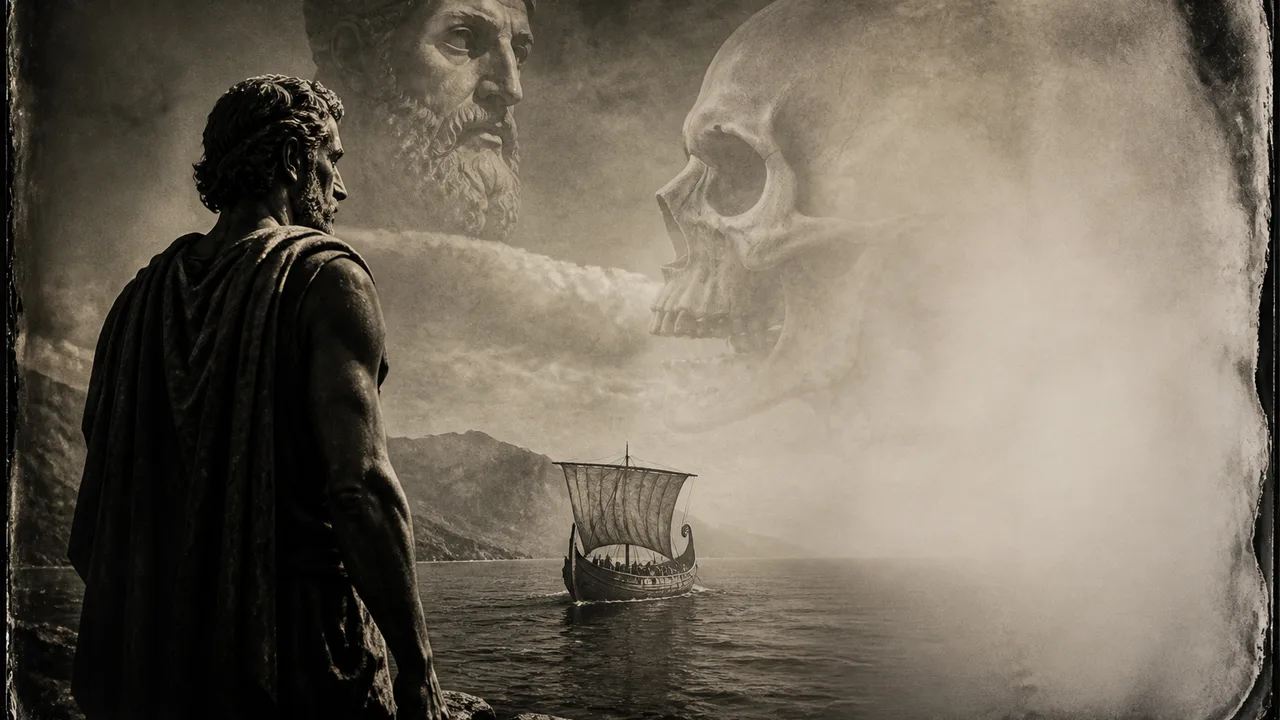
There's a moment near the center of the Odyssey that tends to get overshadowed by the drama surrounding it — the Cyclops, the Sirens, the suitors bleeding out on Ithaca's floor. Odysseus is on Calypso's island, Ogygia. He has been there seven years. The nymph who holds him has offered him exactly what every human being is supposed to want: immortality, agelessness, the permanent suspension of loss. And he sits on the shore and weeps for home.
That image — a man given the gods' own gift and weeping anyway — is where the Odyssey's real argument lives.
The poem is, on its face, one of the oldest surviving works of literature in the world, an epic in 24 books attributed to Homer and, as Wikipedia notes, still one of the most widely read. Britannica describes it as the story of Odysseus, king of Ithaca, wandering for ten years trying to reach home after the Trojan War. It established — according to The Knowledge Library — many of the foundational conventions of Western epic poetry: heroic journeys, divine intervention, complex characters, and grand themes concerning fate, honor, and human resilience. But describing the Odyssey purely in those structural terms is like describing a letter by its envelope.
The deeper structure of the poem is philosophical, and specifically concerned with what it means to be mortal and to know it.
The Choice That Structures Everything
Calypso's offer isn't a side plot. It's the poem's central ethical test, and Odysseus fails it — or passes it, depending on how you read the word "failure."
To refuse eternal life is, by most rational calculations, insane. Odysseus chooses wrinkles and death and a wife who's been waiting so long she's had to outwit a houseful of violent men. He chooses a rocky island, a mortal body, an ending. What Homer seems to be asking, threading this through the whole narrative architecture of the poem, is whether that choice is weakness or wisdom.
The answer the Odyssey builds toward is that the choice is wisdom — that mortality is not a deficiency of the human condition but its defining feature, and possibly its most generative one. As greek.mythologyworldwide.com puts it, Odysseus's journey teaches him "the importance of humility, resilience, and the fleeting nature of life," and "each experience shapes his character, allowing him to grow and adapt in a world where mortality is a constant reality." The key phrase there is constant reality — not occasional backdrop, not narrative device. Mortality as the atmosphere Odysseus breathes through every encounter.
This is what distinguishes the Odyssey from, say, a straightforward hero's quest. Odysseus doesn't transcend his mortality — he comes to understand it, metabolize it, and eventually choose it with eyes open.
Memory as the Only Immortality That Works
One of the more quietly devastating arguments the poem makes runs through its treatment of memory. An academic paper published on Academia.edu examining memory and mortality in the Odyssey explores how Odysseus's encounters shape his understanding of death and the importance of memory, contrasting his journey with that of other characters like Menelaus. The contrast is instructive: Menelaus is another Greek hero returning from Troy, another king trying to rebuild. But where Odysseus's journey is shaped by relentless confrontation with death and loss, Menelaus seems to move through a different register — less transformed, more preserved.
What the Academia.edu paper points toward is that the Odyssey proposes memory — specifically the kind of memory that survives death and gets carried by others — as the only form of immortality available to mortals, and perhaps the only one worth having. Odysseus wants to go home not just because Ithaca is familiar but because it is the place where his story is known and held. Calypso's island is a kind of living erasure: comfortable, beautiful, timeless, and anonymous.
The epic form itself participates in this argument. The Odyssey was, for centuries before it was written down, an oral poem — preserved in performance, passed from one generation of memory to another. The poem about the importance of being remembered was itself an act of collective remembering. That recursion is not accidental.
Gods, Monsters, and the Allegory Problem
There's a reading of the Odyssey — popular in certain classical circles, contested in others — that treats every supernatural element as allegorical scaffolding for a philosophical point. The Sirens represent seduction by knowledge without wisdom; the Lotus-Eaters represent the danger of forgetting; Scylla and Charybdis represent the impossible choices mortals face between different catastrophes.
The allegorical reading has real traction, but it also risks flattening something the poem works hard to keep textured. Homer's gods are not metaphors with good PR. They are capricious, petty, occasionally helpful, and structurally indifferent to human suffering in ways that feel less like allegory and more like a frank account of how the universe actually behaves. Poseidon doesn't plague Odysseus because he represents some inner psychological obstacle; he does it because Odysseus blinded his son and didn't apologize correctly. The cosmos in the Odyssey is not arranged around human moral development. It just happens to produce moral development as a byproduct of its brutality.
This is where the poem's philosophy of mortality gets genuinely interesting, and genuinely uncomfortable. The Odyssey doesn't argue that mortality is meaningful because the universe has arranged it to be. It argues that meaning is something mortals construct, in the face of a universe that isn't tracking their progress. The Journal of Hellenic Studies piece at Cambridge Core approaches the poem as a work of genuine philosophical architecture — a text doing real ethical thinking, not just decorating it with adventure.
That framing feels right. The Odyssey earns its philosophical reputation not by making mortality tidy but by refusing to.
Why This Lands Differently Right Now
The longevity industry — a term that barely existed two decades ago — is now a serious economic and scientific category, drawing significant investment from researchers and technologists who believe human lifespan is not a fixed biological constraint but an engineering problem. Calypso's offer, in other words, has moved from mythology to venture capital pitch deck.
The Odyssey's relevance to this conversation isn't that Homer somehow anticipated it. It's that the poem surfaces the question the longevity industry rarely pauses to ask: what exactly is the good we're preserving? Odysseus on Ogygia has more of everything — time, safety, pleasure, youth — and he is miserable in ways that are specifically about the absence of limits, the absence of stakes, the absence of the people and places that give his life its shape.
Homer doesn't argue that death is good. The underworld scenes are among the most harrowing in the poem; the shades are not at peace, and Odysseus does not come away from the pit thinking death is fine, actually. What the poem argues, more carefully and more unsettlingly, is that a life constructed around the avoidance of death is not the same thing as a life. That the desire to be permanent might, if granted, destroy the very thing it was trying to protect.
That's not a reassurance. It's a provocation the Odyssey has been issuing for nearly three thousand years, and the fact that we still don't quite know how to answer it is, maybe, exactly the point.
More Like This
Middle Platonism's Hidden Role in Western Esotericism
ESOTERICA's new crowdfunded seminar argues Middle Platonism built the foundations of Hermeticism, Gnosticism, and early Christian theology. Here's what that means.
Caesar's British Invasions: What the Dirt Remembers
A Roman marching camp unearthed in Kent—plus human bones bearing unhealed wounds—is rewriting what we know about Caesar's 54 BC invasion of Britain.

Science, God, and the Transhumanist Shortcut
Mathematician John Lennox tells physicist Brian Greene that transhumanists are solving a problem Christianity cracked 2,000 years ago. My generation might actually find out who's right.
The Gods of Pre-Islamic Arabia, In Their Own Words
Ancient desert inscriptions reveal the polytheistic world before Islam—gods, prayers, sacrifice, and fate, recorded by the nomads who lived it.

The Hard Ceiling on Human Lifespan, Explained
Can science push humans past 115? From longevity clinics to cellular reprogramming, here's what the evidence actually says—and what it doesn't.
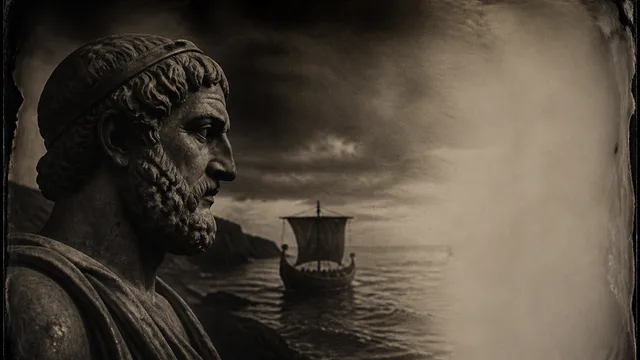
Homer's Odyssey and the Philosophy of Mortality
Homer's Odyssey isn't just an adventure story. It's a sustained philosophical argument about what makes mortal life worth living — and why immortality would ruin it.

DNA Names a Revolutionary War Teen Soldier After 245 Years
Genetic genealogy has identified Private John Pumphrey, a Maryland teen who died at the Battle of Camden in 1780 — one of America's oldest John Doe cases.
Cicero and the Fall of the Roman Republic
Marcus Tullius Cicero defended Rome's Republic with words alone—and paid with his life. A look at history's most consequential orator and his impossible political moment.