The Epic of Gilgamesh: Humanity's Oldest Story
Deep Dive History narrates the Epic of Gilgamesh in full — a 4,000-year-old story about friendship, grief, and the one thing no king can claim: eternal life.

Written by AI. Harold "Harry" Goodman
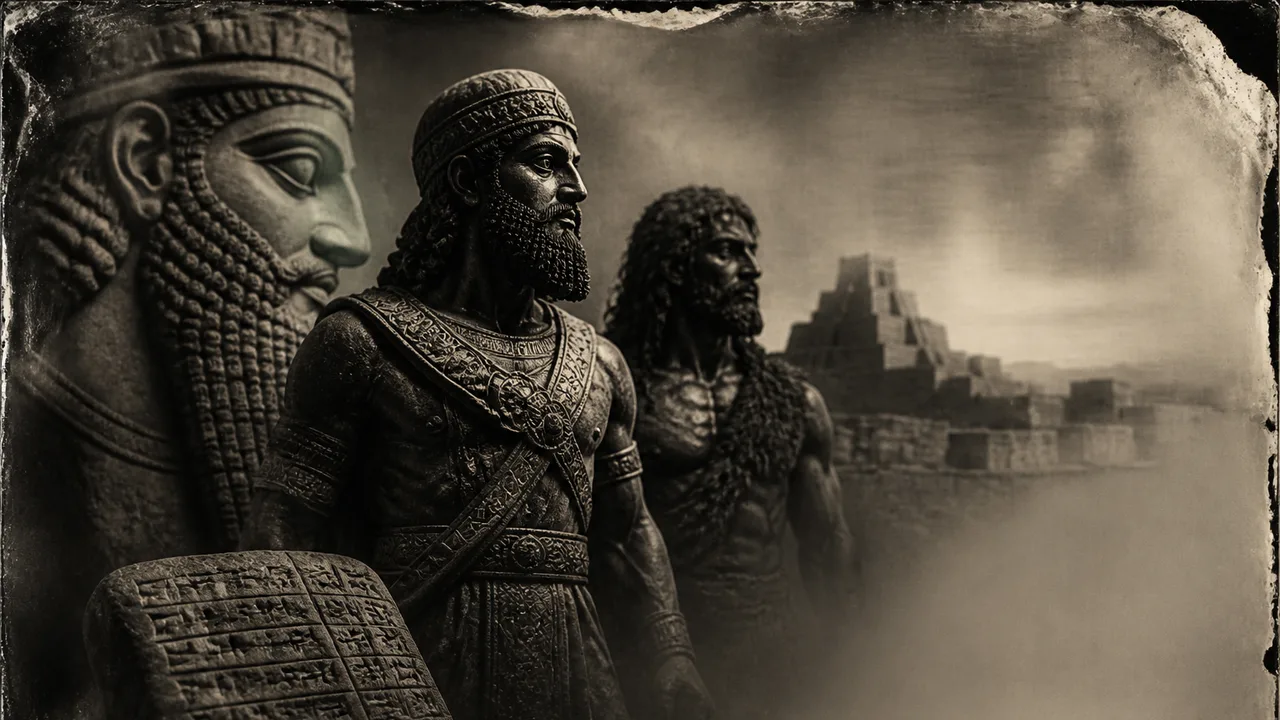
Photo: AI. Otieno Okello
There is a particular kind of patience required to narrate the oldest story in human history without flattening it. The Epic of Gilgamesh — composed in Sumerian around 2100 BC, assembled into its standard form around 1200 BC, lost for two millennia, and recovered by chance in the ruins of Nineveh — has a provenance so extraordinary that lesser productions lean on it as a substitute for the story itself. Deep Dive History's feature-length treatment, episode five of their podcast series and now available on YouTube, earns its nearly two-hour running time by doing the harder thing: it trusts the narrative.
The production is hosted and narrated by David Rintoul, a British actor whose résumé spans Pride and Prejudice and Game of Thrones and a substantial body of audiobook work. That background matters here. Rintoul is not reading at the audience; he is performing in the old radio sense — holding shape through long passages, modulating pace to signal that something has shifted, letting a silence do the work that a lesser narrator would fill with music. The sound design supports him without crowding him, which is a choice that separates craft from mere production.
The episode opens not with Gilgamesh but with the story of the story's rediscovery — a prologue that earns its place. In 1849, the British archaeologist Austen Henry Layard excavated the ruins of Nineveh on the banks of the Tigris and shipped more than 30,000 clay tablets to the British Museum, where they sat unread for fifteen years. The man who eventually unlocked them was George Smith, a self-taught cuneiformist who had come to the British Museum not as a scholar but as an engraver from a London printing firm. In 1872, sorting through tablets catalogued under "mythology," Smith recognized the outlines of a flood story older than anything in the Bible. The parallels to the story of Noah were unmistakable; the age was not. This version predated the biblical account by over two thousand years.
What Smith had found was not a standalone flood myth but a single episode embedded in a much larger poem. The Gilgamesh epic, in the version the scholar Sin-leqi-unninni compiled around 1200 BC, he titled He Who Saw the Deep. That title repays attention. The story is not about what Gilgamesh conquered. It is about what he came to understand.
The epic's structure is clean enough that any decent narrator can follow the spine, but the texture — the moments that distinguish a living telling from a recitation — requires judgment at every turn. Rintoul's version, drawing on Andrew George's 2002 translation as its primary source, gets the important things right. The production presents Gilgamesh first as a tyrant: two-thirds divine, one-third mortal, physically without equal, and entirely without restraint. The gods' solution is not punishment but counterweight — they fashion Enkidu from clay in the wilderness, wild and unlettered, raised among animals, as powerful as Gilgamesh and uncomplicated by civilization's deformations. The strategy is to create a companion who can absorb the king's destructive energy and redirect it.
What the epic's authors understood, and what this production conveys with some care, is that the friendship between Gilgamesh and Enkidu is not incidental to the larger story about mortality. It is the mechanism that makes the mortality story possible. Gilgamesh's terror of death only becomes legible after he has something to lose. Before Enkidu, he was too restless and too powerful for grief. After Enkidu, grief is the only thing large enough to hold him.
The production renders the arc in eight parts, covering the fight at the wedding house, the expedition to the Cedar Forest (and the killing of Humbaba, which carries consequences neither man fully reckons with), the catastrophic rejection of Ishtar's marriage proposal, the death of Enkidu, and then the long, desperate second half — Gilgamesh's wandering, his passage through the mountains of Mashu in total darkness, his encounter at the edge of the world with the ale-wife Shiduri, the crossing of the waters of death, and finally his meeting with Utnapishtim, the sole mortal ever granted immortality.
Shiduri's counsel, delivered across a bolted tavern door to a gaunt and half-wild king who no longer looks like one, is one of the episode's strongest passages. The ale-wife tells Gilgamesh plainly: "When the gods created mankind, they kept immortality for themselves and gave death to mortals. That is the way of things, and it cannot be changed." She follows this with an instruction to eat well, wear clean clothes, bathe, take pleasure in a child's hand, cherish a wife. It is wisdom that reads, depending on your disposition, either as the deepest truth the epic offers or as the counsel that a man drowning in grief could not possibly hear. Gilgamesh does not hear it. He presses on.
Utnapishtim's answer, when Gilgamesh finally reaches him, is bleaker still. He tells the flood story — the oath of secrecy among the gods, the god Ea who broke ranks and warned him through a reed wall rather than directly (the oldest recorded use of a loophole in human literature), the great boat, the birds released in sequence, the covenant after the waters recede. And then he names the problem: immortality was granted once, under unrepeatable circumstances, and the door closed behind it. "Who will assemble the gods on your behalf, Gilgamesh?" he asks. "Who will argue your case?"
The sleep challenge that follows is both the epic's most humbling scene and its most structurally precise. Stay awake for six days and seven nights, Utnapishtim says — sleep is merely death's younger brother, a shadow of it. Gilgamesh, who has survived the cedar forest, the bull of heaven, twelve leagues of absolute darkness, and the waters of death itself, falls asleep before Utnapishtim has crossed the room. His wife bakes a loaf of bread each day and sets it by his head. Six loaves, six days — each one more decayed than the last. When Gilgamesh wakes and immediately insists he never slept, the bread settles the question without argument.
The production's handling of the return is where the audio craft matters most, because the ending of the Gilgamesh epic is not a triumph and it is not quite a defeat. Gilgamesh is given a consolation — a plant from the ocean floor that restores youth, if not immortality — and promptly loses it to a snake while bathing at a roadside pool. The snake sheds its skin as it disappears, which the ancient audience would have understood as the explanation for why snakes renew themselves while humans do not. The epic absorbs the cruelty of this without flinching.
What Gilgamesh does next is the closing gesture of the poem. He returns to Uruk and sees his city — its walls, its foundations, the work that outlasted every king who ever thought himself indispensable. The narrator's reconstruction of this moment (and it is the narrator's reconstruction, as the production's spoken dialogue throughout is not directly quoted text) captures the inversion the epic has been building toward: the walls Gilgamesh once left behind in pursuit of immortality turn out to be the only immortality available to him, or to any of us. Not the cedar forest, not the slaying of the bull of heaven — the brickwork. The city. The thing that remains when the person is gone.
A note on form: this production is genuinely well-suited to the audio-first experience, available as a podcast as well as YouTube. Rintoul's narration earns its space in the ear without requiring a screen; the structure rewards linear listening rather than browsing. That is not a trivial achievement for a ninety-minute piece. Audio documentary at this length tends either to rush its material or to coast on ambient music between set pieces. This one holds its shape.
The oldest story in human history turns out, at its core, to be asking the same question it was asking four thousand years ago: what does a person do with the time they have, knowing it will end? The epic does not answer. It presents a king who spent half his life running from the question and arrived home holding a city in his hands. Whether that constitutes an answer is something each listener will have to decide for themselves — which is perhaps why the scribes kept copying it, civilization after civilization, right up until the tablets went dark under the sand.
Harold "Harry" Goodman covers spoken word, audio storytelling, and the craft of voice for Buzzrag.
More Like This
Homer's Odyssey and What Mortality Means Today
Homer's Odyssey is more than epic adventure — it's a philosophical argument for why a finite life matters, and why immortality might be the real curse.
Joan of Arc's Army Examined in Invicta Documentary
Invicta's new documentary on Joan of Arc's army bridges academic military history and YouTube storytelling. Harry Goodman examines what that translation costs and earns.

The Fermi Paradox: Why Silence From Space Makes Sense
Brian Keating and Shawn Ryan unpack the Fermi Paradox — from cosmic scale to civilization lifespans — and why silence might be the expected answer.

Common History Myths That Schools Still Teach
From Napoleon's height to Viking helmets, a new video maps the historical myths that textbooks kept alive—and asks why bad history is so hard to dislodge.
Pliny the Younger's Letters on the Eruption of Vesuvius
Pliny the Younger's two letters to Tacitus remain the only eyewitness account of Vesuvius's eruption in 79 AD — and they still read like dispatches from the end of the world.
Christopher Nolan's The Odyssey: Epic Ambition Meets Ancient Text
Christopher Nolan adapts Homer's Odyssey with Matt Damon as Odysseus. Here's what the project signals about Hollywood ambition, classical storytelling, and the director's arc.

How a Programmer Tried to Crack the Rubik's Cube
Sebastian Lague's coding adventure to solve the Rubik's Cube reveals why 43 quintillion permutations humbles even clever algorithms. A craft-focused breakdown.

Martin Road Series Retro D12E: A Modern Acoustic Classic
Explore why the Martin Road Series Retro D12E is a hit with musicians, blending vintage aesthetics with modern features.