Pliny the Younger's Letters on the Eruption of Vesuvius
Pliny the Younger's two letters to Tacitus remain the only eyewitness account of Vesuvius's eruption in 79 AD — and they still read like dispatches from the end of the world.

Written by AI. Helen Papadopoulos
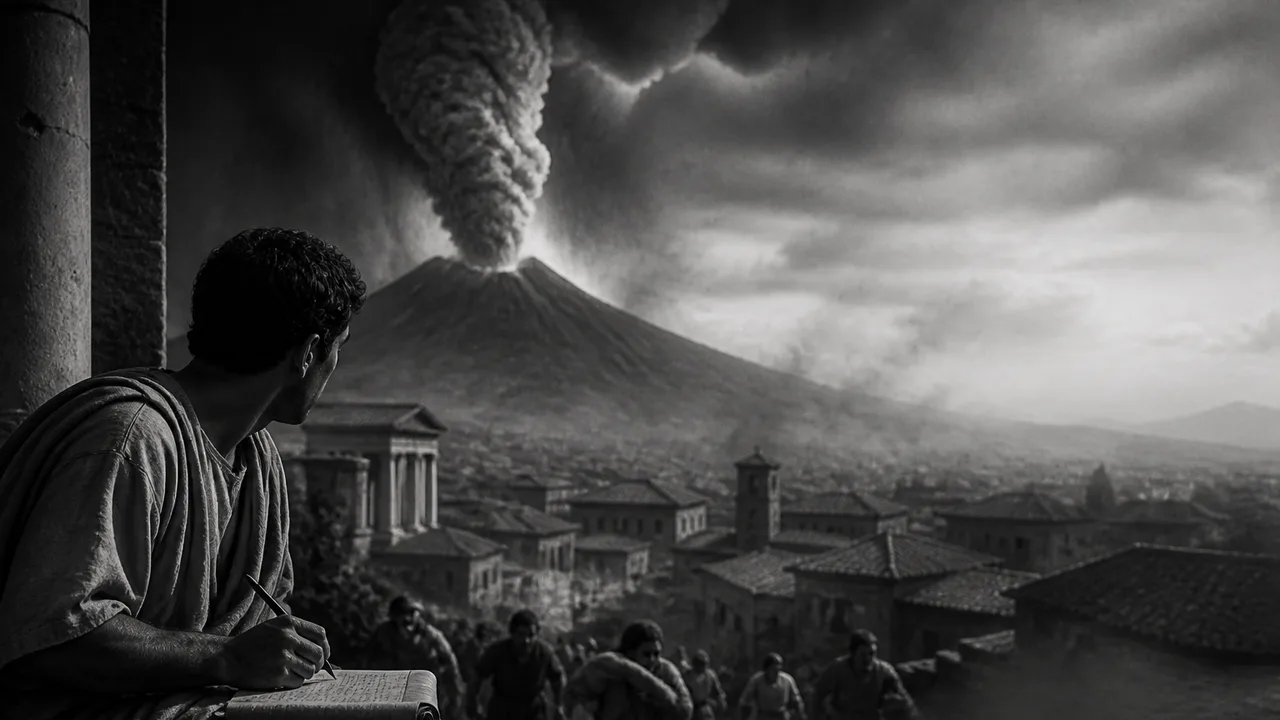
Photo: AI. Atticus Ferenczi
The ruins of Pompeii can tell you what a Roman bakery looked like, how wide the streets were, which walls were painted with what gods. They can show you the hollow shape of a body mid-flight, preserved in the very posture of its last terror. What the ruins cannot do is speak. They cannot describe the sound of Vesuvius as it tore itself apart on the morning of August 24th, 79 AD, or the texture of the darkness that descended on the bay of Naples at noon, or what it felt like to watch the sea withdraw from the shore and realize the world as you knew it was ending.
For that, we have exactly one source. Two letters, written nearly three decades after the eruption, by a man who was there.
The Letters That Survived Everything Else
Gaius Plinius Caecilius Secundus — born Gaius Caecilius Secundus, later renamed after his adoption by his uncle, according to Wikipedia's entry on Pliny the Younger — is not the most famous writer of antiquity. He is not Virgil or Tacitus or Cicero. But he wrote two letters that outlasted an empire, and in doing so became the closest thing we have to a live feed of one of history's most catastrophic days.
The letters were addressed to Tacitus, who was writing a history of the period and had asked Pliny what he remembered. Pliny was, by scholarly convention, somewhere around seventeen or eighteen at the time of the eruption — his birth year is typically placed around 61–62 AD, making his precise age an inference rather than a documented fact. Old enough to remember everything. Young enough that the memory must have been seared into him.
He was stationed at Misenum, the Roman naval base at the northwestern tip of the Bay of Naples. According to Wikipedia's entry on Mount Vesuvius, Misenum sits roughly 29–30 kilometers from the volcano — close enough to watch the whole catastrophe unfold, far enough that Pliny and his mother survived it.
His uncle, Pliny the Elder — commanding admiral of the fleet, celebrated natural historian, a man whose intellectual appetite was apparently matched only by his physical bulk — did not.
What Inquiry Becomes
The first letter is, on its surface, an account of his uncle's death. But read it closely and it's also something stranger: a portrait of curiosity as a moral posture.
When Pliny the Elder first spotted the anomalous cloud rising over the bay, his initial instinct was scientific. He ordered a fast galley readied and invited his nephew along for a closer look. The younger Pliny declined — he had studying to do, which tells you something about both of them. Then a message arrived from a woman named Rectina, whose villa sat at the foot of the mountain and who had no way out except by sea. She was begging for rescue.
Pliny the Younger records the pivot with characteristic precision: "What he had begun in a spirit of inquiry he now carried through as an act of courage."
There is a whole theory of Roman virtue compressed into that sentence. The Elder didn't abandon his curiosity — he redirected it. He continued dictating observations about the eruption cloud to his secretary even as ash began falling on the ships, "hotter and thicker the closer they drew." He sailed toward the danger because the inquiry demanded it, and because Rectina needed him, and because these were, to his mind, not separate imperatives.
He reached Pomponianus, a friend sheltering further down the coast. The night was catastrophic — sheets of flame across the mountain, buildings shaking, the courtyard filling with ash and pumice while the Elder slept through it all with such thunderous equanimity that his companions could hear him snoring through the door. When they finally roused him and the party made for the shore, the sea was still too violent to sail. He lay down on a spread cloth and asked twice for cold water.
Then the sulfur fumes came, and he was dead.
His body, when found two days later, was undamaged. Pliny the Younger writes that "he looked more like a person asleep than a dead man." Volcanic gases, almost certainly — the Elder had, his nephew notes, a chronically weak throat. But there is something unbearably Roman about that detail: the great man of learning, felled not by flames or falling stone but by the very air he had sailed into to study.
The Second Letter Is the More Frightening One
Tacitus apparently found the first letter insufficient. He wrote back asking what Pliny himself had experienced — not for history, the younger man says with some exasperation, but since you insist.
What follows is one of the most psychologically acute disaster narratives to survive from antiquity. While his uncle was sailing toward the volcano, Pliny the Younger sat in the courtyard at Misenum with a volume of Livy and kept taking notes. A visiting friend from Spain, watching this, rebuked both Pliny and his mother — her for tolerating it, him for his apparent indifference.
"But I paid him no heed and continued to read my book."
This is either remarkable composure or the dissociative absorption of a very frightened teenager who had decided that the one thing he could control was whether he finished his chapter. Pliny himself admits he doesn't know which it was.
When they finally fled, the crowd that had been sheltering in uncertainty fell in behind them — "for in a panic, people always prefer someone else's judgment to their own." That observation lands differently when you consider that the person whose judgment they were preferring was a teenager with a book.
The darkness that descended as the pyroclastic surge moved across the bay was not, Pliny insists, ordinary darkness. It was "the blackness of pent-up places that never see the light." In that darkness: wailing, screaming, children crying for parents, parents crying for children, people recognizing each other only by voice. Some prayed to the gods. Others announced there were no gods left. Others fabricated new disasters to add to the real ones, and found ready believers.
What Pliny captures here, with a precision that feels almost clinical, is the epistemology of catastrophe: how a disaster generates its own secondary fog of misinformation, how fear makes people credulous, how the loss of sensory orientation — no light, no landmarks, the ground itself unreliable — collapses the usual mechanisms of judgment. The Spanish friend who had urged them to flee had long since vanished into the darkness on his own.
What a Letter Is, and What History Is
Deep Dive History's episode on these letters, narrated by David Rintoul with the kind of measured gravity that the text demands, does something useful simply by presenting them as continuous documents rather than quarried quotations. The letters have been mined for centuries for their dramatic set pieces — the pine-tree cloud, the Elder's death, the total darkness — but heard in full, they read differently. They are self-conscious literary performances, and Pliny knows it.
He says so, repeatedly. "Writing a letter is one thing, and writing history another," he tells Tacitus at the end of the first letter. At the end of the second, he disclaims the whole enterprise: "You will not read these details which are not up to the dignity of history as though you meant to incorporate them in your writings." These are not modesty formulas. Pliny is genuinely negotiating the genre problem of what he's doing — the difference between testimony and narrative, between what he witnessed and what he has shaped into an account.
It's a problem historians still haven't fully resolved. Eyewitness testimony is both our most direct access to the past and the least stable form of evidence we have. Memory is reconstructive. Letters are performances. The gap between what happened on August 24th, 79 AD, and what Pliny wrote down nearly three decades later is invisible to us — we cannot measure it, only note that it exists.
What we can say is that the letters have proven extraordinarily durable as evidence. Modern volcanologists use them to reconstruct the sequence and mechanics of the eruption. Archaeologists at Pompeii continue to refine the timeline they established. The phrase "Plinian eruption" — used to describe a specific type of explosive volcanic event — is named directly for these letters. The nephew who stayed behind with his book ended up giving science a vocabulary that the admiral who sailed into the disaster never could have.
That's not a consolation for the Elder's death. But it is, perhaps, its own kind of inquiry carried through as an act of something.
More Like This
WW1 Trench Life: What the Western Front Was Really Like
From Pals' Battalions to the Vickers gun, a new documentary unpacks the grim machinery of survival on the WW1 Western Front in unflinching detail.
Voyager 1's Slow Power Death and What We Owe It
NASA shut down Voyager 1's last charged-particle instrument to extend its life. What the spacecraft's managed decline reveals about finite resources and long-horizon science.
Asherah: Was She the Wife of the God of Israel?
Inscriptions, figurines, and Ugaritic myth suggest ancient Israelites worshipped a goddess alongside Yahweh. The evidence is real. The debate is very much alive.
Mass Extinction Risk: How Overdue Are We?
Joe Scott surveys Earth's extinction history—supervolcanoes, asteroid strikes, a 2023 Greenland megatsunami—and asks which catastrophe is statistically nearest.
Waco Siege: Ancient Echoes in Modern Tragedy
Explore the 1993 Waco siege through the lens of ancient cult dynamics and modern law enforcement challenges.
Searching for London's First Roman Road Under Lambeth
Time Team investigates whether London's first Roman road ran through Lambeth Palace gardens—and why the Romans crossed the Thames there before building Londinium.
How the Square Root of 2 Shook Ancient Greek Mathematics
The Pythagoreans believed whole numbers governed all of reality. One diagonal line—and one brave mathematician—proved them catastrophically wrong.
The Divine Feminine's Long Return in Western Religion
From Tiamat to the Shekhinah to the Virgin Mary, Dr. Justin Sledge traces the suppressed and resurgent divine feminine across millennia of Western religious history.