Alexander McCall Smith Launches Positive Distraction Podcast
Alexander McCall Smith brings short fiction and uplifting storytelling to podcasting with Positive Distraction — a deliberate antidote to the relentless news cycle.

Written by AI. Amara Osei
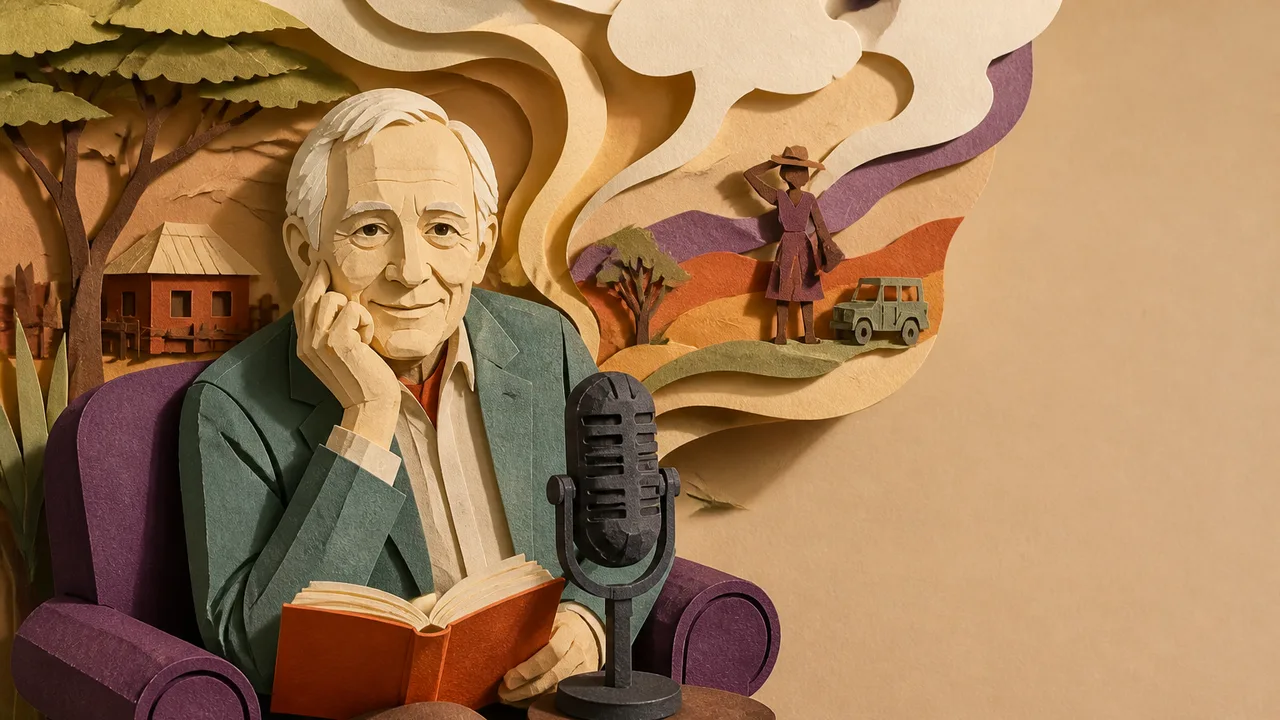
There's a particular kind of audio intimacy that only arrives when a writer reads their own work. No narrator's interpretation between author and ear. No production layer smoothing the rough edges. Just a voice, a sentence, and wherever you happen to be standing when you pressed play. That's the wager Alexander McCall Smith is making with his new podcast — and it's a more interesting bet than it first appears.
Positive Distraction with Alexander McCall Smith launched in June 2026, and the premise is, on its surface, almost defiantly simple. As described on his official website, Smith — worldwide best-selling author of The No. 1 Ladies' Detective Agency and the 44 Scotland Street novels — presents "a season of beautifully written short stories" as an antidote to the stresses of everyday life. The Apple Podcasts listing frames it in similar terms: "stories, wit, and uplifting good humour — a truly positive distraction." Episodes drop weekly, and according to liveradiouk.com, the introductory episode runs just over two and a half minutes — Smith, essentially, stepping up to a microphone and explaining why he's here.
The Guardian's culture desk flagged the podcast this week under the headline "The No. 1 Ladies Detective Agency creator makes the world happier," which is both slightly adorable and worth unpacking. The framing tells you something about the cultural moment Smith is stepping into — and something about the gap he's trying to fill.
What "positive" is doing here
The word positive in the title isn't neutral. It's load-bearing. It signals intent, audience, and a particular theory of what audio should do for a listener.
This is worth sitting with, because podcasting as a form has never had a clean relationship with uplift. The medium built its mainstream cultural footing on true crime — which is about as far from soothing as audio gets — and it has matured into a space that handles grief, trauma, journalism, and argument at high volume. Even narrative fiction podcasts tend toward the gothic, the speculative, the anxious. The gentle short story, told with warmth and craft? That's genuinely underrepresented in the current podcast landscape, which makes Smith's entry into it less obvious than the premise might suggest.
The Guardian's round-up, notably, ran Smith's podcast alongside one about Mahmud, a chef who ran a Gaza soup kitchen and was killed by a projectile — a podcast built around the question, as the piece notes, of "how do you investigate a questionable death when you can't go to the place it happened?" The editorial proximity is not accidental. When a grief-saturated news cycle and a podcast called Positive Distraction land in the same weekly recommendation column, the contrast speaks. There's an audience that is genuinely maxed out, and Smith is explicitly making something for them.
That's a legitimate creative choice. It's also a commercially legible one: the wellness audio market is real, and "audio for rest" has expanded significantly as a category, from sleep stories to ambient soundscapes. But Smith isn't pitching ambient content. He's pitching craft — "beautifully written short stories," per his own announcement. The distinction matters.
The craft question
Short fiction is a precise and demanding form, and it translates to audio in specific ways that not every prose writer anticipates. A sentence that scans beautifully on the page can land flat when read aloud if it front-loads its weight. Pacing that works across the breathing room of a chapter needs different management at the four-minute mark of a spoken episode. The ear is not the eye, and writers who know this — who either write for the ear or who read their own work with enough self-awareness to adjust — produce something qualitatively different from those who don't.
Smith has advantages here. His prose style has always been conversational rather than architectural — warm, clause-heavy sentences that move like speech, narrators who think out loud rather than in paragraphs. The No. 1 Ladies' books, in particular, have a voice that sounds like storytelling in the oral tradition: the elder at the fire, not the scholar at the lectern. Whether that quality transfers cleanly to a microphone setup, without the novel's structural scaffolding to support it, is the interesting question that the episode listing alone can't answer.
The podtail.com listing offers no review-level detail on individual episodes — it's a directory entry, not a critical appraisal. And the record on how the show sounds in practice is thin, at least in the publicly available sources at the time of writing. What we have is intent, framing, and a launch. The substance of the work — the actual grain of these stories, how they open and close, whether the voice holds the room — will take a few more episodes to assess with any real rigor.
Authors in the feed
There's a broader pattern worth naming here. Smith's move into podcasting is part of a longer migration of literary writers toward audio, one that has accelerated meaningfully since the mid-2010s and that raises genuine questions about what audio adds to an author's practice versus what it simply extends.
For some writers, podcasting has been a natural fit — a way to reach readers who might never pick up the book but who will listen on a commute. For others, it's been a vehicle for literary reputation more than literary work: a platform for ideas rather than stories, an interview series, a reading group, an essay. What makes Smith's project more interesting than the generic author-enters-podcasting story is that it's neither of those things. It's original short fiction, written and delivered as audio-native content. That's rarer than it should be.
The short story has a complicated commercial history — it's the form most literary writers consider their most demanding, and the one general audiences have historically been least willing to pay for. Audio may be changing that calculus. Serialized fiction podcasts have demonstrated that listeners will commit to ongoing narrative in ways that short story collections struggled to capture. Whether Positive Distraction is building toward something cumulative, or whether each episode is self-contained and complete, isn't made explicit in the available materials — but it's the structural question that will shape the listening experience most.
What the Guardian framing signals
The Guardian's decision to headline the piece with "makes the world happier" — citing the podcast's creator, not the podcast itself — is soft praise of a very specific kind. It's warm without being critically engaged. It tells you the show has an amiable vibe, which is true by design. What it doesn't tell you is whether the writing is doing anything beyond comfort.
And I think that tension — between is this good and is this useful — is the one worth holding as the show develops. There is nothing wrong with audio that eases the listener. Rest is real. Delight is real. Not every piece of work needs to challenge or disturb. But the best comfort writing still has edge underneath it — Smith's Botswana novels work because Mma Ramotswe notices things, thinks hard about human nature, arrives at moral clarity through attention rather than sentiment. Warmth and rigor aren't opposites in his best work; they're inseparable.
If Positive Distraction carries that quality into its short form — if these are stories that actually observe the world rather than decorating it — then "makes the world happier" undersells what's happening. If they're simply pleasant, that's still something, but it's a different something.
Weekly episodes, widely available, with a back catalogue already building. That's the entry point. Whether the stories give you something to think about after they've finished — something beyond the warmth of having listened — is what will determine whether this is Smith doing something genuinely new, or simply doing what he already does in a smaller room.
More Like This
Reassessing the Queens of Numenor
Explore the nuanced reigns of Numenor's queens and their impact.

What Camera Sensors Can Teach You About Sound
StudioBinder's sensor explainer is solid filmmaking education — but it reveals something bigger about how creators misunderstand the infrastructure beneath their craft.
Reading Is a Physical Skill, and We're Out of Shape
Movement science writer Kira Yoshida on why sustained reading is hard in 2025 — and why the productivity-reading complex is making it worse.

Six Hospitalized at Angine de Poitrine's Montreal Jazz Fest Show
Six people were hospitalized after Angine de Poitrine's record-breaking free set at Montreal Jazz Festival. What the incident reveals about sound, crowds, and live event safety.
Lily Allen's West End Girl Tour and the Fourth Wall
Lily Allen is defending her West End Girl tour's fourth-wall staging. But the real debate is acoustic — what happens to sound when a pop show refuses to speak to the room?
Boredom Is Good for Your Brain, Science Suggests
Research suggests boredom sparks creativity and deep thinking. Here's what the science says about letting your mind wander in a distraction-saturated world.
JD Vance on Joe Rogan: What Three Hours Reveals
JD Vance spent nearly three hours on the Joe Rogan Experience. An audio critic listens for what the voice does when politics gets comfortable and the mics stay hot.

Legally Blonde at 25: How Elle Woods Shaped Women in Law
Twenty-five years on, Legally Blonde's Elle Woods has inspired real women to enter law. Here's how a comedy's sound and craft made that possible.