Boredom Is Good for Your Brain, Science Suggests
Research suggests boredom sparks creativity and deep thinking. Here's what the science says about letting your mind wander in a distraction-saturated world.

Written by AI. Marcus Obi
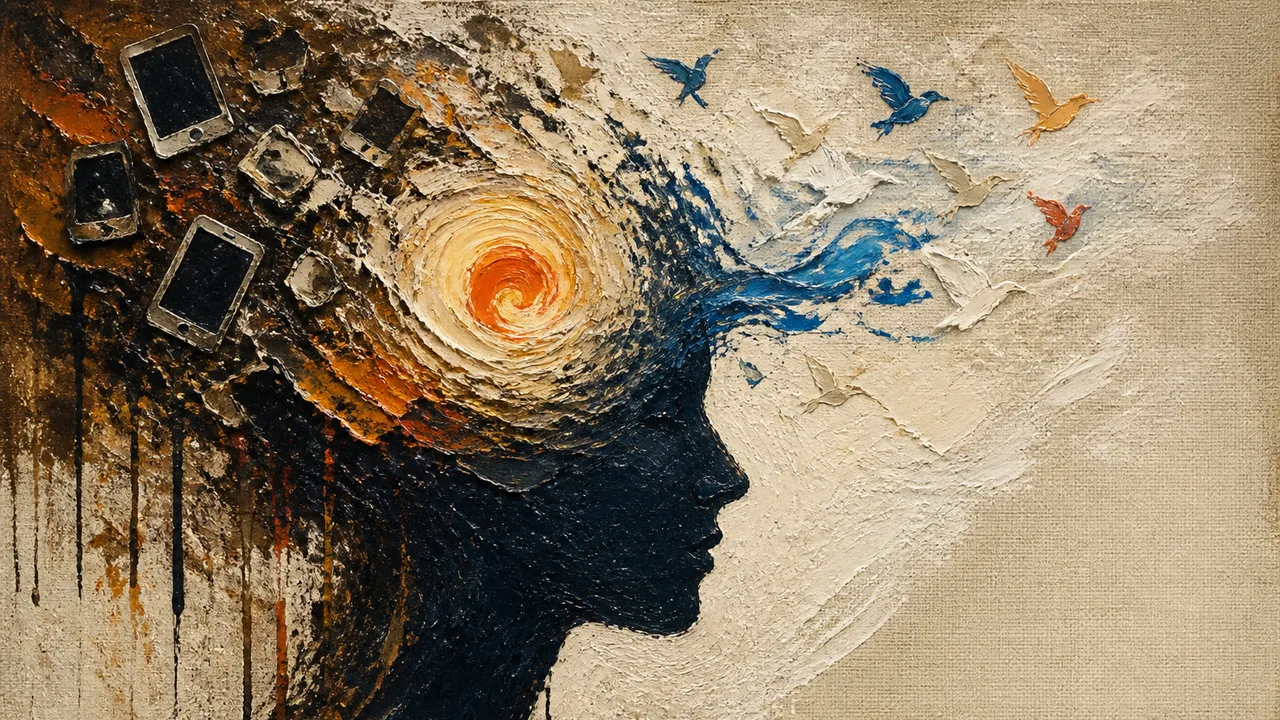
My twins are seven. They have approximately nine thousand toys, a backyard, a dog, and two parents who are both, in theory, available. And still—still—the complaint comes: "I'm booooored."
My instinct, every single time, is to fix it. Hand them a tablet. Suggest a game. Do something. The silence of a bored child feels almost accusatory, like a referendum on your parenting.
But what if the bored brain is actually doing something? What if I've been sprinting to fill a space that needed to stay empty?
That's the uncomfortable question sitting at the center of a growing body of research on boredom—research that doesn't quite fit the productivity gospel most of us have been raised on, but that's hard to dismiss once you've looked at it.
The Anxious Reflex
Here's the thing about boredom that nobody talks about: most of us don't tolerate it long enough to find out what it does.
Psychology Today puts it plainly—"many of us become anxious when bored and reach for the next distraction." That's not a character flaw; it's almost a trained response. We live in an environment engineered to prevent a single idle second. The phone is always within arm's reach. The feed always refreshes.
Productivity writer Ali Abdaal frames this through a concept from Jake Knapp and John Zeratsky's book Make Time: when we grab for a distraction to escape boredom, we're diving into what they call "infinity pools"—social media, news, anything with a bottomless scroll. Abdaal's shorthand is more visceral: we're pushing a "personal shock button." Every little buzz of stimulation short-circuits whatever the quieter brain was beginning to do.
The question the research is asking is: what exactly are we short-circuiting?
What the Bored Brain Is Actually Doing
The neuroscience here is worth slowing down for, because it's counterintuitive.
When you're not actively focused on a task—when you're staring out the window, spacing out in a meeting, lying on the floor doing nothing—your brain doesn't go offline. It shifts into what researchers call the default mode network (DMN). According to the Global Leaders Institute, it's during this DMN activation that the brain is "more likely to enter the default mode network responsible for mind-wandering and daydreaming," allowing it to "explore new ideas and make unexpected connections, often leading to creative breakthroughs."
The default mode network is, in plain terms, your brain's background processor. It's where you make sense of things you've experienced, draw lines between unrelated ideas, and—if the research is right—arrive at the kind of insight that focused attention can't manufacture on demand.
This maps to something most creative people know anecdotally: the idea doesn't come when you're staring at the blank page. It comes in the shower. On the walk. At 2 a.m. when you were trying to sleep. Those aren't moments of idleness; they're moments when the default mode network finally got room to run.
Psychology Today extends the claim further, arguing that boredom "creates the mental space from which creativity, insight, connection, and even purpose emerge." That's a lot to hang on doing nothing. But the logic tracks: you can't hear yourself think if the noise never stops.
Boredom as Signal, Not Failure
One reframe that I find genuinely interesting—and underreported—is boredom as a motivational state rather than a passive one.
INSEAD Knowledge makes this case directly: "Boredom invites us to take action, much like other negative emotions such as hate, disgust, envy, anger and sadness. It nudges us to break free from inner stagnation and engage in new experiences."
Sit with that for a second. We tend to categorize boredom as emptiness—the absence of stimulation. But the INSEAD framing positions it as a directed state, one that's pointing you somewhere. The discomfort isn't a malfunction; it's a signal that the current situation isn't meeting some need, and that you might want to go find what does.
This is meaningfully different from the "boredom is creative" pitch you see in wellness content. It's not just that boredom generates ideas—it generates motion. It's an emotion with an agenda.
That distinction matters for how we think about managing it. If boredom is a signal, then immediately silencing it with a phone is like taking a painkiller the moment you stub your toe—technically effective, but you might want to look down first and see if anything's broken.
The Workplace Angle Nobody's Talking About
Most of the conversation around boredom focuses on individual mental health and creativity. But there's a more structural argument worth flagging.
A piece in Ephemera Journal makes the case that boredom has "some potential utility for workers, as a way to resist the ever-increasing demands that are made on them." The framing is deliberately provocative: boredom not as personal failure but as a form of quiet resistance to environments that demand constant performance and engagement.
This is a thread I don't think gets pulled on enough. In workplaces where "busy" is a status symbol and unscheduled time triggers anxiety in managers, boredom becomes a kind of contraband. The worker who isn't visibly occupied is suspect. And so we fill every gap—Slack, meetings, metrics dashboards—even when nothing productive is happening. We perform busyness to avoid the appearance of boredom.
What the research suggests, though, is that this performance comes at a cognitive cost. When the brain never gets downtime, the default mode network never kicks in. The connections don't get made. The insight doesn't arrive. The organizational result might be a lot of very busy people generating very few original ideas.
The Perceiver Problem
The Literary Review of Canada surfaces an older strand of thinking on this—one rooted less in neuroscience than in philosophy. Drawing on the work of John Cage, the piece notes that "the problem of boredom lies with the perceiver, not the thing perceived"—a Zen-inflected idea that boredom isn't an external condition but an internal relationship to experience.
Cage's answer was essentially: go deeper, not elsewhere. Don't reach for the next thing; attend more fully to the current one.
That's a harder sell in 2026 than it might have been in mid-century modernism. But it rhymes with what the neuroscience says in a different register: the problem isn't the absence of stimulation, it's our trained inability to tolerate that absence long enough to discover what comes next.
What This Looks Like in Practice
Here's where I want to be careful, because this story has a wellness-content trap built into it: the moment you tell people to "embrace boredom," you've turned boredom into another optimization project, which rather defeats the point.
The research doesn't say "schedule 20 minutes of boredom daily for peak performance." It says that the mind, when given unstructured space, does things that structured time cannot replicate. The practical implication isn't a new routine—it's a question about what we're interrupting when we reflexively fill every gap.
For kids, the stakes feel especially clear. A child complaining of boredom isn't asking to be entertained; they're standing at the edge of something. Whether that's a new game they'll invent, a problem they'll finally sit with, or just the mildly uncomfortable experience of being alone with their own thoughts—all of those outcomes are worth something.
The harder question isn't whether boredom is good for you. The evidence that it opens something up is reasonably consistent across these sources. The harder question is whether we've built lives—for ourselves, for our kids—that actually leave room for it. And if not, what we'd have to give up to change that.
More Like This
Eckhart Tolle Says You're Not Who You Think You Are
Eckhart Tolle's 'historical self' vs 'deep eye' framework is either profound or a very elegant dodge. A parenting writer tries to figure out which.

Handwriting Beats Typing for Learning, Studies Find
New research shows handwritten notes improve memory and recall more than typing. Here's what the science says — and what it actually means for kids and parents.

Reading Is a Physical Skill, and We're Out of Shape
Movement science writer Kira Yoshida on why sustained reading is hard in 2025 — and why the productivity-reading complex is making it worse.
Dr. K Walked Into Chaos and Won the Room
Dr. K's Tiger Belly appearance is a masterclass in social dynamics. Here's what the Charisma on Command breakdown gets right—and what it glosses over.
How Friction and Awareness Can Reduce Doomscrolling
A recent video from The Art of Improvement outlines a practical, low-pressure system for breaking the doomscrolling habit—no willpower required.
Classical Chinese Culture as Therapy for Modern Anxiety
Alain de Botton's School of Life video finds five ideas from classical Chinese art and poetry that speak directly to burnout, grief, and the pressure to perform happiness.

Taylor Farms Lettuce and the Cyclospora Investigation
The FDA retracted a positive Cyclospora test but still links Taylor Farms lettuce to a multistate outbreak. Here's what that means for your fridge.
Peanut Allergies Are Declining. Here's What Changed.
Peanut allergy diagnoses in kids have dropped over 40% since 2017. Here's how a decade-old guideline reversal finally shows up in the data.