Dr. K Walked Into Chaos and Won the Room
Dr. K's Tiger Belly appearance is a masterclass in social dynamics. Here's what the Charisma on Command breakdown gets right—and what it glosses over.

Written by AI. Marcus Obi
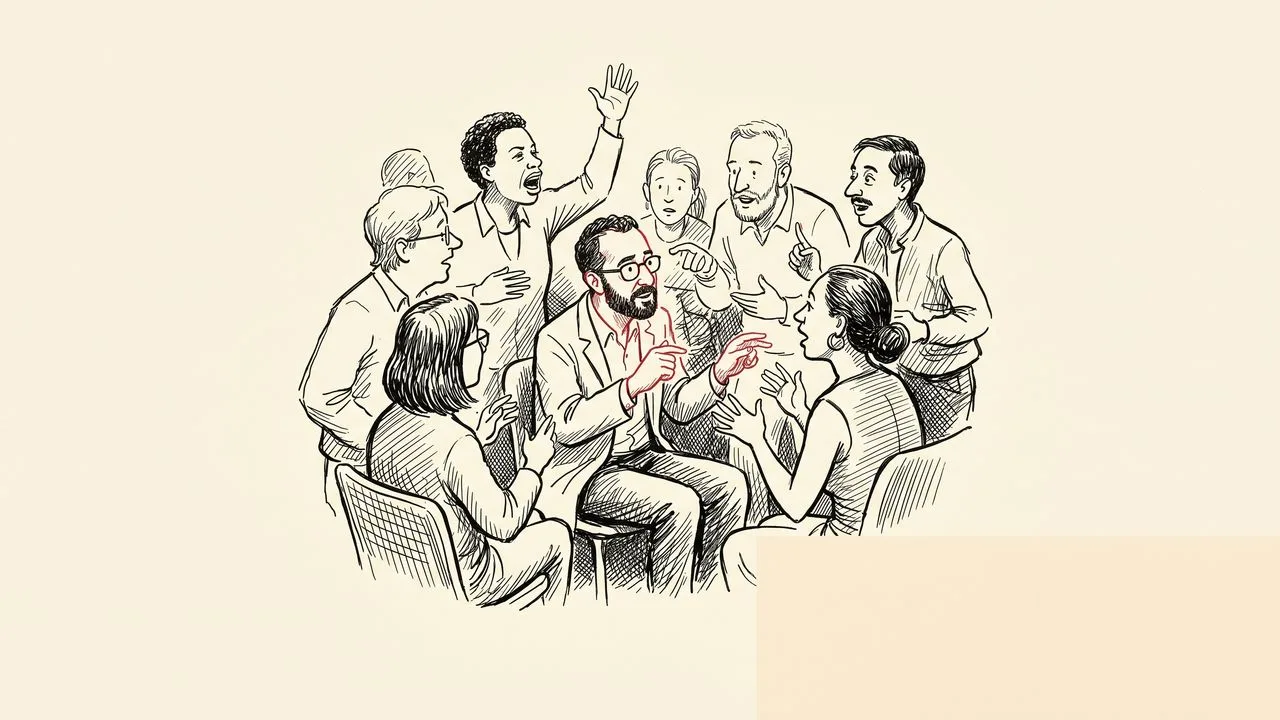
Photo: AI. Eira Pendragon
I was watching this Charisma on Command video at 11pm on a Tuesday—twins finally asleep, dishes not done, the usual victory lap of modern fatherhood—and about halfway through I had to pause it because I recognized something uncomfortable. Not in Dr. K. In myself. Specifically: in every school pickup circle I've ever ruined by showing up with the wrong energy.
The video breaks down Dr. K (psychiatrist Alok Kanojia, who trained at Harvard Medical School) arriving at the Tiger Belly podcast and doing something genuinely impressive. Bobby Lee's show is, by design, a fever dream. Someone's always singing. Someone's always two sentences from a meltdown. The vibe is chaotic in the way that only truly confident people can manufacture. And Dr. K—calm, thoughtful, the kind of guy who talks about meditation for a living—walks in and somehow ends up being the person everyone wants back.
Charisma on Command's breakdown identifies five moves that got him there, and most of them hold up.
Step one is the one nobody wants to do
Before Dr. K says anything meaningful, he does nothing. He watches. He reads the room—who's getting attention, what kind of energy is landing, what the unspoken rules are. The Charisma on Command narrator puts it plainly: if you fail to figure out what people are paying attention and responding to, you're most likely going to end up being ignored.
Which is exactly what happens to Dr. K in the first few minutes. He tries to suggest the group meditate. The room evaporates around him. Nobody is cruel about it—they're just already three steps ahead in a conversation that doesn't include him yet.
I know this feeling at a molecular level. I showed up to my kids' class parent mixer two years ago and made the mistake of leading with something I actually cared about—I was mid-read on a book about the history of urban planning and thought maybe someone else might be into it. Reader, no one was into it. I stood next to the charcuterie board alone for a period of time I will not specify.
The observation step sounds passive. It's not. It's intelligence-gathering.
The trap nobody warns you about
Once Dr. K has watched long enough to understand the room, he joins it. When Bobby Lee suggests he can "come down to Dr. K's level," Dr. K fires back: "Why do you assume mine is lower?" The room wakes up. He's in.
But here's where the video gets genuinely interesting, because it doesn't stop there. It names the trap: you join the chaos, you get accepted, and then you just... keep performing the thing that got you accepted. You become the Jokey Guy. You talk about sports for the next fifty minutes even though you've never watched a game voluntarily in your adult life.
I did this at daycare drop-off for an entire year. The dad energy at our school ran toward youth soccer leagues and weekend game schedules, and I—a man who once described himself as "not really a sports guy" on a first date—learned to talk about travel soccer with genuine-sounding enthusiasm. I got accepted. I made friends. I also spent fourteen months pretending to have opinions about whether seven-year-olds should specialize early. It cost me something I can't fully name.
The Charisma on Command narrator describes this as a people-pleasing trap, which is accurate. What he doesn't say—probably because this is a social skills video, not a therapy session—is that the trap works. That's why it's a trap. You get real social warmth in exchange for a performance, and at some point the warmth starts to feel like payment for a role you didn't audition for.
Making the unspoken spoken
The third move is the one that surprised me most: Dr. K makes the social agreement explicit.
Every room has invisible rules—are we teasing each other or supporting each other, are we serious or silly, what gets rewarded with attention and what gets ignored? These rules usually go unspoken, which is fine until two people are operating under different ones. The video uses a guest (whose name is only audible as something like "George" in the Charisma on Command footage—we're not running the name until it's confirmed) who showed up to Tiger Belly with a serious register, got roasted by Bobby Lee, and eventually stormed off. Bobby, notably, was shocked. He didn't want that outcome. The social agreement just wasn't clear.
Dr. K sidesteps this entirely by naming it: "I'm just trying to figure out what kind of energy I should be bringing today." That's it. That's the move. He makes the invisible visible, which lets the room self-organize around him instead of him trying to guess.
I've started doing a version of this with my kids, honestly. Not because I'm a great communicator but because I got tired of misreading the room at home. "Are we in a talking mood or a quiet mood right now?" works surprisingly well on seven-year-olds. Also on tired spouses. Also, apparently, on chaotic podcast sets.
Change how, not what
This is the piece of the framework I keep thinking about.
Dr. K doesn't abandon his actual interests to fit in. He doesn't pretend to care about things he doesn't care about. What he does instead is translate. When he wants to talk about meditation with Bobby Lee and company—a topic that in its standard form would land like a wet blanket on a show that runs on high-energy chaos—he doesn't lead with breathwork. He leads with: "If you guys want to know the ecstasy of meditation, all you have to do is imagine you really need to go pee and then you finally get into the bathroom."
Same content. Different packaging. The room leans in.
The contrast the video shows is stark: put Dr. K next to Dr. Mike, a physician with a more clinical register, and he's explaining the epistemological problems with Ayurvedic medicine in full academic mode. Same person, completely different frequency. Neither version is fake. Both are real. The difference is calibration.
The Charisma on Command narrator frames this as an exercise: imagine explaining something you care about to kids, to teenagers, to adults. He's into mythology, so with adults he'd discuss the Minotaur through a Jungian lens; with teenagers he'd just tell the myth; with kids he'd chase them around pretending to be the Minotaur. That last option is also, I'd argue, the most fun for everyone involved.
For what it's worth: I write about parenting policy and family dynamics. At dinner parties, I've learned to translate "the American childcare system is a structural failure that treats caregiving as a private problem rather than a public good" into "so does anyone else feel like they're just making it up day by day and wondering why it's so hard?" Gets the same conversation going. Much less likely to clear the room.
Taking people somewhere they didn't expect to go
The final move is the one that requires the most trust, from both sides. Once Dr. K has the room's attention and has established the shared rules, he starts quietly expanding what gets rewarded. Instead of laughing at every joke, he starts giving his deepest attention to Bobby's moments of vulnerability. He asks about Bobby's depression. He listens so carefully that he can reflect it back better than Bobby said it himself: "This is a guy who's had overcast skies his whole life."
Bobby opens up. The room follows. But then—and this is the detail the video rightly highlights—Dr. K offers an off-ramp. "I mean, look, we could joke if you guys want." He's not pulling anyone somewhere they don't want to go. He's showing them the door and letting them decide.
By the end, Bobby Lee—a man whose entire professional identity is built around not taking things seriously—says: "I realized that was my relationship with every comedian. It's all play. It's all like, let's not think about what's really going on."
That's a real shift. Whether it lasts beyond the recording is a different question. But something moved.
The video closes with a pitch for Charisma University, a 30-day program the channel sells. I'll leave that part to you. What I will say is that the framework itself—observe, join temporarily, name the agreement, translate your authentic interests, then lead somewhere new—is doing something more interesting than most social skills content, which usually boils down to "make eye contact and ask questions." This is more structural. It's about how rooms actually work, not just how to seem likable.
The thing I'll carry from this six months from now isn't the five steps. It's the image of Dr. K walking into a room that wasn't made for him, not pretending to be someone else, and by the end being the person everyone wanted to come back. Not because he performed. Because he translated.
There's a version of that available to most of us. It just requires knowing what you actually want to talk about in the first place—which, if you've spent a year discussing travel soccer without meaning any of it, turns out to be harder than it sounds.
More Like This

When Feeling Stuck Is Actually Feeling Safe
The Art of Improvement argues comfort—not laziness—is what keeps people stuck. The idea is compelling. It's also worth examining carefully.
What Seven Years Building a Startup Actually Teaches You
Undo CEO Greg Law shares the uncomfortable truths about going from programmer to founder—ego, misdiagnosis, and why sales is harder than code.

Heavy Spoilers Builds an Office, Ditches the Algorithm
YouTube creator Paul from Heavy Spoilers explains why he built a garden office, changed his logo, and chose depth over views in content strategy.
Dementia's Lessons: Living with Less Regret
Explore insights from dementia patients on living a life with less regret through self-improvement.

Living in the Now: Eckhart Tolle's Wisdom for Parents
Discover Eckhart Tolle's insights on mindfulness and presence, and how they relate to parenting.
Are We Obedient or Just Trained? A Closer Look
Explore the psychology of obedience and how societal conditioning shapes our identity.

How to Make a College Tour Actually Matter
College tour season is here. Here's how families can shift from passive observers to active explorers—and why who leads the visit changes everything.
Public Trust in Science Is Fragile and Complicated
Trust in science is eroding—but the data is more complicated than the panic suggests. Here's what's actually happening, and why it matters.