How Friction and Awareness Can Reduce Doomscrolling
A recent video from The Art of Improvement outlines a practical, low-pressure system for breaking the doomscrolling habit—no willpower required.

Written by AI. Ellis Redmond
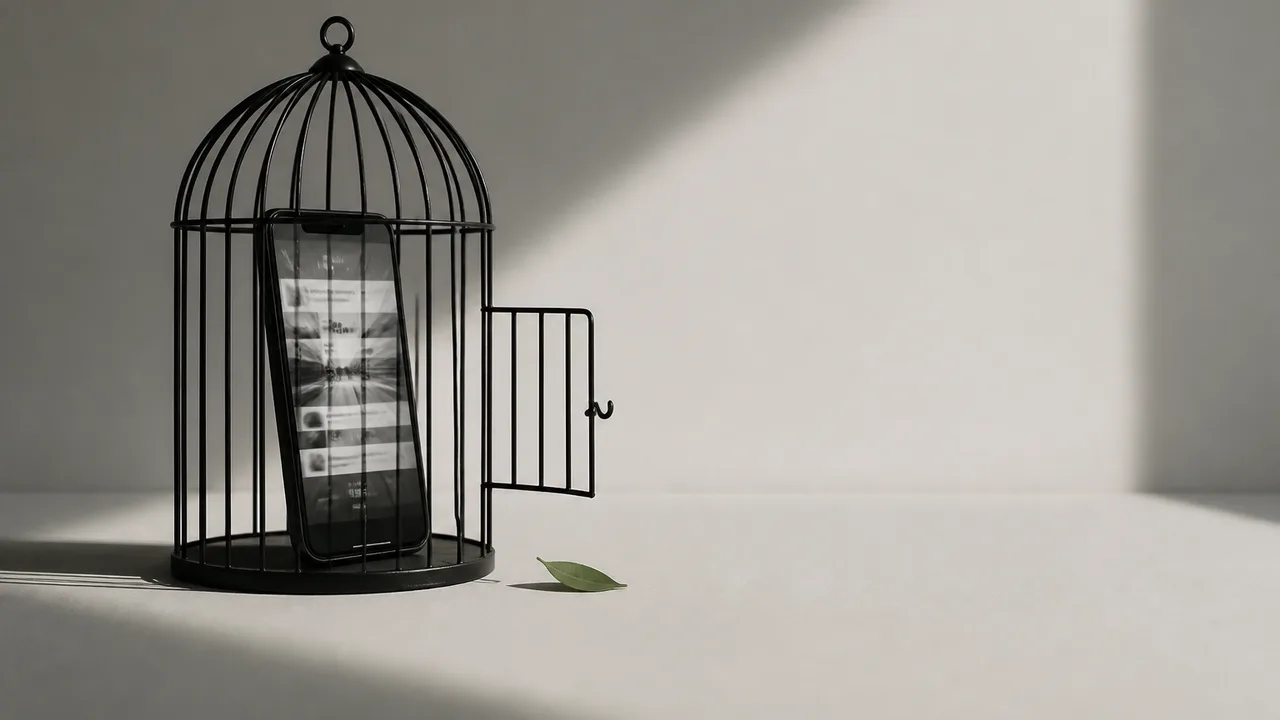
Photo: AI. Tomoko Hayashi
Here's a scenario that probably doesn't require much imagination: you pick up your phone to check the time. Forty minutes later you're watching a video of a dog doing something mildly impressive, and you have no memory of the journey that got you there.
This is the part that makes doomscrolling genuinely weird as a habit. It doesn't feel like a decision. The video from The Art of Improvement puts it plainly: "Most of the time your hand moves first and your mind catches up later." Which is a fairly concise description of what behavioral scientists would call an automatized behavior—a habit so grooved that conscious intention barely gets a seat at the table.
The standard response to this, as the video correctly identifies, is to prescribe more willpower. Lock your apps. Set limits. Be better. The problem is that willpower is a finite resource that operates on a slower timescale than a conditioned reflex. You are not going to out-discipline a slot machine. The design of social feeds—variable reward schedules, infinite scroll, algorithmic precision—has spent billions of dollars optimizing for exactly this moment. Matching that with "I'll try harder" is not a fair fight.
So what actually works? The approach outlined by The Art of Improvement sidesteps the willpower question almost entirely. Instead of asking people to resist the pull, it asks them to change the physics of the situation.
The Friction Argument
The core insight here is architectural rather than motivational. Most phone habits survive not because they're deeply satisfying, but because there's almost no resistance between impulse and action. The phone is already in your hand. The app opens where you left it. The feed starts moving before you've formed a conscious intention. Eliminate that frictionlessness and a lot of mindless scrolling simply doesn't happen.
The recommended intervention is deliberately, almost comically, modest: put your phone in another room for one hour. Not a digital detox. Not a screen-free weekend. Just a room away, during your worst scrolling window—whatever that is for you.
"If your phone is beside you, the habit can begin before you notice. If it is in another room, you have to stand up, walk over, pick it up, and admit what you're doing."
That admission is the mechanism. It converts an unconscious behavior into a conscious choice. This aligns reasonably well with what habit researchers like Wendy Wood at USC have documented: environment design is often more effective than intention at changing behavior, because it operates at the level where habits actually live—automatic, environmental, cued.
The second friction move is to change the first app your thumb opens when you unlock your phone. Whatever that app is—Instagram, TikTok, Reddit, whatever your particular flavor—it's functioning as the front door to a longer scroll. Move it. Bury it in a folder. Log out. Replace that prime home screen real estate with something that doesn't have an algorithmic feed engineered to keep you scrolling. A reading app. A notes app. A podcast.
This is worth pausing on, because it's easy to dismiss as too simple. But there's a meaningful behavioral distinction between an app that rewards you for putting it down (a book, a podcast episode with an end) and one that rewards you for never putting it down. Swapping your front door changes what the autopilot walks into.
The Awareness Piece
Friction handles the before and the during. But what about the moment you catch yourself already scrolling? The video proposes what it calls the "stop scroll journal"—two questions, written down when you notice the habit is already running:
Why am I scrolling right now? What would I rather do for the next 10 minutes?
The framing here is interesting, and worth examining carefully. The video argues that the content itself is almost incidental—"The content is only the doorway. What you are often looking for is escape." Escape from boredom. From a difficult task. From an uncomfortable feeling. From silence.
This is the bit that I find genuinely useful, and also the bit that the self-help industrial complex often handles badly. If scrolling is a coping mechanism—and for a lot of people, that's exactly what it is—then the solution isn't just to remove the coping mechanism. You have to understand what it's coping with. The journal questions do something clever: they don't shame you for picking up the phone. They ask you to get curious about why.
Name the reason, the argument goes, and you have more choice. Tired? Rest properly, not by trading one feed for another. Avoiding work? Do the smallest possible piece of it. Bored? Choose something that leaves you feeling better afterward. The prescriptions are sensible, if not revolutionary.
The Guilt Trap
One of the more psychologically astute moves in the video is the explicit warning against guilt. If you catch yourself scrolling and spiral into "I've wasted the day," that bad feeling becomes fuel for more scrolling. The loop feeds itself.
The proposed antidote is a question: Can I do 1% better right now?
This is a pressure-reduction technique dressed up in the language of incremental improvement. The value isn't really in the 1% framing—it's in detaching the next action from the story you're telling about your failure so far. You don't need to recover the whole day. You just need to close the app. That's it. That's a win.
Whether this framing resonates probably depends on the individual. Some people find quantified improvement questions clarifying; others find them faintly absurd. But the underlying principle—interrupting the guilt-scroll loop with a small, achievable action—has some grounding in the behavioral science of self-compassion. Kristin Neff's research on self-compassion, for instance, consistently finds that people who treat themselves kindly after failure are more likely to try again than people who beat themselves up. Counterintuitive to the productivity-culture instinct, but well-documented.
The Accountability Layer
The final piece is social: find one person, share your daily screen time total with them for seven days, agree on one shared rule. No phone in the bedroom. No scrolling before breakfast. Whatever fits.
The mechanism is simple—"Someone else knows what you said you would do. That makes it harder to quietly abandon."—and it's backed by a reasonably solid body of research on implementation intentions and accountability. Private goals are easy to renegotiate at 11pm. Public commitments, even tiny ones, carry more weight.
What the video doesn't address—and this is worth noting—is that accountability structures have uneven effects depending on personality and relationship dynamics. For some people, sharing a screen time number with a friend is motivating. For others, it's either anxiety-inducing or so low-stakes as to be meaningless. The research on social accountability tends to show it helps most when the relationship involves genuine mutual investment and when the goal is specific enough to measure.
What This Approach Is and Isn't
Taken as a whole, the system The Art of Improvement describes is honest about what it is: a set of environmental and behavioral nudges, not a cure. It doesn't claim to address why the feeds are built the way they are, or why so many people are reaching for escape from boredom or discomfort in the first place. It doesn't engage with the structural conditions—job stress, economic anxiety, loneliness—that make mindless scrolling an attractive option.
That's not a flaw in the video so much as a scoping decision. And it's probably the right scope for practical advice. You can't redesign the attention economy in one focused work block.
What you can do is put the phone in another room and see what happens to the itch. That's actually interesting data about yourself, regardless of whether the habit changes. Notice what the discomfort is pointing at. That question tends to be more useful than whatever the feed was offering.
More Like This

How to Stop Losing Time Without Realizing It
Not a time management overhaul—just a clearer look at where your hours actually go, and what's worth doing about it.

When Feeling Stuck Is Actually Feeling Safe
The Art of Improvement argues comfort—not laziness—is what keeps people stuck. The idea is compelling. It's also worth examining carefully.
How to Sound Like Yourself on Camera
Nick Nimmin's advice on natural on-camera presence cuts against the creator economy's obsession with performance. Here's what it actually gets right.
The Power of Starting Conversations with 'What'
Discover how asking 'what' instead of 'why' can transform communication and influence.

Languishing Is Real — and Distinct from Depression
Languishing sits between thriving and depression. Here's what the science says about why you feel nothing — and how behavioral activation can help.
How Streaming Platforms Use Psychology to Hold Your Attention
Streaming platforms are built on behavioral science. Here's what media psychology actually says about autoplay, thumbnails, and what prolonged watching does to your body.

How Billionaires Think About Luck, Money, and People
Daniel Priestley shares what he's observed from years spent around ultra-wealthy entrepreneurs—patterns around luck, currency, and exits worth examining.

The Hard Ceiling on Human Lifespan, Explained
Can science push humans past 115? From longevity clinics to cellular reprogramming, here's what the evidence actually says—and what it doesn't.