Peanut Allergies Are Declining. Here's What Changed.
Peanut allergy diagnoses in kids have dropped over 40% since 2017. Here's how a decade-old guideline reversal finally shows up in the data.

Written by AI. Marcus Obi
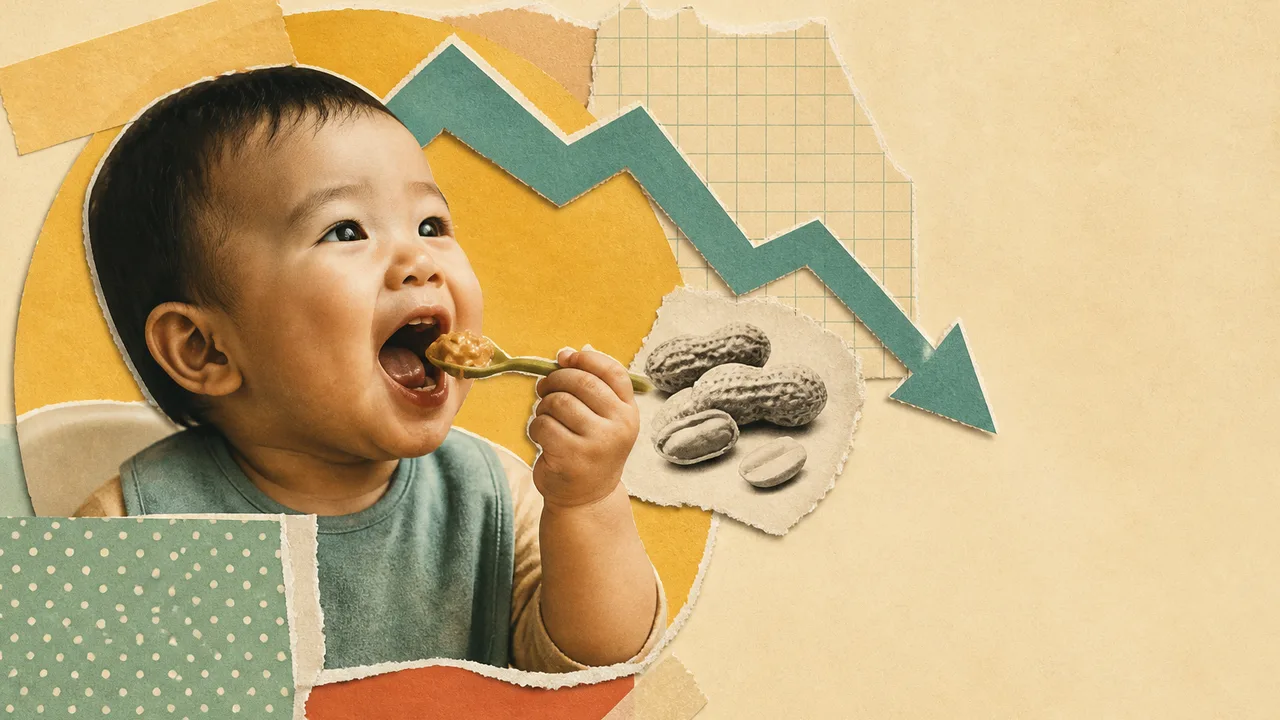
There was a period — not that long ago — when bringing a peanut butter sandwich to a playdate felt roughly equivalent to showing up with a flamethrower. You knew the rules. You'd internalized them. Peanuts were the enemy, and keeping them away from small children was just what responsible parents did.
That period turned out to be built, at least in part, on a guideline that was wrong.
A study published in Pediatrics — the journal of the American Academy of Pediatrics — found that peanut allergy diagnoses among children have dropped more than 40% since 2017, according to The Guardian. That is not a rounding error. That is a public health shift. And to understand it, you have to go back to how we got the old advice in the first place — and why it stuck around long after the evidence had moved on.
The Rise: How Avoidance Became Doctrine
For roughly two decades, the standard pediatric wisdom was avoidance. Keep peanuts away from infants and toddlers. Wait until they're older. Better safe than sorry. The logic felt intuitive: if peanuts cause allergic reactions, don't expose young immune systems to them.
The problem is that peanut allergies didn't hold steady under this regime. They exploded. NPR reports that the New England Journal of Medicine referenced a quadrupling of peanut allergies in the years leading up to 2015, a period that coincided almost exactly with peak avoidance-based guidance. Growing anxiety about food allergies reshaped ordinary American life: schools banned peanut butter sandwiches, summer camps went nut-free, airlines quietly retired the snack bags that had been a fixture of coach class since forever.
The policy was making the problem worse. Or at minimum, it was doing nothing to stop it.
The reversal came from a landmark 2015 clinical trial — the LEAP study — which found that early, regular peanut exposure in high-risk infants dramatically reduced the likelihood of developing an allergy. The research was striking enough that in 2017, the National Institute of Allergy and Infectious Diseases issued new guidelines recommending early introduction, not avoidance.
Henry Ford Health notes that we're now a decade past those guidelines, and the data is finally showing up in the numbers.
The Numbers
The Pediatrics study, covered in detail by The New York Times, found that food allergy rates in children under three dropped from 1.46% in the 2012–2015 period to 0.93% between 2017 and 2020. That's a meaningful reduction in absolute terms — and a significant proof-of-concept for what happens when you actually follow the evidence.
Economist and parenting researcher Emily Oster has been tracking this shift at ParentData, noting that the trend appears to represent a real population-level effect from the guideline change, not just statistical noise. USA Today puts the headline plainly: peanut allergies are on the decline, in part because of some game-changing advice.
"In part" is doing real work in that sentence. The early introduction guidelines appear to be the primary driver, but researchers are careful not to claim this as a closed case. The data covers children under three — it doesn't yet tell us what the long-term picture looks like across age groups, or whether the gains hold.
Why It Took So Long
Here's what's genuinely interesting about this story, and what doesn't get enough attention: the 2017 guidelines were issued nearly a decade ago. The LEAP trial data was published in 2015. The evidence has been available. So why did the culture of peanut avoidance persist so long — in school policies, in parenting norms, in the ambient anxiety at snack time — even after the science shifted?
Part of the answer is just how parenting norms work. Once a safety behavior gets wired into the culture, it doesn't disappear because a journal published contradictory findings. It gets passed on. Parents told other parents. Teachers kept the old rules. Lunch tables stayed nut-free because no one wanted to be the person who changed the policy and then had to explain themselves if something went wrong.
That's not irrationality — it's asymmetric risk logic. The cost of keeping peanuts out (minor inconvenience) felt much lower than the perceived cost of introducing them and being wrong. What the evidence did, slowly, was shift what "being wrong" actually meant. Turns out the avoidance strategy carried its own risks; we just weren't accounting for them.
Advanced Allergy and Asthma notes that the allergy spike had already become something "of the past in most communities" before these new numbers confirmed the decline — suggesting the norm was already shifting at the ground level even before the data caught up.
What This Means for Parents Now
If you have an infant or are expecting, the current guidance is clear: early introduction of peanut-containing foods — typically around four to six months, once solids are appropriate, and barring high-risk indicators your pediatrician will flag — is recommended, not something to be nervous about. The Henry Ford Health guidance echoes this directly.
For parents of older kids who grew up under the avoidance era, the situation is more complicated. The new data applies to children who were introduced to peanuts early; it doesn't reverse existing allergies or change management protocols for kids already diagnosed. If your child has a confirmed allergy, none of this changes their treatment plan.
The broader takeaway — and this is where the story gets interesting from a systems perspective — is that pediatric guidelines can and do change, and the lag between evidence and practice is real. The LEAP study findings were unambiguous by 2015. It took another decade for them to register as a measurable decline in allergy rates. That's ten years of families navigating unnecessary anxiety, ten years of kids eating around restrictions that were actively counterproductive.
The Absurdity We Normalized
There's a version of this story that's just a clean public health win: guidelines changed, doctors communicated the shift, parents adapted, allergies declined. Good news, full stop.
But I keep coming back to what the avoidance era actually looked like on the ground. The notes home from preschool. The birthday cake ingredient interrogations. The elaborate snack negotiations at parks where one parent's PB&J caused visible tension — that specific silent judgment that only happens around food and children. We built an entire micro-infrastructure of vigilance around a risk we were, in many cases, making worse by trying to eliminate it. The anxiety was real. The precautions were earnest. And the advice they were based on was backwards.
That's not a criticism of the parents who followed it. You do what the evidence says. The problem is that the evidence wasn't reaching people fast enough, and when it did, the cultural norm had calcified.
The genuinely hopeful read on all of this is that the next generation of parents — the ones introducing puréed meals in 2025 and 2026 — are starting in a world where early peanut introduction is just... normal.
More Like This

Ten Scientific Failures That Reshaped Modern Research
From thalidomide to cold fusion, ten scientific failures that caused real harm—and forced the protocols that protect us today.

Eckhart Tolle Says You're Not Who You Think You Are
Eckhart Tolle's 'historical self' vs 'deep eye' framework is either profound or a very elegant dodge. A parenting writer tries to figure out which.

Handwriting Beats Typing for Learning, Studies Find
New research shows handwritten notes improve memory and recall more than typing. Here's what the science says — and what it actually means for kids and parents.

UK Doctors Say Social Media Harms Kids. Now What?
UK's top doctors say social media harms kids like smoking harmed adults. Here's what that actually means for schools, clinics, and parents right now.
Dr. K Walked Into Chaos and Won the Room
Dr. K's Tiger Belly appearance is a masterclass in social dynamics. Here's what the Charisma on Command breakdown gets right—and what it glosses over.

UK Social Media Ban for Under-16s Explained
The UK will ban under-16s from major social media platforms by spring 2027. Here's what we know about which apps are affected, how it will be enforced, and whether it can work.

How to Make a College Tour Actually Matter
College tour season is here. Here's how families can shift from passive observers to active explorers—and why who leads the visit changes everything.
Public Trust in Science Is Fragile and Complicated
Trust in science is eroding—but the data is more complicated than the panic suggests. Here's what's actually happening, and why it matters.