How to Make a College Tour Actually Matter
College tour season is here. Here's how families can shift from passive observers to active explorers—and why who leads the visit changes everything.

Written by AI. Marcus Obi
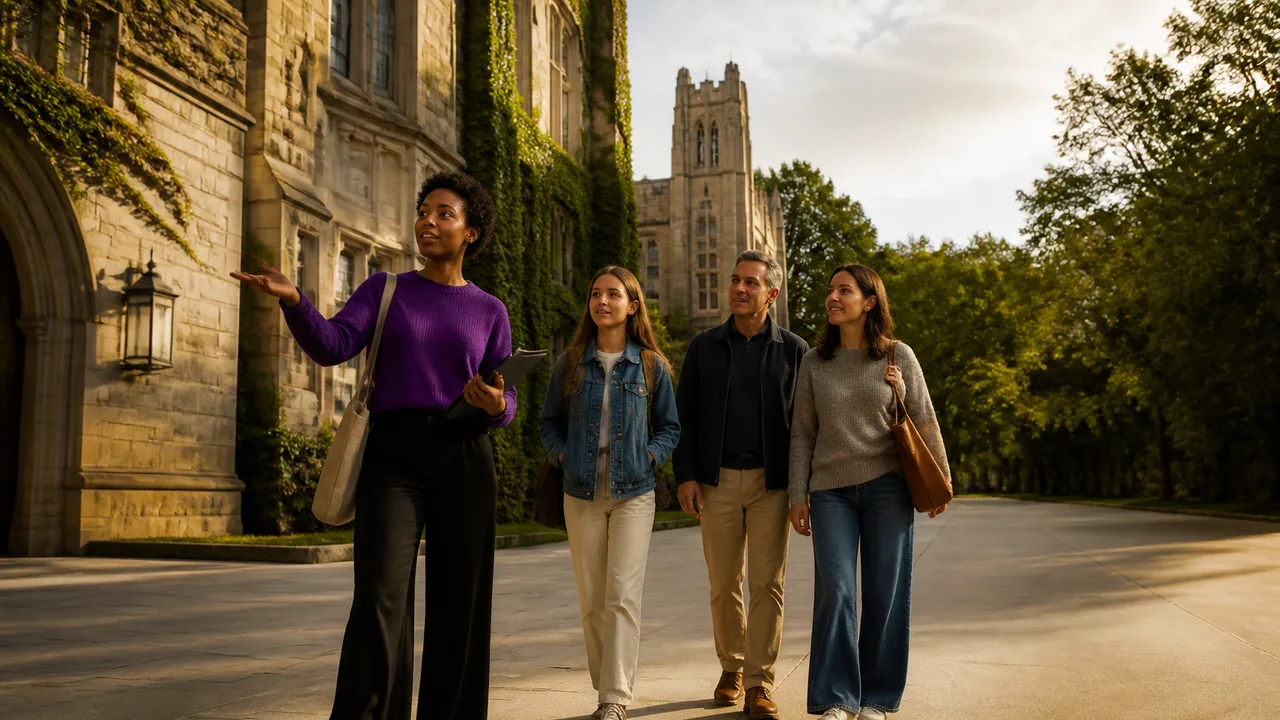
There's a particular kind of family I've noticed at every zoo, museum, and school open house I've ever attended: the parents who are clearly having more fun than the kid. Lots of eager pointing. Lots of "Oh, look at this!" The child, meanwhile, has checked out somewhere around the third exhibit.
I think about that dynamic a lot when I read about college tours.
Tour season is in full swing, and with it comes the annual wave of well-meaning guidance about how to squeeze maximum value from campus visits. Most of it is genuinely useful. But underneath the logistics—where to walk, what to ask, how long to stay—there's a quieter, more important question that doesn't get enough airtime: whose visit is this, exactly?
The answer sounds obvious. It's the student's. But the way families actually behave on tours often tells a different story.
The 90-Minute Window
Start with the basics, because the basics matter more than people think. According to High Point University's admissions guide, most college tours run between 60 and 90 minutes—though personalized tours can run longer. That's not a lot of time. It's roughly the length of a Marvel movie, minus the post-credits scene.
Sixty to ninety minutes to get a feel for a place where your kid might spend four years and incur the better part of a hundred thousand dollars in tuition. The pressure families feel to optimize that window is completely understandable. It's also where things can quietly go sideways.
When the clock is ticking and the stakes feel enormous, the instinct is to maximize information intake. Ask all the questions. Cover all the ground. Don't waste a step. That instinct is human and it makes sense—but it can accidentally convert a prospective student from the protagonist of the visit into a passenger. And passengers don't develop opinions; they absorb whatever the driver decides is important.
What "Student-Led" Actually Means in Practice
The advice to "let your student lead" gets repeated so often it risks becoming wallpaper. So it's worth being specific about what it actually looks like.
TheCollegeTour.com's campus tour guide makes a useful distinction: the formal tour is not the whole visit. It recommends striking up conversations with tour guides, wandering into campus cafes and student lounges, and—if timing allows—attending campus events or club meetings. The goal is to make contact with the actual texture of student life, not just the curated version of it.
That distinction between the curated tour and the lived campus is where a lot of families leave value on the table. The official route is designed by admissions offices. It hits the highlights. It is, almost by definition, the best-case version of the institution. What you find when you wander off that route—who's hanging out in the quad, whether the library feels like a place you'd actually want to study, whether the dining hall smells like hope or disappointment—that's harder to fake.
CollegeAdvisor's campus tour checklist frames this as a question of relevance: think about the spaces you'll actually inhabit. Is it the library? The English department? The 3D printing lab? The recommendation is to prioritize exploring spaces tied to your potential major and interests—because those are the rooms you'll be in for four years, not the ones on the tour route.
This is genuinely good advice. It's also a form of triage that requires the student to have thought, at least a little, about what they're looking for. Which circles back to the parent's actual job on these visits.
The Parent's Real Role
Here's where it gets interesting, and a little uncomfortable for parents who are used to managing things (all of us, in other words).
Psychology Today's piece on college tours engages directly with the psychological dimension of this transition. The college tour isn't just a fact-finding mission—it's one of the first major opportunities for a teenager to practice making a consequential decision with real stakes. How parents show up in that moment sends a signal about whether they trust their kid to navigate it.
That doesn't mean parents become mute. It means the questions you ask are aimed at drawing the student out rather than filling the silence yourself. "What did you think of that?" lands differently than "I thought the facilities looked great, didn't you?" One opens a door. The other is a door that's already been decided.
Salem State's Viking Family Hub makes a practical point worth underlining: give yourself time to explore the campus beyond the information session and formal tour. Campuses tend to be livelier in the afternoons. If you're doing a morning visit and racing out by noon, you're potentially missing what the place actually feels like when it's fully inhabited. That unstructured time after the official program is often where students form the gut-level impressions that end up mattering most.
The Personalization Problem
There's a structural tension worth naming here. Most campus tours are built for efficiency—same route, same stops, same talking points, repeated dozens of times a week. That works fine as an introduction. It doesn't work particularly well as a decision-making tool for students with specific interests, nontraditional backgrounds, or anything other than a generic college experience in mind.
Paskill, a higher-ed marketing agency, argues this from the institutional side: schools should reconsider one-size-fits-all tour routes and instead try to tailor experiences around students' academic programs and extracurricular interests—helping prospective students actually visualize themselves in relevant spaces. Whether individual schools are doing this well is genuinely uneven. Some are. Many are still running the same loop they ran fifteen years ago.
The implication for families is that you often have to engineer your own personalization. That means doing homework before you arrive—knowing which departments or programs the student wants to see, whether there are clubs or teams worth asking about, whether there are student-run events happening during the visit window. CollegeAdvisor's broader college visit guide notes that firsthand campus experience is one of the most effective tools for consolidating a college list—comparing which schools actually resonate versus which ones look better on paper. But that comparison only works if the visits are yielding genuine data points rather than identical highlight reels.
What a Good Visit Actually Produces
None of this is to say the formal tour is worthless—it's not. It provides orientation, context, and baseline information families need. The campus map finally makes sense. You find out where the health center is. You meet one real student who either confirms or complicates your assumptions about the place.
But the families who seem to get the most out of these visits treat the organized portion as a starting point, not a deliverable. They arrive with questions the student generated. They leave with unstructured time built in. They resist the urge to narrate or evaluate in real time and instead give the student space to form their own impressions—even messy, half-formed ones—which can be processed later.
There's something developmentally significant happening on these trips that's easy to miss if you're focused on yield. A teenager who leads their own college tour is practicing a skill—advocating for information, navigating an unfamiliar environment, sitting with uncertainty about a major decision—that they're going to need more of, not less, once they actually get to campus.
The tour is a rehearsal. The question is whether the student gets to play the lead, or whether they spend the morning watching someone else perform the role for them.
More Like This
Eckhart Tolle Says You're Not Who You Think You Are
Eckhart Tolle's 'historical self' vs 'deep eye' framework is either profound or a very elegant dodge. A parenting writer tries to figure out which.

Small Group Italy Tours Are Reshaping Travel
Small group Italy tours promise authenticity over crowds. But do they deliver — and at what cost to the communities they claim to honor?

Handwriting Beats Typing for Learning, Studies Find
New research shows handwritten notes improve memory and recall more than typing. Here's what the science says — and what it actually means for kids and parents.
Dr. K Walked Into Chaos and Won the Room
Dr. K's Tiger Belly appearance is a masterclass in social dynamics. Here's what the Charisma on Command breakdown gets right—and what it glosses over.
Discipline Is About Removing Options, Not Building Willpower
Mark Manson argues discipline has nothing to do with willpower—it's about eliminating choices. Here's what the research says, and what the theory leaves out.

Learning Local Culture Without Setting Foot in a Museum
From grocery stores to barbershops, Mark Wolters argues everyday spaces teach travelers more about a culture than any museum ever could. He makes a strong case.
Public Trust in Science Is Fragile and Complicated
Trust in science is eroding—but the data is more complicated than the panic suggests. Here's what's actually happening, and why it matters.

Animal Empathy: What Science and Instinct Both Get Right
Do some people genuinely connect with animals in extraordinary ways? Marcus Obi explores the science of animal empathy, what research actually supports, and what it means for the rest of us.