Albert Einstein: From Scientific Genius to Global Brand
How Einstein became a million-dollar brand after death—and what the legal battles over his image reveal about fame, family, and intellectual property.

Written by AI. Harold "Harry" Goodman
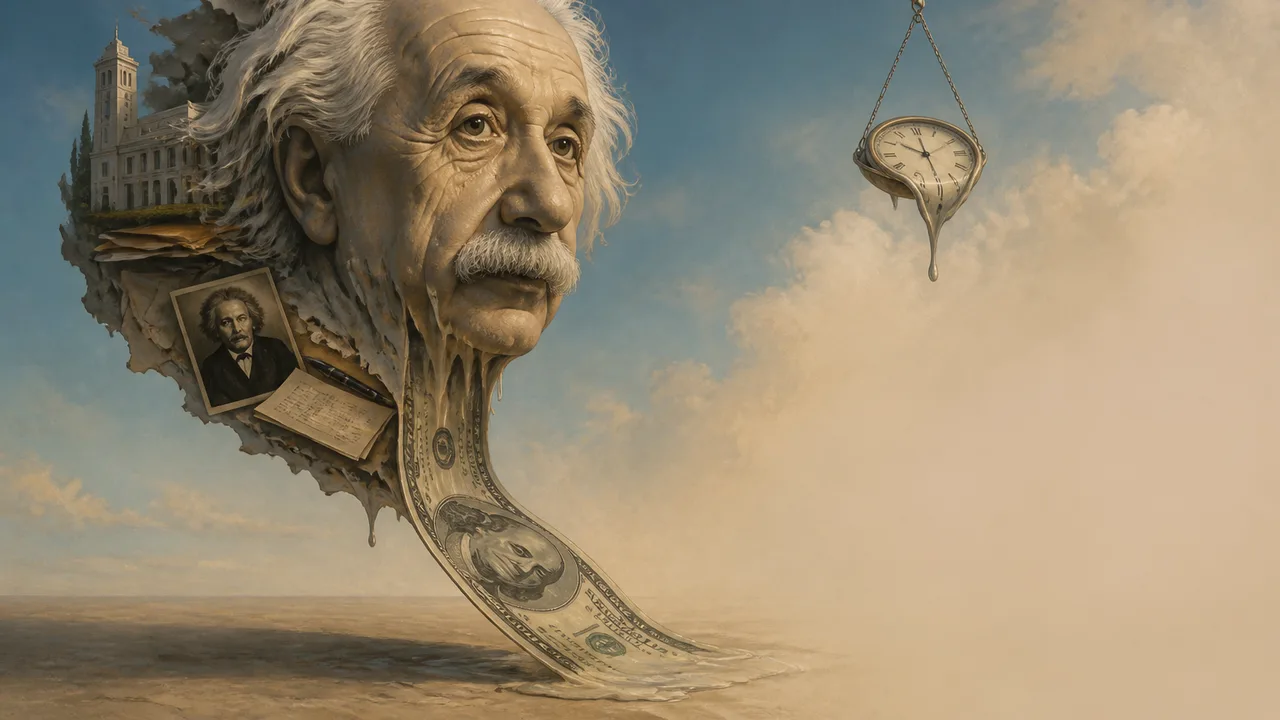
Photo: AI. Iolanthe Fenwick
The documentary Albert Einstein: How a Genius Became a Global Icon and Million-Dollar Brand, recently published by Doc of the Day, opens with a proposition that most people accept without quite examining it: that Einstein was not merely famous, but famous in a way that reorganized what scientific fame could mean. The narration arrives confident and measured — the voice of a museum audio guide who has walked these galleries many times and trusts you to keep up. It is efficient, occasionally warm, and thoroughly in command of its own reverential register. Whether that voice earns the reverence it projects is the more interesting question.
The Making of a Celebrity Scientist
The biographical scaffolding here is reliable. Einstein is born in 1879 in Ulm, Germany. The family maid calls the late-talking child "the dopey one." At five, a compass his father shows him ignites a curiosity that will not be extinguished. By fifteen, he has taught himself calculus. He fails the entrance exam at the Zurich Polytechnic because his French and botany scores drag him down — not, the film is careful to note, because he lacks aptitude for the subjects that actually matter to him. The myth of the failed student is addressed and dismantled with evident satisfaction.
What the documentary handles more gracefully is the 1905 miracle year — four papers, one 26-year-old patent clerk, months of work that rewrote the terms on which physics operated. When a commentator explains why Max Planck's endorsement mattered, he leans into the word "outlier" in a way that carries genuine weight, his cadence slowing just enough to let the isolation of Einstein's position land before moving on. Science, the voice reminds us, is competitive. Recognition is not automatic. A brash outsider needs a sponsor.
The 1919 solar eclipse confirmation arrives as the documentary's first real dramatic payoff, and the narration knows it. The description of waiting months for photographic plates to travel from Africa to England to be measured and verified — that detail about the physical labor of early 20th century scientific confirmation — does more atmospheric work than anything the film attempts with archival imagery. By the time Einstein's boat docks in New York in 1921 to crowds that some observers compared to the Beatles' 1964 arrival four decades later, the film has built a coherent story about how scientific celebrity happens: slowly, then all at once.
The Estate and Its Discontents
Einstein died on April 18th, 1955, at 76. He had refused surgery for an abdominal aneurysm, reportedly saying: "I have done my share. It is time to go. I will do it elegantly." He was cremated the same day, his ashes scattered in the Delaware River, per his explicit wishes — no funeral, no grave, no marker. He had not wanted to become a monument.
The estate he left behind was modest: $20,000 to his secretary Helen Ducas, $10,000 to his son Hans Albert, $15,000 set aside for his institutionalized son Edward, $20,000 and the Princeton house to his stepdaughter Margot. His literary rights were placed in trust with Ducas and colleague Otto Nathan, to be transferred after their deaths to Hebrew University in Jerusalem. That transfer happened in 1982, when Ducas died. What no one in 1955 had any framework for anticipating was what those rights would eventually be worth.
This is where the documentary finds its real subject, and where the narration's museum-guide composure serves it less well. When a commentator explains Hebrew University's licensing arrangement with a firm called Greenlight — which fields, the film asserts, hundreds of applications per year for uses of Einstein's image — the delivery is businesslike, almost satisfied. There is a crispness to it that sits oddly against what the film is actually describing: a dead man's face becoming a revenue stream, Greenlight fielding requests for bobblehead rights with the same administrative equanimity as requests for educational materials.
The GM episode is worth a paragraph: in 2009, General Motors used a digitally altered Einstein image in an advertising campaign without licensing it from Hebrew University. The university sued. GM's defense was that Einstein had been dead long enough to enter the public domain. The documentary presents the court's resolution as a victory for that argument — characterizing the outcome as the judge ruling that enough was enough, that Einstein now belonged to the public at large — though viewers would be well advised to treat the film's account of the legal reasoning as the film's account, not as a settled summary of case law.
What the GM dispute distills is a question the film raises but does not fully pursue: at what point does protecting a legacy become exploiting one? Hebrew University says, with apparent pride, "We own Einstein, but we share him with the entire world." It is a formulation that manages to be simultaneously generous and self-congratulatory, and the documentary lets it stand without friction.
The friction arrives in the figure of Evelyn Einstein, and here the film's pacing shifts in a way that tells you the filmmakers knew they had found something. The narration slows; the cadence shifts from chronicle to something closer to reckoning. The documentary describes her — according to its account — as intelligent, a cancer survivor, a woman whose health was in serious decline by 2011 and who told the press she had been dismissed when she asked Hebrew University for help with healthcare costs. She had filed suit in 1996 when Einstein letters surfaced at auction and fetched nearly a million dollars, a settlement eventually reached but kept confidential. By 2011, she was watching merchandising revenue accumulate — the Baby Einstein franchise alone, started in 1996 by a Georgia couple for an $18,000 investment, was valued at $400 million by 2001 after Disney purchased it — while telling reporters she could not afford a safer assisted living facility.
Evelyn died on April 13th, 2011, at 70 years of age.
The documentary does not editorialize much about this. It does not need to. The juxtaposition is doing its own work: Hebrew University's licensing partner receiving hundreds of applications per year to monetize a face, while the man's own granddaughter could not get a phone call returned. One commentator observes that Einstein "probably didn't realize that he was leaving his family a little strapped compared to how he left the other beneficiaries." The understatement is doing heavy lifting.
The film closes with the cultural footprint: Einstein on the Beach, the Philip Glass opera; the ballet E=MC²; 46 slivers of his brain placed on public display in Philadelphia in 2011; the "God Letter," in which he confirmed his atheism to a philosopher friend, selling at auction for over $3 million in 2012. The documentary asserts that his brain, according to one of its commentators, is still in scientific custody somewhere — a claim worth holding lightly as the film's representation rather than as verified fact.
The documentary has the shape of a celebration, and Einstein's achievement is large enough to support the weight. Four papers in a handful of months, general relativity confirmed by a solar eclipse, a Nobel Prize, a moral seriousness about nuclear weapons that cost him his peace of mind in his final decade — there is real grandeur here, and the film locates most of it.
But the more durable image it leaves is not the tongue-out photograph from 1951, now the most reproduced image in the story. It is Evelyn Einstein, dying at 70, watching royalty checks flow toward an institution while she asked for help that did not come. There is gold in E=MC², as one commentator puts it. The question the documentary leaves open, without quite naming it as such, is who gets to decide what the gold is for.
More Like This

Bodmin Moor's Bronze Age Village and Its Neolithic Cairn
Archaeologists confirm a Bronze Age village on Bodmin Moor—and find a 6,000-year-old cairn that may have outlasted the community that built it.
Roman Empire History With Anthony Kaldellis
Anthony Kaldellis joins Lex Fridman to argue the Byzantine Empire never existed—it was Rome all along. A historian makes the case across 2,200 years.
WW1 Trench Life: What the Western Front Was Really Like
From Pals' Battalions to the Vickers gun, a new documentary unpacks the grim machinery of survival on the WW1 Western Front in unflinching detail.

Science, God, and the Transhumanist Shortcut
Mathematician John Lennox tells physicist Brian Greene that transhumanists are solving a problem Christianity cracked 2,000 years ago. My generation might actually find out who's right.
Rommel's Gold: Nazi Plunder or Enduring Myth?
The story of Rommel's lost gold is part treasure hunt, part Holocaust history. What do we actually know—and what are we choosing to romanticize?
Waco Siege: Ancient Echoes in Modern Tragedy
Explore the 1993 Waco siege through the lens of ancient cult dynamics and modern law enforcement challenges.
Bonhoeffer's Philosophy of Stupidity, Explained
Philosopher Jonny Thomson explains Bonhoeffer's three elements of stupidity—outsourced thinking, willful ignorance, and conformity—and why they threaten democracy.
Reverse Engineering Is Getting Cheap Fast
Cheaper 3D scanners, AI-assisted code analysis, and desktop 3D printers are making reverse engineering accessible to small shops and solo tinkerers.