Bodmin Moor's Bronze Age Village and Its Neolithic Cairn
Archaeologists confirm a Bronze Age village on Bodmin Moor—and find a 6,000-year-old cairn that may have outlasted the community that built it.

Written by AI. James Morrison
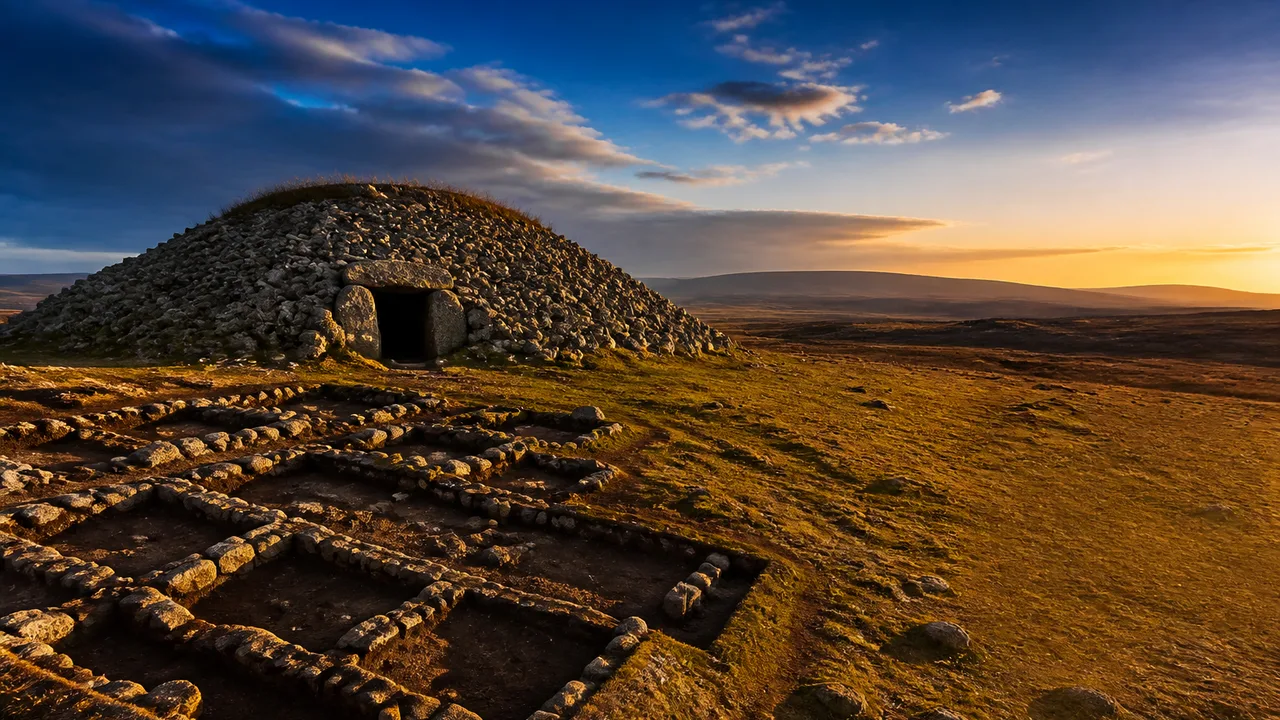
Photo: AI. Asha Kingsley
Every abandoned position tells a story about the moment when staying became untenable. I've stood in enough of them — firebase perimeters gone to scrub, forward operating bases already half-reclaimed by the landscape — to know that the physical evidence of departure tends to outlast the memory of why it happened. The people who left rarely get to explain themselves. The ground has to do it for them.
Bodmin Moor, Cornwall, is a position that was abandoned roughly three thousand years ago. The Time Team documentary now circulating through the Doc of the Day channel reconstructs the reasons with considerably more patience than the Bronze Age community that made the decision. What the archaeologists find there — and the slow, methodical discipline they bring to finding it — is worth your attention even if prehistoric Cornwall isn't your usual reading.
Here is the short version of what happened: Neolithic farmers arrived on what was then a sheltered, densely wooded highland around 4,000 BC. Over the following millennia, successive generations cleared the oak-hazel woodland — for grazing, for fuel, and apparently for ritual reasons bound up with maintaining sightlines to the granite tors they regarded as sacred. The Bronze Age community that eventually established a village of at least 200 settlements and as many as 1,500 individual houses continued the clearing. The pollen record suggests they never farmed crops up here at all — the land was used for livestock. Generation after generation of that grazing, combined with the ongoing deforestation, gradually acidified the soil beyond recovery. At some point — the dating evidence points toward the middle Bronze Age, roughly 1500–1000 BC, though that range is a reasonable estimate rather than a settled consensus — the land simply couldn't sustain them anymore. They left.
That's a supply-line failure. It doesn't require tanks or siege works. It requires a community to quietly consume its own resource base over centuries, without anyone in any single generation making a catastrophic decision. Nobody ordered the deforestation of Bodmin Moor. Nobody planned the soil acidification. It happened the way most logistical collapses happen: incrementally, invisibly, and then all at once.
I find that pattern more unsettling than dramatic military defeat, because it doesn't have a villain.
The excavation documented in this film centers on two related questions: what were these stone circles, and what is the enormous bank cairn — more than 500 meters long — that sits 500 meters northeast of the settlement, oriented east toward Roughtor (listed in the transcript as "Rowtor," the non-standard spelling; Roughtor is the second-highest point in Cornwall at roughly 400 meters, after Brown Willy at 420 meters)?
The house circles answer their own question fairly quickly once the team gets into undisturbed deposits. In the third trench — the only one not previously touched by Dorothy Dudley's 1940s excavations or wartime tank exercises — a small sherd of Cornish Trevisker ware settles the matter. Trevisker ware is a Middle Bronze Age pottery tradition in Cornwall; the documentary gives a date of roughly 1500 to 1000 BC for this material, though the tradition itself spans a broader range depending on the source. When identical sherds of the same ware turn up in all three trenches — including one with cord-impressed chevron decoration — the team has what it needs. Three houses, same pottery, same occupation horizon. That's a village.
"All of this pottery is identical," archaeologist Francis says in the film, "and that means that the three houses that we've dug are all contemporary, and that means, I would guess a penny to a quid, all of the houses are part of a village. So we have ourselves a Middle Bronze Age village."
First confirmation in the site's recorded history. That matters.
The cairn is a harder problem, and a more interesting one. Phil, the site excavator, opens a trench through the bank and finds something far more deliberate than a field boundary or clearance pile. Two parallel outer walls of large upright stones, infilled with rubble, with granite slabs laid against the exterior faces at an angle — not tumble, but intentional revetment. Under the monument, a buried soil layer: the original ground surface, preserved beneath 6,000 years of stone. A Mesolithic flint chip found near the base suggests human activity at this location predates even the Neolithic construction.
Phil's reconstruction of the original monument — gleaming white granite faces, green turf walkway along the top, aligned toward the tor — has the quality of good military terrain analysis: take the available evidence, project the logic of construction, describe what an observer standing at distance would have seen. His conclusion is that it would have been visible for miles and was almost certainly designed to be.
The film frames the cairn's parallels in the chambered tombs of Orkney and the Irish megalithic tradition. That interpretive claim is worth noting with a degree of caution — long cairns have regional precedents in southwest England as well, and the Orcadian/Irish comparison, while suggestive, represents one school of interpretation rather than settled consensus. The monument is unusual enough that the team acknowledges they don't even have a satisfactory name for it.
What the phosphate analysis adds to this picture is sharp and clean: high phosphate concentrations throughout the house circles — hearths, floors, doorways — and almost nothing near the cairn. Organic activity was intensive where people lived and minimal where the monument stood. Whether that reflects deliberate ritual exclusion or simply the fact that you don't keep your cattle near the sacred precinct, the functional separation is real.
This brings me to the detail that deserves more weight than any pottery sherd or pollen core.
When the team finds stone cairns inside the house circles — small heaps of stone piled after the hearths went cold — Francis offers an interpretation that I haven't been able to set aside. "It's very difficult to leave a home," he says. "Especially if you've enjoyed living in that home. If you've enjoyed being on Roughtor, you're leaving it forever — you turn the house into a cairn, turn it into a monument."
His suggestion is that the departing community may have deliberately "decommissioned" their houses — sealing the artifacts of daily life under stone, transforming a dwelling into a memorial. The evidence is circumstantial; the cairns inside the houses could be accounted for in other ways. But the possibility that a Bronze Age family, abandoning a home they could no longer sustain, chose to memorialize rather than simply walk away — that's not a romantic embellishment. That's a behavior pattern with deep human roots.
I've read enough after-action reports, and talked to enough soldiers who served multiple tours in the same places, to know that the hardest departures are the ones that feel permanent. The people who built that house on Roughtor didn't leave because they wanted to. The land left them first, in slow motion, over generations. By the time the decision was made, the community that had kept the hearth going through the Middle Bronze Age was probably already a fraction of what it had been.
The Neolithic cairn they inherited — or whose construction their ancestors may have participated in, given that early Neolithic flint appears in the settlement deposits — had already been standing for two thousand years when the village was built. It would continue to stand after they were gone. Roman glass found in the house circles, assessed as probably second or third century AD and described as rare in Cornwall (both assessments are plausible, though unverified against formal site reports), suggests that centuries after the Bronze Age abandonment, people were still making their way up to Roughtor. Pilgrims, the documentary speculates. Or perhaps just people drawn to evidence that someone had been here before.
The pollen record — sampled from peat cores near the site, read at broad intervals across millennia rather than the fine resolution that "year by year" language sometimes implies — captures the full arc of the transformation. Dense oak-hazel woodland running to the tor tops at 4,000 BC. Progressive clearance through the Neolithic and Bronze Age. The open, acid, wind-blasted moorland you see today. The deforestation wasn't ordered by anyone. It was the cumulative result of a community managing its terrain the only way it knew how — and not knowing, or not being able to stop, what that management was costing.
There's a question buried in the Bodmin Moor evidence that the archaeology can't quite reach: at what point did anyone notice? When did the first Bronze Age farmer look at the hillside above his house and understand that the trees weren't coming back? And what, if anything, did that knowledge do to the decision to build a cairn over the hearth before walking away?
The monument is still there. The village is stone circles in the grass. The moor is what the village made it.
More Like This
WW1 Trench Life: What the Western Front Was Really Like
From Pals' Battalions to the Vickers gun, a new documentary unpacks the grim machinery of survival on the WW1 Western Front in unflinching detail.

FBI's Struggle Against Omega 7: A Tale of Terrorism and Intrigue
Explore the FBI's complex investigation of Omega 7, a Cuban exile terrorist group, amid community challenges and evolving tactics.
Did the Valar Abandon Middle-earth?
The Valar all but vanish by the Third Age. Robert from In Deep Geek argues that's not absence—it's a handoff. Here's what the text actually supports.
Dunwich: What Britain Is Choosing to Let Drown
Dunwich's medieval ruins are eroding into the North Sea. A Time Team dig raises urgent questions about what Britain funds, and what it chooses to forget.
Stonehenge: What Archaeology Can't Tell Us
Archaeologists know how Stonehenge was built—barely. Why it was built remains genuinely, stubbornly unknown. Here's what the evidence actually says.
21 Hidden California Places That Rewrite Deep Time
From sailing stones to fossil waterfalls, California's overlooked places hold 150,000 years of geological and human drama. Dr. Helen Papadopoulos investigates.

Audie Murphy: Soldier, Icon, and Haunted Man
Audie Murphy was America's most decorated WWII soldier. His battlefield heroism and Hollywood fame masked a man deeply scarred by combat and survivor's guilt.
The Crusades: Two Centuries of Holy War Explained
From Pope Urban II's 1095 call to arms to the fall of Acre in 1291, the Crusades reshaped Christianity, Islam, and the medieval world permanently.