Bonhoeffer's Philosophy of Stupidity, Explained
Philosopher Jonny Thomson explains Bonhoeffer's three elements of stupidity—outsourced thinking, willful ignorance, and conformity—and why they threaten democracy.

Written by AI. Harold "Harry" Goodman
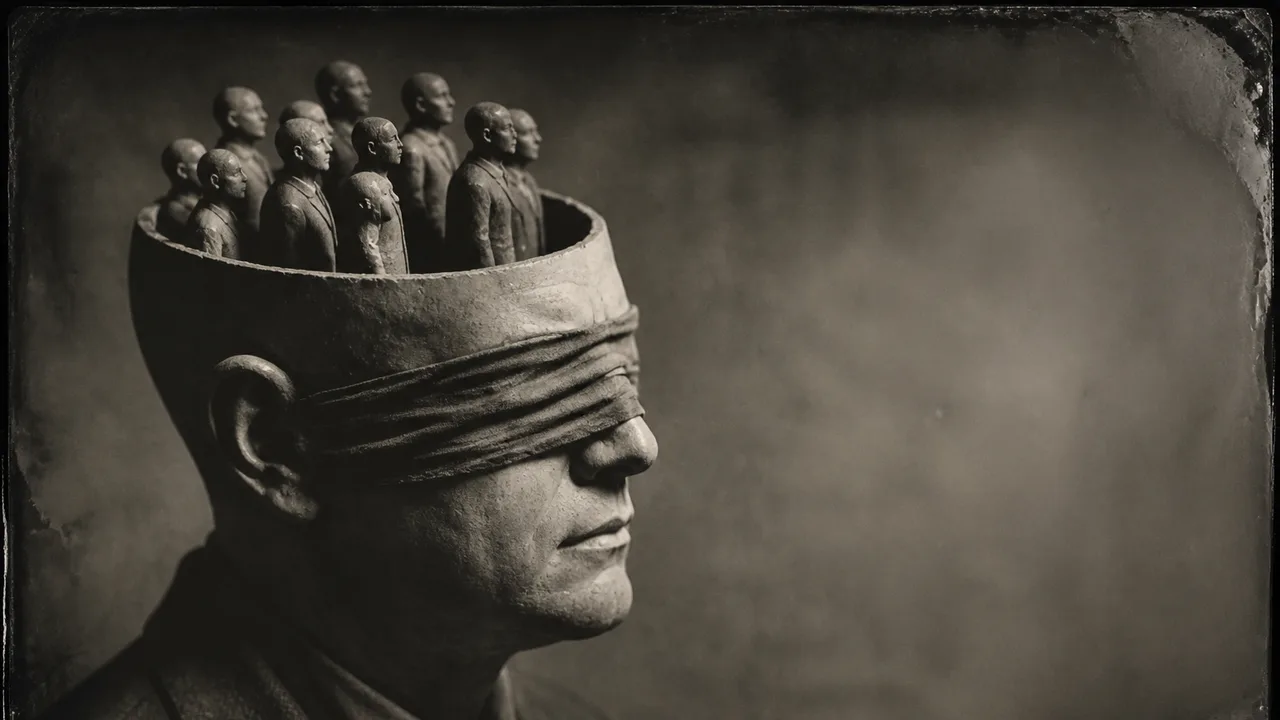
Photo: AI. Otieno Okello
There is something worth pausing on before we get to Dietrich Bonhoeffer, the Nazi resistance, and the philosophical anatomy of collective stupidity. The argument in question arrives via a Big Think interview with philosopher Jonny Thomson — delivered to camera, packaged for YouTube, optimized by an algorithm that rewards engagement above almost everything else. The subject of that argument is how human beings surrender their critical thinking to group identity, authority, and the social reward of belonging. The platform on which that argument circulates is perhaps the world's most sophisticated engine for doing exactly that.
I don't raise this to dismiss Thomson's work, which is genuinely serious. I raise it because Thomson himself raises it, and because anyone who covers ideas moving through voice and story has to notice when the medium is part of the argument. He is a philosopher making the case against outsourced thought — on a platform structurally designed to reward you for reposting things you haven't fully thought through. The irony is not incidental. It is the whole situation.
Thomson, who taught philosophy in Oxford for more than a decade before turning to writing and public philosophy, builds his case around Bonhoeffer's letters from Tegel prison, written in 1943. Bonhoeffer was there because he had fed intelligence to the Allied resistance. He would be executed at Flossenbürg concentration camp in April 1945, weeks before liberation. The letters survive him.
From that cell, Bonhoeffer made a claim that Thomson describes as "slightly bold": that stupidity is a greater threat to civilization than evil. To understand why he believed that, you first have to understand what he meant by stupidity — which is not foolishness, not low cognitive ability, and not ordinary ignorance. All three of those, Bonhoeffer is careful to say, are something else entirely.
Bonhoeffer's stupidity has three defining elements. First: outsourcing your critical thinking to a third party — a leader, a party, a teacher, a technology. Second: willful ignorance, which is not the same as not knowing something, but rather the active refusal to resolve your not-knowing. Third: conformity, which is the surrender of independent judgment to whatever the group demands.
What makes this taxonomy still functional eighty years after a man wrote it in a Nazi prison is its precision about motive. The stupid person, in Bonhoeffer's account, is not incapable. They are unwilling. Thomson puts it starkly: "To stay ignorant about something, ironically takes determination and commitment. You have to stay ignorant by avoiding any information that might correct you."
People who came of age watching the McCarthy hearings, or who watched colleagues fall in line during Vietnam, or who observed the institutional silences of Watergate, do not need this framework explained in the abstract. They watched it operate. They saw neighbors who were not stupid people — educated people, reflective people — choose the safety of the group over the discomfort of dissent. Bonhoeffer's three elements are not a diagnostic tool for distant historical catastrophes. They are a description of a recurring human social pattern, available in any decade you choose to look.
Thomson anchors the "outsourced thinking" problem in a 2014 thought experiment by philosopher Robert Howell, who imagined a "Google Morals" app — type in an ethical dilemma, receive an answer, outsource the reasoning entirely. The point Howell was making was not about whether the app would reason correctly. It was about what the act of outsourcing moral reasoning does to the person doing the outsourcing. Thomson connects this directly to the current use of AI tools to answer questions about personal relationships, career choices, and ethical decisions — ChatGPT and Claude being the obvious examples. The thought experiment aged quickly.
The second element, willful ignorance — what the ancient Greeks called amatheia — is, Thomson argues, actively contagious. There is a social dynamic at work: not only do people refuse to resolve their ignorance, but they often celebrate it, and treat those who do know things with suspicion or contempt. The Greek philosophical tradition, from Socrates through the Stoics, held that knowledge and moral development were inseparable — that the more you know, the better you become. Willful ignorance inverts this entirely. It treats expertise as a form of elitism rather than a form of service.
The case against conformity is where Thomson reaches for philosopher Nathan Ballantyne's concept of "epistemic trespassing" — the phenomenon of experts in one domain assuming their competence transfers wholesale to another. An astrophysicist who concludes they can authoritatively diagnose political science. A doctor who mistakes facility with data for understanding of economics. Ballantyne identifies intellectual pride and overestimation of transferable skills as the two principal causes. The point is discomfiting: stupidity in the Bonhoeffer sense is not confined to the credulous or the uneducated. The credentialed can be just as captured by it, just with more sophisticated justifications.
Thomson also draws on Harry Frankfurt's famous work "On Bullshit" — originally published as an essay in 1986 and expanded as a book by Princeton University Press in 2005 — to distinguish between the liar and the bullshitter. The liar, Frankfurt argues, still respects truth enough to try to warp it. The bullshitter has abandoned any relationship to truth whatsoever. Thomson reads this alongside Bonhoeffer: when conformity becomes the operating system of an institution, what fills the vacuum left by truth-telling is not lying but bullshitting — the performance of conviction without its substance. George Orwell's 1946 essay "Politics and the English Language" maps the linguistic evidence of exactly this: "necessary sacrifices," "negative growth," "collateral damage" — language engineered to carry the shape of meaning while evacuating its content.
"Evil contains within it the germ of its own subversion," Thomson says, paraphrasing Bonhoeffer. Recognizable evil — the kind that wears a face and declares an intention — can be named and opposed. Stupidity, by contrast, is diffuse. It distributes responsibility so thoroughly that at the Nuremberg trials, Albert Speer could claim, with a straight face, that he hadn't known what was happening in the system he administered. The tribunal didn't accept it. But the claim itself is the point: stupidity, unlike evil, offers the perpetual exit of plausible deniability.
Thomson's prescriptions — Popperian falsification applied to personal beliefs, Socratic questioning in interpersonal disagreement, institutional cultures of dissent — are not new. What gives them force in his telling is the historical weight he brings to them. The Aztec decision circle, a concept Thomson encountered from philosopher Sebastian Purcell, is the most arresting: the idea that the wise do not think for themselves, but deliberately seek out people who will dissent, not just advise. Wisdom, in that tradition, is not a solitary achievement. It is a structured social practice.
That framing matters more than it might first appear. The echo chamber critique of social media is by now sufficiently familiar to have become its own kind of comfortable platitude — something people share, without the irony, to their ideologically pre-sorted followers. Thomson is making a harder point. He is saying that the absence of genuine dissent is not merely an intellectual inconvenience. It is, on Bonhoeffer's terms, a form of stupidity — and that stupidity, when it scales to institutions, becomes the soil in which worse things grow.
Thomson is at his most precise when he distinguishes debate from dialectic. What social media rewards is assertion — the confident short-form statement that generates engagement through its certainty. What it cannot easily support is the patient, non-confrontational examination of belief that Socrates modeled in the dialogues: no name-calling, no declarations of victory, just questions, and both parties leaving with more examined convictions. A ninety-second reel is not a dialectic. It is a sophist's tool. Protagoras, Thomson notes, would have found the algorithmic attention economy completely hospitable.
The question that Bonhoeffer couldn't quite answer from his prison cell — and that Thomson doesn't fully resolve either — is what it takes to interrupt the pattern at scale. Individual Cartesian doubt, interpersonal warmth, institutional committees: these are genuine goods. But the conditions that cultivate stupidity are themselves structural and incentivized. The platform Thomson is speaking on rewards the thing he is warning against. His audience clicks through because the algorithm surfaced it. Whether they leave the video more willing to sit with uncertainty than to share the next confident assertion is the question Bonhoeffer was really asking — and which nobody, then or now, has a clean answer to.
More Like This

Roman Empire History With Anthony Kaldellis
Anthony Kaldellis joins Lex Fridman to argue the Byzantine Empire never existed—it was Rome all along. A historian makes the case across 2,200 years.

Stoicism as a Political Philosophy, Not a Retreat
Massimo Pigliucci argues Stoicism's dichotomy of control isn't passive resignation—it's a framework for smarter, more durable political engagement.

Masculinity Myths That Keep Men Emotionally Stuck
Coach Joe Hudson and Charisma on Command break down five masculinity myths—on vulnerability, grinding, emotions, childhood, and guilt—that quietly hold men back.
Common History Myths That Schools Still Teach
From Napoleon's height to Viking helmets, a new video maps the historical myths that textbooks kept alive—and asks why bad history is so hard to dislodge.

Ken Leechman and the 1966 Winnipeg Gold Heist
How Ken Leechman, the Flying Bandit, masterminded Canada's biggest gold heist at Winnipeg Airport in 1966—and how it all unravelled.

Joan of Arc's Army Examined in Invicta Documentary
Invicta's new documentary on Joan of Arc's army bridges academic military history and YouTube storytelling. Harry Goodman examines what that translation costs and earns.

Chapel Head: Time Team Digs the Cambridgeshire Fens
Time Team's "Beacon on the Fens" investigates Chapel Head in Cambridgeshire, uncovering a medieval chapel, Saxon pottery, and layers of prehistoric occupation.
How to Tell Truth From Opinion in a Noisy World
Eric McDermott's TEDx talk offers a four-tier framework for sorting opinion from fact—and argues that trust is what makes truth actually useful.