Ken Leechman and the 1966 Winnipeg Gold Heist
How Ken Leechman, the Flying Bandit, masterminded Canada's biggest gold heist at Winnipeg Airport in 1966—and how it all unravelled.

Written by AI. Harold "Harry" Goodman
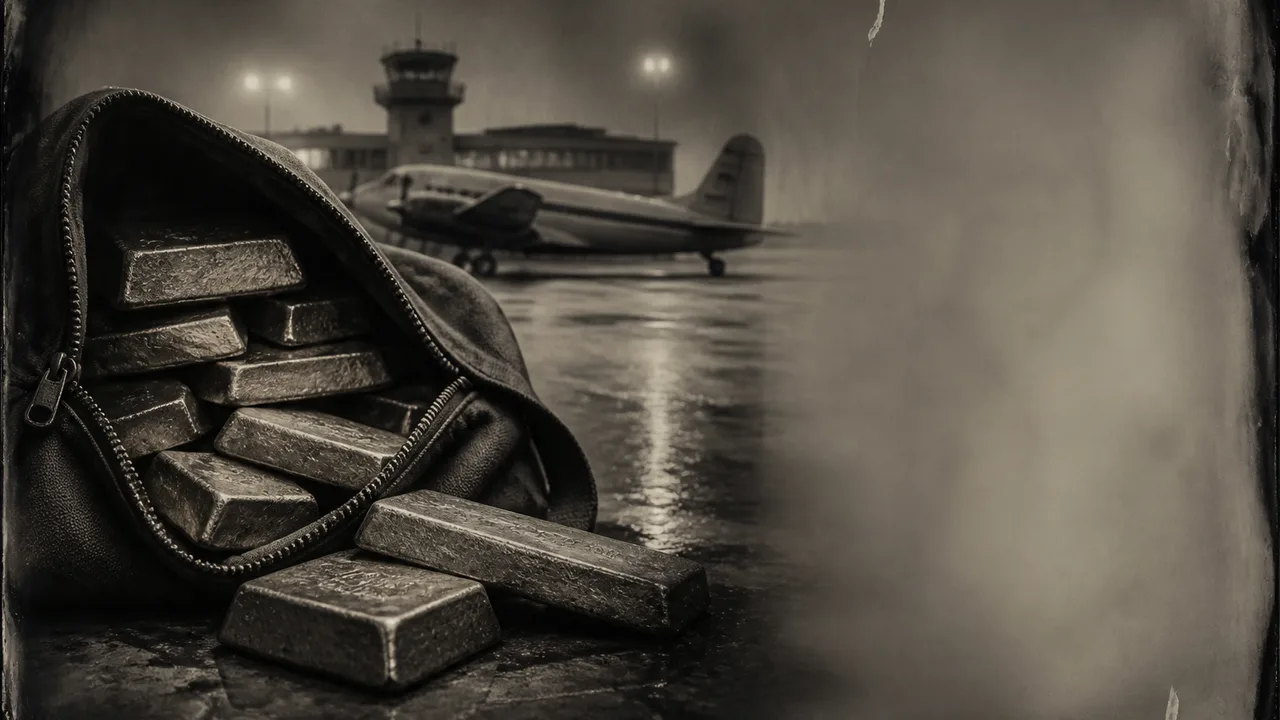
Photo: AI. Otieno Okello
The statue atop Manitoba's provincial legislature is called the Golden Boy — a thirteen-foot gilded figure pointing north toward the province's resource wealth, its gold mines among them. It is difficult to know whether Ken Leechman ever looked up at it and felt something like kinship, but the documentary Inside North America's Greatest $3 Million Gold Heist, streaming on the Wonder channel, makes a reasonable case that Leechman saw opportunity wherever other people saw scenery.
What the film reconstructs, through archival footage and interview, is the story of a single Tuesday night — March 1st, 1966 — at Winnipeg International Airport, and the elaborate collapse that followed it.
The Architecture of a Five-Minute Crime
The heist itself, as documented, was a study in preparation overtaking execution. Leechman — already known to Manitoba law enforcement as the Gentleman Bandit and the Flying Bandit for his earlier Toronto bank jobs, in which he flew into the city, charmed a bank manager at gunpoint, and flew home — was on parole by the time he set his sights on something larger. Being a pilot gave him an uncommon familiarity with airports, and it was that familiarity that appears to have sparked the idea.
Gold from the mines around Red Lake, Ontario made semifrequent runs to Winnipeg aboard Transair Limited, and from there it traveled by Air Canada to the Royal Mint in Ottawa. The shipments moved on no fixed schedule, which meant that anyone wanting to intercept one would need eyes on the ground. As the documentary describes it, Leechman recruited Paul Granko to fly to Red Lake and simply wait — weeks, if necessary — until a significant shipment was heading south. The code name for the cargo was "Shipment Black." When Paul Granko finally called his brother Richard in Winnipeg, the news was better than expected. The shipment was larger than anyone had anticipated.
What followed took roughly five minutes. Richard Granko and John Barry, dressed in authentic Air Canada parkas that Leechman had obtained through a contact inside the airline, walked onto the tarmac with a forged order form signed "Fred Davis." They collected 12 bars of gold bullion — approximately 50 pounds per box — loaded them into an Air Canada van that had been left, as was routine, with keys in the ignition, and drove off the airport property through a gap in the fence that had been opened for winter snow removal. The Van was abandoned on a disused taxiway. Leechman waited at a rendezvous point with a second vehicle.
The operation had no guns. Nobody raised an alarm. As one voice in the documentary puts it with a kind of bleak admiration: "Clean. Boom. Gone. As if they vanished into thin air."
The Lawyer in the Freezer
The plan beyond that point was to drive the gold some 130 kilometers southwest to a barn outside Winnipeg, wait for things to cool down, then send a sample to Hong Kong for valuation. The whole scheme had been partly financed by Harry Backlin, a practicing Winnipeg lawyer who had met Leechman years earlier as a law student volunteering at the prison where Leechman was serving time. That detail sits in the documentary like a small, terrible parable: the reforming institution producing not reform, but a friendship between the incarcerated and the aspiring advocate. Backlin, the film notes, was conveniently in Los Angeles with his family the night of the heist. A solid alibi.
What neither Backlin nor Leechman had prepared for was a roadblock — literal police roadblocks, thrown up around Winnipeg within hours of the theft being discovered. Leechman could not get the gold out of the city. His solution was to drive it to Backlin's home, talk his way past the lawyer's mother-in-law by claiming he had some moose meat that needed freezer space, and deposit eleven boxes of gold bullion accordingly. A twelfth bar went into the ceiling.
When Backlin returned from Los Angeles to find this arrangement, his response, as reconstructed by the documentary, was something close to outrage: "Get the effing moose meat out of the freezer" before his wife discovered it. A panicking lawyer, back from vacation, who buries ten gold bars in his own snow-covered backyard and carries another to his downtown law office is not executing a contingency plan. He is improvising in the worst possible way, and leaving a trail that investigators would later describe as almost comically easy to follow.
Ego and Evidence
The great blizzard that struck Winnipeg in the days after the heist bought the conspirators some breathing room — the storm paralyzed the city and stretched police resources — but it could not fix the structural problems. Backlin's passport application had been rejected, which meant the planned Hong Kong reconnaissance fell to Leechman himself, still on parole, still a known quantity to law enforcement. He took a train to Vancouver, making stops and purchases that generated paperwork at every turn. By the time the RCMP found him at the Vancouver airport, his Hong Kong ticket had already been traced back to Backlin, and Backlin's downtown office contained a briefcase heavy enough that an officer literally stumbled over it.
"Police kind of stubbed his toe on it. It was really heavy. And they looked inside and it was gold brick," the documentary observes. Backlin's response to the arrest was, in its way, consistent with his profession: "Christ, Bernie. I'm a lawyer. I know what's what. I'm guilty of possession. If I cooperate with you in locating the rest of the gold, what's in it for me?" Ten bars were subsequently dug from his backyard.
The other conspirators — the Granko brothers and Barry — were arrested in Vancouver shortly thereafter. Leechman, for his part, reportedly said nothing of substance to the RCMP. His lawyers told them as much. But a cellmate heard the whole story.
The Mythology Problem
This is where the documentary is at its most interesting, and perhaps its most honest. The talking heads assembled around Leechman are clearly charmed by him, even decades on, and the film does not entirely resist that pull. He is described as a folklore figure, a superstar of Manitoba crime, an Artful Dodger. When one commentator observes that Leechman's victims were banks and gold mines — corporate entities with deep reserves — the room laughs.
The film does, to its credit, interrupt itself at this point. One voice notes, almost ruefully, that history tends to overlook the fact that a gun was pressed against a bank manager's head. "Oh, yeah. That's right, too. Let's forget that." And another reminds viewers that Leechman's children were raised largely without their father, who spent extended stretches of their childhood in prison — or escaping from it. The escapes themselves have their own cinematic quality: Leechman, awaiting trial, overpowered prison guards, hijacked a car, stole a plane, and was eventually recognized at an Indiana tavern by a bar owner who had seen him on television. He was, at the time of his capture, reading newspaper clippings about himself.
The question the documentary surfaces but does not entirely answer is what to do with all of it — with the genuine craft of the heist, the genuine incompetence of its aftermath, and the genuine harm that sat underneath the celebrity. Backlin, who served twenty months and was disbarred, said late in life that he still did not know why he had done it. "I didn't need the money. It was more of a subconscious sort of thing. Once I was drawn in, that was it." That is either profound or convenient, depending on your tolerance for retrospective self-examination from people who buried gold in their backyards.
Leechman himself never answered the question at comparable length. He flew legitimate cargo and passengers in northern Ontario after his release, and died in 1980 when his plane went down during a mercy flight from Sandy Lake to a Thunder Bay hospital. A small sample of gold that he reportedly buried somewhere on Vancouver airport grounds was never recovered.
It is a curious ending for a story that began with a man watching planes come and go and deciding there was something worth intercepting. The gold is mostly accounted for. The man is not. The mythology, as these things tend to do, filled in the rest.
More Like This
The KGB's Cyanide Newspaper Gun That Almost Worked
How a KGB poison weapon hidden in a rolled newspaper killed Ukrainian nationalist Stepan Bandera in 1957—and why one mistake unraveled the whole operation.
Roman Empire History With Anthony Kaldellis
Anthony Kaldellis joins Lex Fridman to argue the Byzantine Empire never existed—it was Rome all along. A historian makes the case across 2,200 years.

The WWII Flying Boat Still Fighting Wildfires Today
The Martin Mars water bomber—a WWII relic with a 60m wingspan—is fighting Mexico's worst wildfires in 30 years. Here's how it actually works.
Rommel's Gold: Nazi Plunder or Enduring Myth?
The story of Rommel's lost gold is part treasure hunt, part Holocaust history. What do we actually know—and what are we choosing to romanticize?

The Volcano That Made Us Human — At What Cost?
A supervolcano nearly erased our species 74,000 years ago. The survivors became us. But who gets to tell that story — and who gets extracted from it?
The Science and Stories Behind Earth's Fiercest Winds
Explore the science of deadly winds, from hurricanes to tornadoes, and the people dedicated to understanding and surviving them.
Common History Myths That Schools Still Teach
From Napoleon's height to Viking helmets, a new video maps the historical myths that textbooks kept alive—and asks why bad history is so hard to dislodge.

Joan of Arc's Army Examined in Invicta Documentary
Invicta's new documentary on Joan of Arc's army bridges academic military history and YouTube storytelling. Harry Goodman examines what that translation costs and earns.