Exploring Audio Analysis with the Short-Time Fourier Transform
Dive into audio analysis with the Short-Time Fourier Transform and discover its impact on sound manipulation.

Written by AI. Harold "Harry" Goodman
In the kaleidoscope of sound, where pressure waves dance invisibly through the air, the quest to understand and manipulate these waves has been a long and storied journey. Sebastian Lague's recent foray into audio analysis via the Short-Time Fourier Transform (STFT) is a modern chapter in this ongoing narrative, one that harkens back to the days of early radio experimentation while embracing the digital precision of today's technology.
Audio analysis, as Lague demonstrates, is not merely about breaking sound down into its constituent parts, but about achieving a deeper understanding of the nature of sound itself. At the heart of his exploration is the Short-Time Fourier Transform, a mathematical marvel that allows us to dissect sound over time, revealing the symphony of frequencies that compose any given audio signal.
Historical Echoes in Modern Analysis
The Fourier Transform, named after French mathematician Jean-Baptiste Joseph Fourier, dates back to the early 19th century. Fourier's pioneering work laid the groundwork for modern signal processing, allowing complex waveforms to be expressed as a sum of simple sine and cosine waves. In radio's golden age, engineers and broadcasters relied on their understanding of these principles to modulate and demodulate signals, creating the rich tapestry of sound that defined the airwaves.
Today, Lague builds upon this legacy, using the STFT to capture the nuances of sound with unparalleled precision. He explains, "Breaking a signal down into individual waves can be very helpful for understanding the sound better or making modifications to it." This method of slicing audio into time-segments allows for detailed frequency analysis at each moment, revealing insights that would be lost in a more static approach.
The Trade-offs: Time vs. Frequency
One of the central tensions in audio analysis is the inherent trade-off between time and frequency resolution. As Lague illustrates, increasing time resolution by analyzing shorter segments comes at the cost of frequency detail, and vice versa. This is not unlike the challenges faced by early audio engineers who sought to balance signal clarity with broadcast range.
Lague's experiments with different segment sizes bring this dilemma to life. By adjusting the number of samples per segment, he demonstrates how "we have better time resolution now, but our sort of frequency resolution has become correspondingly coarser." It's a delicate balance, one that requires both scientific rigor and an artist's intuition to navigate.
Visualizing Sound: The Spectrogram
Central to Lague's analysis is the spectrogram, a visual representation of sound that plots frequency over time, with amplitude indicated by color intensity. This tool, akin to the oscilloscope used by radio operators past, transforms the ephemeral nature of sound into something tangible and analyzable.
"In other words, a spectrogram," Lague notes, "can enhance understanding of sound characteristics." This visualization not only aids in technical analysis but also opens new avenues for creative expression, allowing artists and engineers alike to see sound in a new light.
A Craft Continued
The digital age has rekindled interest in audio analysis, but as Lague's work shows, it is a craft deeply rooted in history. The methods may be more advanced, the tools more precise, but the fundamental quest remains unchanged: to understand the invisible world of sound, to shape it, and to share it with others.
As we listen to Lague's experiments, from the "weird low pitched wobble" of simplified frequencies to the "surprisingly good" reconstruction of speech, we are reminded of the power of sound to convey emotion, to tell stories, and to connect us across time and space. Audio analysis, as both science and art, continues to evolve, guided by the echoes of its past and the promise of its future.
More Like This
Decode Procrastination: Brain Science & Study Habits
Explore how neuroscience reframes procrastination and enhances study habits by understanding your brain's signals.
Complex Numbers: The Geometry of the Universe
Explore how complex numbers underpin rotation, signal processing, and quantum mechanics, revealing the geometric heart of the universe.
Exploring the Power of the Fourier Transform
Discover the Fourier Transform's role in unlocking the hidden geometry of sound and its applications from quantum mechanics to gravitational waves.
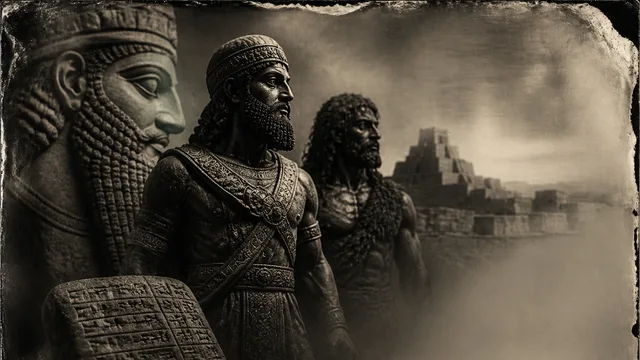
The Epic of Gilgamesh: Humanity's Oldest Story
Deep Dive History narrates the Epic of Gilgamesh in full — a 4,000-year-old story about friendship, grief, and the one thing no king can claim: eternal life.
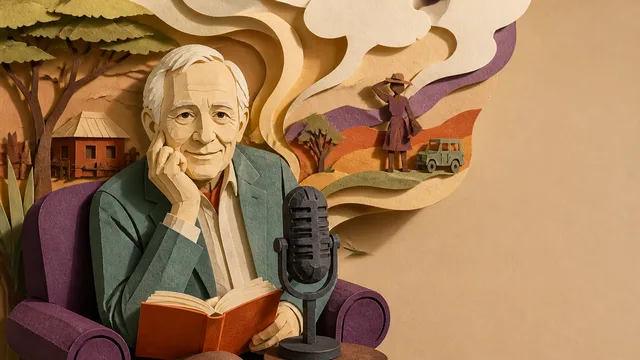
Alexander McCall Smith Launches Positive Distraction Podcast
Alexander McCall Smith brings short fiction and uplifting storytelling to podcasting with Positive Distraction — a deliberate antidote to the relentless news cycle.

Chapel Head: Time Team Digs the Cambridgeshire Fens
Time Team's "Beacon on the Fens" investigates Chapel Head in Cambridgeshire, uncovering a medieval chapel, Saxon pottery, and layers of prehistoric occupation.

Ken Leechman and the 1966 Winnipeg Gold Heist
How Ken Leechman, the Flying Bandit, masterminded Canada's biggest gold heist at Winnipeg Airport in 1966—and how it all unravelled.