Chapel Head: Time Team Digs the Cambridgeshire Fens
Time Team's "Beacon on the Fens" investigates Chapel Head in Cambridgeshire, uncovering a medieval chapel, Saxon pottery, and layers of prehistoric occupation.

Written by AI. Harold "Harry" Goodman
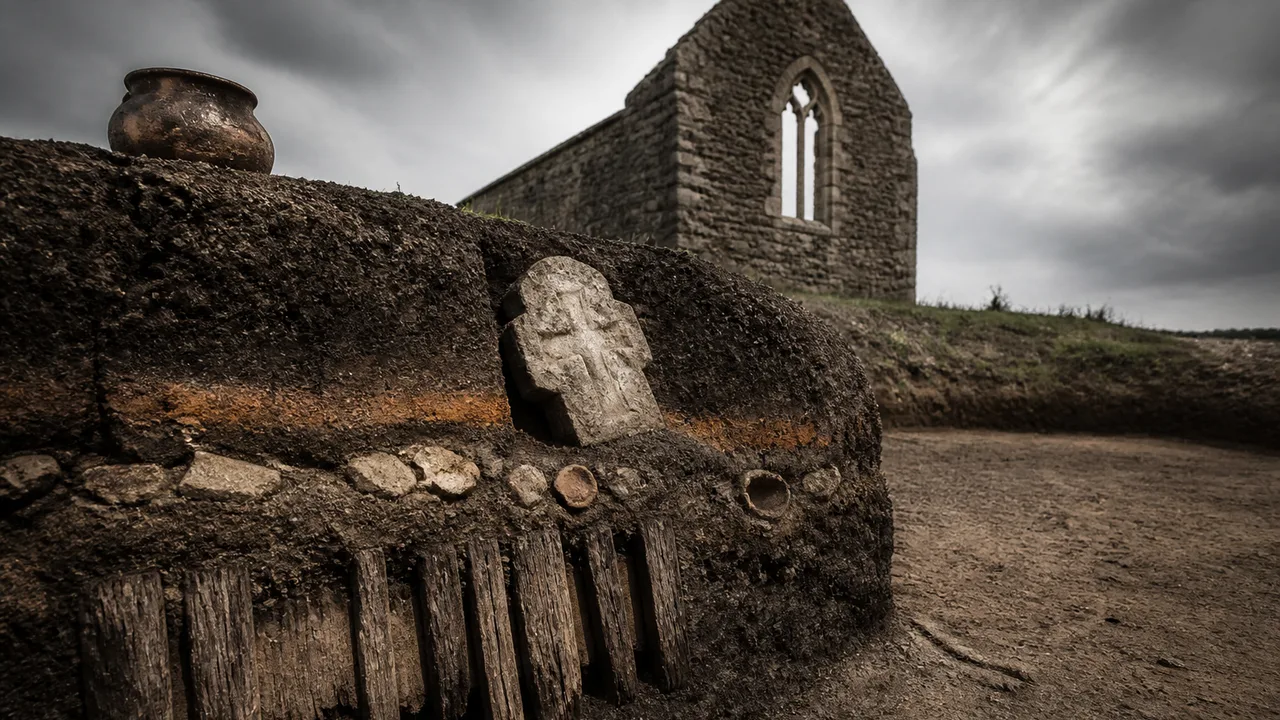
Photo: AI. Kasper Winter
There is a particular pleasure in watching a good theory dissolve in real time, especially when the people holding it are too honest — and too professionally committed to evidence — to pretend otherwise. That pleasure is on full display in Beacon on the Fens, the Time Team Classics episode investigating Chapel Head in Cambridgeshire, a mound so modest it barely qualifies as topography and yet commands the flat peat fen around it like a lighthouse commands the sea.
The premise is a local legend: farmers working the field over generations have turned up dressed stone, medieval floor tile, and two prehistoric stone axes. The mound is called Chapel Head. Is there a chapel under it? And if the site drew medieval monks, did it draw people long before them too?
Those are two questions running on parallel tracks, and for most of the episode they pull in opposite directions — which, it turns out, is rather the point.
What the Fens Do to Perspective
Francis Pryor, the veteran fensman and prehistoric specialist on the dig, offers the first real reorientation of scale. "To you, that probably doesn't look like much of a hill," he says to Tony Robinson. "It's virtually flat. But to a fensman, it's vertiginous. And around it, there would have been water. It would have looked like an island surrounded by an inland sea."
This is not a picturesque observation. It is a methodological one. Landscape archaeology in the fens depends on understanding that what looks trivial on a dry modern afternoon was, for most of human prehistory, the only solid ground for miles. A mound a few meters high was not a minor feature of the terrain — it was the terrain. The sacred and the practical converge when the alternative to the hillock is standing in water.
Pryor builds from this to a larger theory: that the ring ditch visible in the aerial photograph encircling the crown of the mound might be the remnant of a Neolithic causewayed enclosure, later re-dug as a henge around 2,500 BC, with a burial barrow at the center. The axes, the Neolithic flint flakes, the Bronze Age pottery — all of it points to a site that commanded ceremonial attention for thousands of years before anyone thought to erect a Christian chapel on it.
It is a compelling synthesis. It is also almost entirely wrong, at least in its specifics — and watching Pryor navigate that is one of the episode's quiet satisfactions.
The Archaeology Does Not Cooperate
The geophysics team struggles from the start. Wet clay swallows their survey data, leaving the team to fall back on conventional excavation guided by aerial photographs and surface observation. Two trenches go in: one targeting the possible chapel, one targeting the supposed prehistoric ring ditch.
The chapel trench pays off almost immediately. Medieval floor tile appears in the topsoil. Cobbled surfaces suggest pathways. Limestone rubble — not locally quarried, hauled in from the Peterborough area some twenty miles distant — indicates substantial construction. A documentary find reinforces the physical evidence: historian Helen Geake locates a 1535 land transfer naming a chapel within the manor of Woolvey, which pertained to the infirmarius of Ramsey Abbey — the monk responsible for the infirmary, for the sick and elderly brothers. Mick Aston, ever the institutional historian, explains what that connection might mean: income from leasing the land, a monastic grange, perhaps a place for bloodletting or other medical practice. He also raises the possibility of a hermit — Ramsey Abbey, he notes, was energetically acquisitive of saints' relics, and a hilltop hermitage would have attracted exactly the kind of devotional attention that drew pilgrims and their coin.
"It's possible that they knew there'd been a hermit on a site like this," Aston says on screen. "We don't have the documents for that. It's quite a possibility."
That careful hedging is characteristic of the episode at its best. Possibility is not evidence, and nobody here pretends it is.
Meanwhile, the prehistoric trench tells a different story than the one Pryor was hoping to tell. The ring ditch he was so confident about turns out to be a medieval bank, not a prehistoric ditch at all. Surveyor Stuart Ainsworth works out the explanation: moisture trapped against a long-since-ploughed-away medieval earthwork bank created a crop mark that read, from the air, like something far older. The medieval circular enclosure that produced the crop mark connects not to a Neolithic henge but to the manorial complex Stuart has already identified in the field across the road — the "lumpy field," he calls it, full of earthworks that match the earliest maps.
Francis has, as Tony puts it with characteristic gentleness, "had one of his senior moments."
The Axes Remain
What Pryor does not abandon — and what the episode does not let him abandon — is the broader point. The prehistoric finds are real. Two stone axes, Bronze Age pottery, Neolithic flint flakes, and a Mesolithic flint that one specialist on screen suggested could date back as far as 6,000 BC: these things did not arrive at Chapel Head by accident. As Pryor puts it, with the exasperation of a man who has just watched his best theory evaporate: "These things weren't dropped out of the beak of a low-flying heron. They had to have been put here by people."
The revised picture is less architecturally tidy than a henge-to-chapel lineage but arguably more interesting. Bronze Age pottery in what appears to be a settlement ditch suggests sporadic domestic occupation. A later rectangular enclosure may be Iron Age, given a small sherd of flat-based shell-ware that narrows the dating range in that direction. And then, beneath the 12th-century stone foundations of the chapel itself, Phil Harding finds a beam slot running parallel to the chapel's chancel wall — possibly the ghost of a Saxon timber church that preceded the stone building Ramsey Abbey eventually erected on top of it.
Pottery from the Saxon period had already surfaced in the earlier trenches, dating occupation to roughly the period of Ramsey Abbey's founding. The timber church hypothesis is speculative at this stage, but it fits a pattern familiar from English ecclesiastical archaeology: a minster-scale institution identifying a place of local sanctity, planting a wooden structure, and later rebuilding in stone as wealth and ambition grew.
What the Chapel Became
By the final day, the chapel has declared itself in some detail. Two phases of pottery span the 12th to the 16th centuries. Lead window came indicates glazed windows — something one of the specialists describes as rather "posh" for an estate chapel. Contrasting glazed floor tiles consistent with 14th- and 15th-century fashions suggest a significant renovation late in the medieval period. Round pits in the western extension of the building may be rope pits for a bell tower — a feature more common on parish churches than private estate chapels, which raises questions about who exactly was using the building and in what capacity.
A small lead seal recovered from the chapel trench adds a human texture the stonework cannot supply. Helen Geake reads it, with the help of a scanned and mirror-flipped image, as the seal of someone named Arnold — surname either Giffen or Gifford — a 13th-century figure who once stood on this cold, exposed mound and, at some point, lost his identifying document seal in the dirt. Eight hundred years later, it came up in a trowel.
Stewart's survey of the causeway connecting the mound to the manorial earthworks across the road completes the picture: a double-banked causeway linking a chapel on its exposed hilltop to a moated enclosure with the remains of domestic buildings. The chapel sat outside the moated complex rather than within it — which suggests either that it predated the manor and was incorporated into it over time, or that it served a congregation broader than the household.
The episode cannot resolve that question in three days, and it does not pretend to. What it can say — and does, clearly — is that this small, frost-bitten mound in the Cambridgeshire fens has been a place that mattered to successive human communities from the Bronze Age through the dissolution of the monasteries. The reasons shifted with each era. The habit of returning did not.
That is a harder thing to explain than a neat ritual lineage from Neolithic henge to Christian chapel. It may also be the more honest finding.
Time Team's "Beacon on the Fens" is available on the Time Team Classics YouTube channel. The team's new podcast, presented by Helen Geake and Martyn Williams, can be found at podfollow.com/time-team.
More Like This

Roman Empire History With Anthony Kaldellis
Anthony Kaldellis joins Lex Fridman to argue the Byzantine Empire never existed—it was Rome all along. A historian makes the case across 2,200 years.

Medieval England: How Peasants and Guilds Shaped Society
A new documentary traces medieval England's social divide through two real families—one peasant, one guild merchant—and the starkly different worlds they inhabited.
Digging for King John's Palace at Clipstone
Time Team excavates Clipstone, Nottinghamshire, hunting for King John's lost royal palace on the edge of Sherwood Forest. Here's what they found.

Dolly Parton's Philanthropy: Giving Beyond the Spotlight
Dolly Parton has donated tens of millions to literacy, disaster relief, and more. A look at what her quiet giving reveals about celebrity philanthropy.
Searching for London's First Roman Road Under Lambeth
Time Team investigates whether London's first Roman road ran through Lambeth Palace gardens—and why the Romans crossed the Thames there before building Londinium.

Exploring Mont Orgueil: A Fortress of Secrets
Discover the hidden history and strategic significance of Mont Orgueil Castle in Jersey, unearthed by Time Team's archaeological investigation.

Ken Leechman and the 1966 Winnipeg Gold Heist
How Ken Leechman, the Flying Bandit, masterminded Canada's biggest gold heist at Winnipeg Airport in 1966—and how it all unravelled.

Common History Myths That Schools Still Teach
From Napoleon's height to Viking helmets, a new video maps the historical myths that textbooks kept alive—and asks why bad history is so hard to dislodge.