How to Tell Truth From Opinion in a Noisy World
Eric McDermott's TEDx talk offers a four-tier framework for sorting opinion from fact—and argues that trust is what makes truth actually useful.

Written by AI. Ellis Redmond
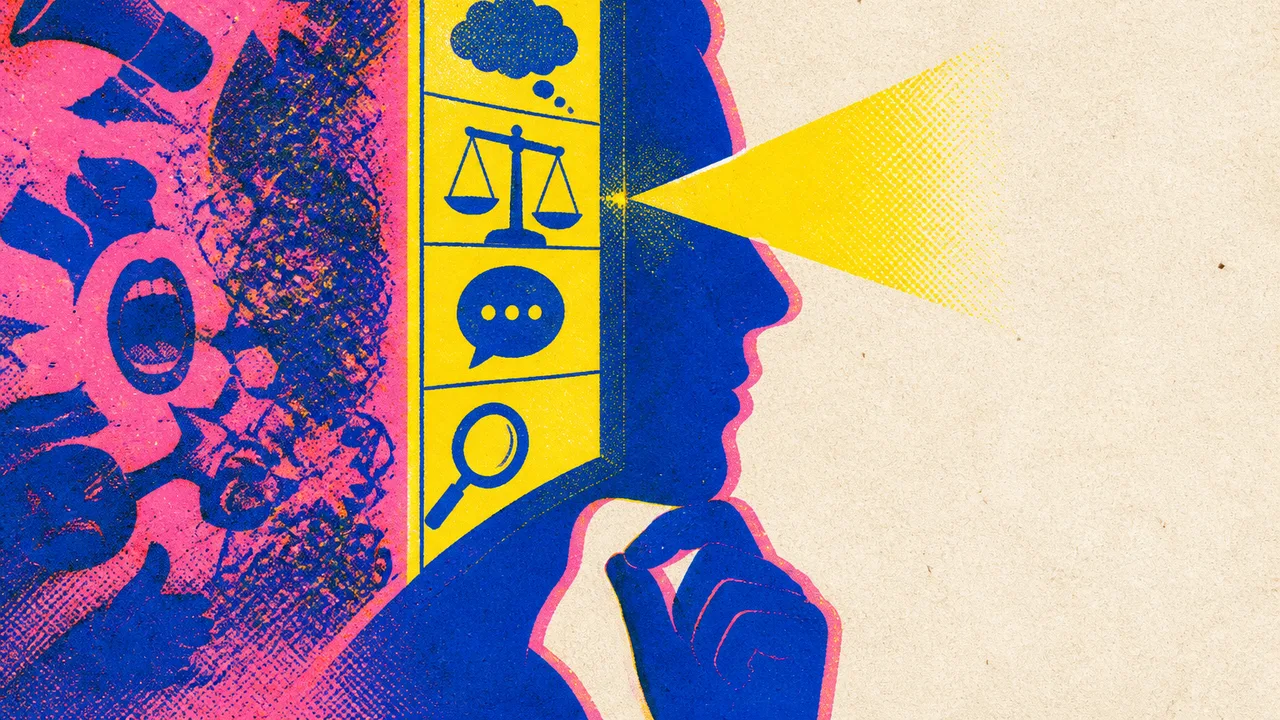
Photo: AI. Jorah Maktoum
Here's a small thing that keeps nagging at me: we live in the era of the fact-check, and yet nobody seems to feel more informed. We have Snopes, PolitiFact, a thousand browser extensions that promise to flag the bad stuff—and somehow the comment sections keep getting worse. Something in the standard "fight misinformation with more information" approach isn't landing. Which is why a recent TEDx talk by Eric McDermott, a financial planner and social media figure with half a million TikTok followers, is worth sitting with for a bit. He's not the first person to say "not all truths are created equal," but the specific way he carves it up raises some genuinely interesting questions.
The Taxonomy Problem
McDermott opens with the observation that two people can read the same headline and walk away with opposite emotional reactions—one horrified, one elated. His diagnosis: "Our brain is not built for objectivity. Our brain is built more for survival, stories, and shortcuts." This isn't a novel claim—cognitive scientists and behavioral economists have been saying versions of it for decades—but McDermott uses it as a launching pad into something more structured than the usual "watch out for your biases" advice.
His central move is to lay out what he calls the four tiers of truth: opinions, assessments, assertions, and facts. The scaffold goes like this:
- Opinions are pure beliefs—"It's too hot in here"—held loosely, shifted easily. Feathers.
- Assessments are beliefs you're committed enough to act on—"It's too hot; I'm going inside." Straw.
- Assertions are testable beliefs—"It's over 90° out here, I'm going inside." They can be confirmed or refuted. Sticks.
- Facts are beliefs that have been tested, proven reproducible, and verified by objective third parties through transparent methods. "It's 91.5°—I can see it on the thermometer and my weather app. What does yours say?" Bricks.
The taxonomy is clean and teachable. It also maps, roughly, onto distinctions that philosophers of language and epistemologists have drawn for centuries—though McDermott is upfront that he did the nerdy work of wading through "2,000 years of epistemology" to compress it into something livable. Whether you find that compression elegant or reductive probably depends on how much philosophy you've read.
The building-materials metaphor—feathers, straw, sticks, bricks—is the kind of thing that works well on a stage and works even better when he flips it. You'd build a house out of bricks, obviously. You wouldn't build a pillow out of them. The point: context determines which tier of truth is appropriate. Opinions aren't inferior to facts—they're just suited for different purposes. "Opinions should be reserved for things like what should we eat tonight and how do I look," McDermott says, while facts belong in "medical triage, building airplanes, or pretty much anything involving electricity or large equipment."
This is the framework's real value, and its most underappreciated implication. The problem isn't just that people spread misinformation—it's that they routinely apply the wrong tier of truth to the wrong situation. Treating an opinion like a brick doesn't make the opinion wrong, exactly; it makes it misapplied. Using a brick as a pillow doesn't make bricks bad—it just means you haven't thought about what you're trying to do.
Where the Framework Strains
I find this framework genuinely useful, and I also find myself wanting to poke at it.
The tidiest-looking tier is "facts"—beliefs tested, proven, and reproducible by objective third parties. But science studies and epistemology have spent a long time interrogating exactly what counts as "objective" and how reproducibility holds up under scrutiny. (The replication crisis in psychology, for instance, dented the apparent solidity of a lot of peer-reviewed findings.) McDermott's definition of a fact is aspirationally correct and practically necessary, but it quietly assumes that we can always locate trustworthy third parties and transparent methodologies—which is precisely what becomes contested when trust has already broken down. The framework describes the destination well; it's less clear on how you navigate the journey when institutions are themselves the disputed variable.
There's also a reasonable counterargument that the line between "assertion" and "fact" is fuzzier than the framework implies. In practice, many claims exist in an ongoing state of being-tested-but-not-fully-resolved. Climate science is factual consensus; early pandemic guidance on transmission was, at various points, its best available assertion. Treating these as categorically different might actually make it harder to communicate scientific uncertainty honestly.
None of this breaks the framework—it just means it's a starting-point tool rather than a complete solution. Which McDermott would probably concede.
The Trust Problem Is Actually the Harder Problem
Halfway through, McDermott pivots, and this is where the talk gets more interesting to me. He's just finished laying out the four tiers and then effectively says: none of that is enough.
"Truth alone is like one hand clapping. What's missing? Trust."
He's right, and this is probably the part worth thinking about longest. The reason fact-checking hasn't resolved the misinformation crisis is that factual accuracy and social trust are doing different jobs. You can hand someone a brick and they'll decide what to do with it based on how much they trust you, not based on the brick's structural integrity. "Those very same bricks," McDermott notes, "can be used to throw through a window."
His response is to offer what he calls the "three eyes of trust"—intention, integrity, and impact—as a way of evaluating whether a source is worth trusting at all.
The most practically useful of the three, in my reading, is integrity—specifically his heuristic for spotting it in strangers. He watches for two things: absolutes and accomplishments. On absolutes: "Always, never, everyone, definitely... these are the linguistic equivalent of expired milk." That's a note worth taping to your monitor. Sweeping certainty from someone who has no particular reason to have sweeping certainty is a signal, not a credential. On accomplishments versus assurances: what has this person or institution actually produced, repeatedly, under verifiable conditions? Not "trust me," but "here's the evidence of what I've done."
The intention piece—his call to shift from "winning" to "succeeding" in disagreements—is the softest element of the talk, and it knows it. "Winning is about being right. Success is about a better future. I might be able to win an argument with my wife, but I will not succeed." It lands as warmly as it's meant to. Whether it's operationalizable at scale is a separate question. Telling people to want better outcomes rather than victory is the kind of advice that sounds obvious until you're in an actual argument about something you care about, at which point the advice tends to evaporate.
Impact, the third eye, is the framework's most practical lever: calibrate how much epistemic rigor you need to the stakes of the decision. Trusting your friend's opinion on what to wear is appropriate when the cost of being wrong is low. Trusting an oncologist's assessment is appropriate when the cost of being wrong is your life. This isn't a new insight—it roughly describes how most of us behave already—but naming it explicitly is a useful corrective for the moments when we're either over-investing scrutiny in low-stakes questions or dangerously under-investing it in high-stakes ones.
What the Framework Doesn't Do
McDermott closes with the idea that "trust and truth begin local"—that while misinformation runs global, the practice of epistemic care starts with individuals applying it to themselves and their immediate communities. It's a hopeful note, and it's one I'm genuinely uncertain about. There's a version of this that's true: modeling better information habits does ripple outward. There's another version where it risks becoming the individualist response to a structural problem—the same move as telling people to recycle while the fossil fuel industry shapes energy policy.
The talk doesn't really address the machinery that manufactures and distributes misleading information at scale—the algorithmic incentive structures that reward outrage, the economic interests served by confusion, the political actors who benefit when epistemic norms collapse. That's a much bigger conversation than twelve minutes can hold, and McDermott's project is explicitly a personal tools talk, not a media criticism talk. But knowing what a framework isn't designed to do helps you use what it is designed to do more honestly.
What McDermott has built is a practical vocabulary for a problem that often goes nameless in daily life. Most of us already sense that "opinions treated like facts and facts treated like attacks" is happening everywhere—he just gives you a cleaner way to identify the mechanism in real time and ask the right question: what kind of truth is this, and is it being used appropriately?
That question, applied consistently and honestly, probably won't fix the internet. But it might change the next conversation you have.
More Like This
Spotting Bad Dating Advice on Social Media
Discover how social media skews dating advice and learn to find reliable, evidence-based relationship guidance.
Rethinking Reasonableness for Neurodiverse Justice
Exploring the legal challenges faced by autistic individuals and the need for reform.
The Power of Starting Conversations with 'What'
Discover how asking 'what' instead of 'why' can transform communication and influence.

Tom Scott's Counterintuitive Advice for Creators
Tom Scott spent over 25 years making internet content. His WIRED creator Q&A is full of honest, sometimes uncomfortable advice most YouTube gurus won't give you.

The Algorithm Knows You Better Than You Think
Crash Course's Hank Green explains how recommendation algorithms exploit our worst impulses—and what it costs creators who refuse to play along.

Your Inner Climate Is Already Shaping Every Room
Ajai Kumar's TEDx talk on "inner climate" offers a practical framework for emotional influence—here's what it gets right, and what's worth questioning.

Why Being Complicated Might Be the Point
Yahia Ghaleb's TEDx talk argues we should stop flattening ourselves into simple labels. Here's what the psychology actually says about living in the gray.
YouTube Lighting for Beginners: What Actually Matters
Before you buy a new camera, fix your lighting. A practical breakdown of what beginner YouTubers get wrong—and how to fix it for under $50.