Tom Scott's Counterintuitive Advice for Creators
Tom Scott spent over 25 years making internet content. His WIRED creator Q&A is full of honest, sometimes uncomfortable advice most YouTube gurus won't give you.

Written by AI. Nadia Marchetti

Photo: AI. Otieno Okello
Here's what I keep turning over: Tom Scott built a genuinely large audience on YouTube by being — almost pathologically — honest. No fabricated drama. No AI-generated cauldron explosion with an uncanny valley version of his own face. No gambling sponsors. He said no to the thumbnail that would have gotten more clicks, and yes to the one that was actually true. On a platform that has spent fifteen-plus years perfecting the machinery of manufactured desire, that is a strange and slightly anomalous data point.
It's the kind of thing I'm professionally drawn to. Things that shouldn't work, but do.
Scott appeared in WIRED's Creator Support format — a Q&A format where real people submit real questions — and the session runs 24 minutes of the most unsentimental creator advice I've come across. Not because Scott is harsh. He isn't. He's warm, funny, occasionally self-deprecating to a degree that borders on therapy-avoidance. But he will not tell you what you want to hear. And in a genre absolutely overrun with people who will tell you exactly what you want to hear for $19.99 a month, that's genuinely odd.
The question that carries the most weight isn't the one Scott spends the most time on.
Someone called Beneficial List asked: "How do you deal with burnout when your heart is tired but you don't want to give up?"
Read that again. When your heart is tired. That's not a productivity question. That's someone at the edge of something. And it came, Scott notes with gentle specificity, from a subreddit for an adult content platform — a detail that shifts the entire frame. Burnout on a platform where intimacy is the product is a different animal. You're not just depleting creative reserves. You're depleting something harder to replenish.
Scott doesn't pretend to solve it. "I'm not a therapist. I wish I knew," he says. What he does offer is a structural observation that I think is more useful than most burnout advice: the more you feed personal material — memories, vulnerability, pieces of yourself — into the content engine, the better the audience tends to respond. And there is a finite supply of that material. Which means the most "authentic" creators are often running the most unsustainable operation.
Worth sitting with.
On the mechanics of the platform, Scott is largely persuasive — with some asterisks worth noting.
His reframe of the YouTube algorithm is the bit that's gotten the most traction, and it deserves scrutiny as well as credit. He relays advice he says he received from a YouTube head of product recommendations (identified only as "Todd"): in any sentence where you use the word algorithm, replace it with audience. The algorithm isn't a gatekeeper making arbitrary decisions — it's trying to be a transparent layer that surfaces what people actually want to watch.
It's a tidy reframe. It's also possibly too tidy. "The algorithm reflects the audience" is both true as a general principle and conveniently self-exonerating for a platform that has faced significant criticism for shaping audience behavior rather than merely reflecting it. The rabbit hole recommendation problem, the outrage engagement loops, the way Watch Time as a metric historically rewarded videos that kept people watching past the point of enjoyment — none of that disappears because we swap one noun for another. Scott isn't wrong that creators should think about human attention rather than gaming a machine. But "the algorithm is just the audience" slides over the fact that the audience's behavior on the platform is itself shaped by how the platform was designed.
I find Scott credible. I also think this is a place where he might be rationalizing a platform relationship that is, structurally, complicated.
The thumbnail conversation is the most honest thing in the session, and it reveals something about Scott's actual theory of audience.
YouTube's AI tools will now generate thumbnails automatically. Scott tested this for a video he filmed at a candy factory. The AI produced: a cauldron with dramatic bubbling sugar, and Scott himself — rendered in full uncanny valley — apparently recoiling in terror from a vat he was actually just standing next to, calmly, holding a camera.
"It's a very good thumbnail," he admits. "It would have attracted people to the video."
He didn't use it. Not because he's above optimization — he A/B tests three titles and three thumbnails per video, which is not the behavior of a man who has transcended the platform — but because the thumbnail was a lie, and the audience it would have attracted wasn't his audience. He'd have gotten views from people who wanted dramatic confectionery peril and got a thoughtful factual video instead. Those viewers leave. They tank your metrics. They're not who you were making it for.
Scott's position — thumbnails matter enormously and they should be honest — is a more sophisticated argument than either "clickbait works" or "clickbait is evil." It's a targeting argument. Deceptive packaging doesn't just offend your existing audience; it imports the wrong new audience and leaves you worse off than before.
Whether this holds universally is another question. Scott makes factual content for an audience that has specifically opted into his particular brand of rigorous transparency. The calculus might look different for a creator whose audience is fine with a little spectacle. But as a framework for thinking about what a thumbnail is for, it's more useful than most.
The brand deal section is where Scott's honesty about his own compromises is most interesting.
He draws a line at gambling sponsors and apps that use gacha mechanics — addiction-adjacent monetization, essentially. He won't take those. And then he immediately acknowledges the meta-structure of that position: everyone draws their ethical line just below what they're actually doing. The person who takes gambling sponsors draws the line at something else. The person who takes nothing draws the line at Scott.
"Everyone draws the line of what is an acceptable brand deal just below what they're doing."
He says this without defensiveness, which is disarming. He also mentions — flagging it explicitly as a rough rule of thumb that will vary enormously by creator, niche, and deal structure — that brand deals can pay around ten times what platform ad revenue generates. That figure comes from his own experience and is clearly not a universal rate. But it explains, without requiring much further analysis, why the brand deal ecosystem is what it is.
The career-arc advice is where Scott is least useful to most people, and he seems to know it.
His story: he spent decades making things for the internet before his channel found real traction, then jumped to full-time when he had savings, a deteriorating work situation, and some momentum coinciding at once. He is explicit that this was luck. He's explicit that most people don't have savings or time or the alignment of circumstances that made his leap viable. He told someone he'd just met — who had 5,000 TikTok followers and was considering quitting their job — that this was probably a bad idea.
"It is financially reckless to jump out of a job that you need because there might be something coming in in future that is massively unfair, but unfortunately capitalism."
That's not inspirational. It is, I think, true.
What he's less good at is the question of what you do if you have none of those structural advantages — no savings, no time, no flexibility. The advice to "build a buffer," to "make stuff and make stuff and make stuff," to find your ikigai (what you love, what you're good at, what the world needs, what you can be paid for) — this is sound, and it's also advice that requires leisure to act on. Scott knows this. He gestures at it. He doesn't resolve it, because it can't be resolved inside a 24-minute Q&A.
The final question in the session is the one that keeps surfacing for me.
Someone from the LA influencer snark subreddit — so, yes, asked with some edge — wanted to know what happens to creators when they're no longer relevant. Scott's answer is the Michael Underwood answer: Underwood was a Blue Peter presenter in the UK (a long-running BBC children's institution, for readers who didn't grow up with it) who is now a teacher. He occasionally surfaces on TikTok. Former viewers in their thirties recognize him and say thank you. He seems happy.
"Pop culture is ephemeral. Relevancy is ephemeral. There is always a peak and there is always a comedown after. And the comedown sucks. But what a joy to be able to say, 'I did that.'"
Scott frames this as consolation. I'm not entirely sure it's only that. There's something in it that also functions as permission — to not organize your entire self around peak relevance, to not treat the metric as the point. Whether that permission is easier to extend when you've already had the peak is a question Scott doesn't raise, and probably should.
Which is either the one blind spot in an otherwise unusually self-aware set of answers — or a mercy, depending on where you're standing when you ask it.
More Like This
Unraveling the Mysteries of Magic in Middle-earth
Explore how magic in Middle-earth defies traditional spells, rooted in nature, craft, and intent.
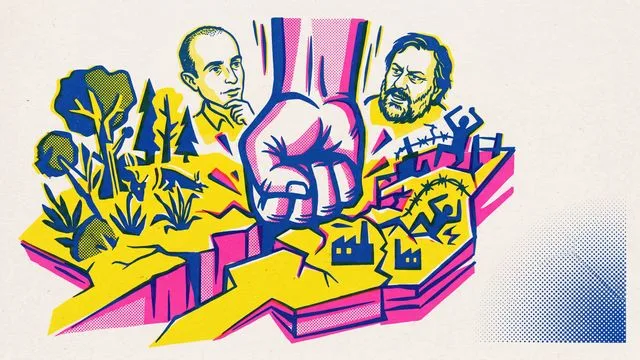
Is Nature Good? Harari and Žižek Say No
Yuval Noah Harari and Slavoj Žižek agree: nature isn't inherently good. Their debate reveals why "natural" is almost always a political argument in disguise.
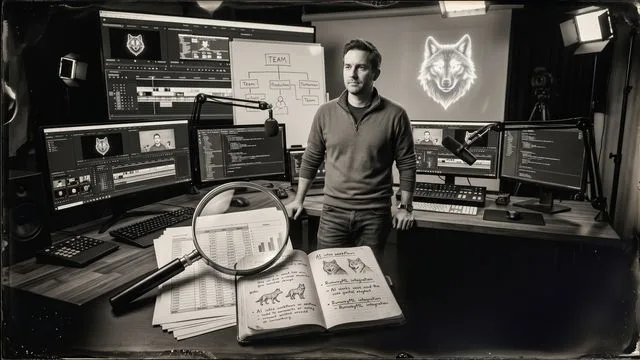
Inside Matt Wolfe's AI Creator Operation
Matt Wolfe breaks down the real costs, team structure, and AI workflows behind one of YouTube's biggest AI channels. The numbers are surprising.
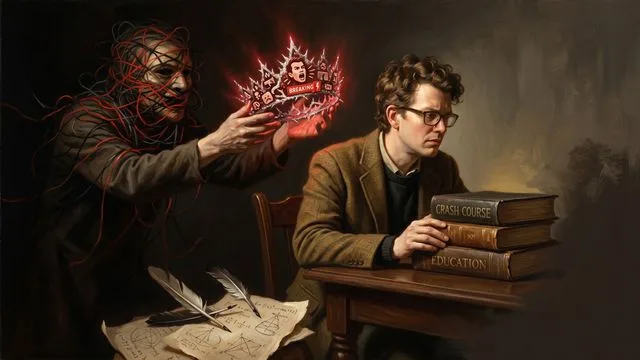
The Algorithm Knows You Better Than You Think
Crash Course's Hank Green explains how recommendation algorithms exploit our worst impulses—and what it costs creators who refuse to play along.
How Ancient Athens Actually Invented Democracy
Mass graves, marble lottery machines, and a reformer with divine backing: NOVA's Athens documentary reveals democracy's stranger-than-expected origins.
Lee Cronin's The Mummy Wears Egypt Like a Mask
Lee Cronin's The Mummy sells Egypt and delivers Evil Dead. The visual identity gap between what it promises and what it shows is where the film collapses.
Do DMT Entities Point to Alien Consciousness?
Cognitive scientist Donald Hoffman claims DMT entities may be real alien minds. The math is real. Whether it proves anything about consciousness is a different question.

Viking Landers and the Unsolved Mars Life Debate
Fifty years after Viking landed on Mars, one experiment's positive result remains unexplained. Here's what the science actually shows—and what we've learned since.