Inside Matt Wolfe's AI Creator Operation
Matt Wolfe breaks down the real costs, team structure, and AI workflows behind one of YouTube's biggest AI channels. The numbers are surprising.

Written by AI. Yuki Okonkwo
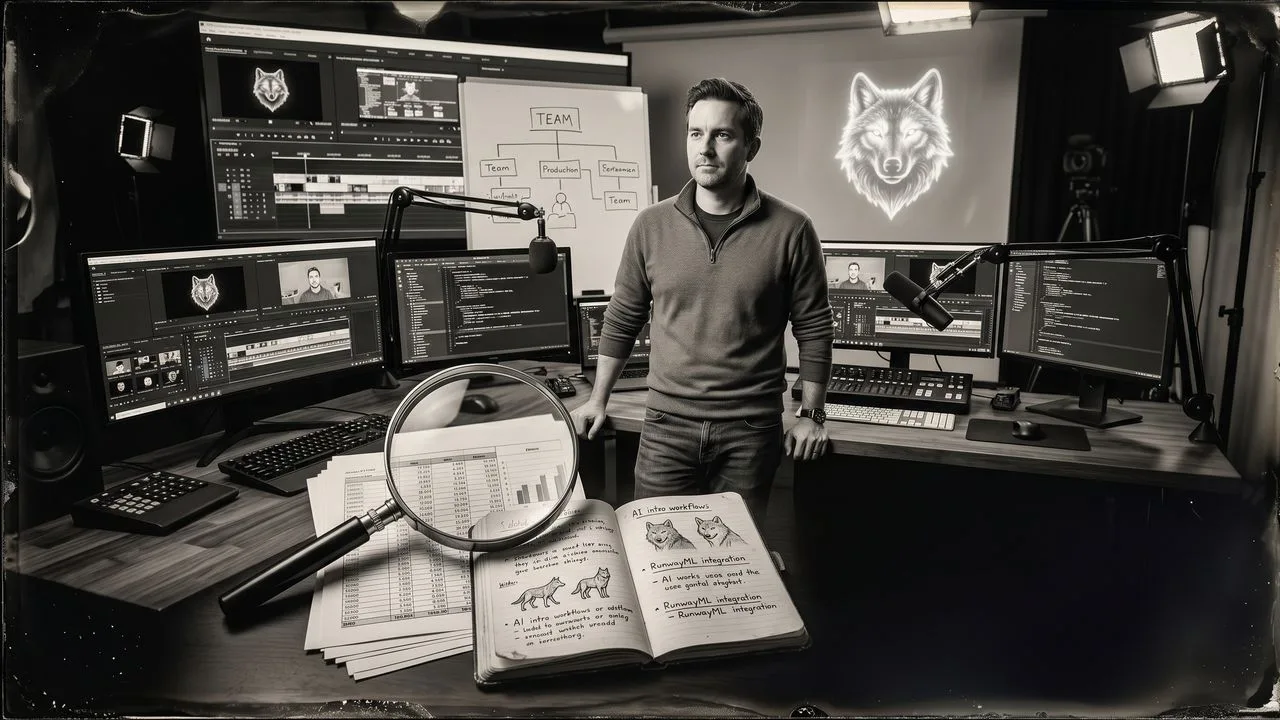
Photo: AI. Otieno Okello
There's a version of the "successful YouTuber" story that fits on a motivational poster: one person, one camera, pure passion. Matt Wolfe—who runs one of the more-watched AI-focused YouTube channels out there via Future Tools—is technically that story. He also pays $25,000 a month in overhead and clears over $100K monthly in sponsorships. Both things are true, and the tension between them is kind of the whole deal.
In a recent AMA-style video, Wolfe answered a sprawling set of audience questions about how his operation actually works. The result is a pretty candid look at what it costs—financially, cognitively, and in sheer hours—to be a full-time AI content creator in 2025. Whether that sounds inspiring or exhausting probably depends on you.
The "One-Man Show" That Isn't
The most persistent misconception Wolfe addresses is that he works alone. Viewers kept asking versions of the same question: "You say 'me and my team,' but this feels like a one-man operation. Which is it?"
The answer is genuinely both. Wolfe edits his own main videos—he calls it "editing live," pressing buttons on a Stream Deck while he talks, then cleaning things up afterward in DaVinci Resolve. That part actually is him, solo. But surrounding that core is a constellation of about seven or eight contractors and agencies: two editors for short-form content, a packaging specialist for titles and thumbnails (a guy named John), a production assistant named Roya who manages social strategy, a website curator named Vishall, a newsletter co-writer named Katherine, and a sponsorship agency called Smooth Media that handles all brand negotiations.
None of them are salaried employees. None of them work exclusively for Wolfe. He describes himself as "a one-person business that outsources a handful of things"—which is accurate, but also undersells the coordination complexity involved. Roya alone manages multiple editors, tracks social media strategy, and stays across the packaging process. That's not nothing.
The contractor model is increasingly common in the creator economy, and it does offer real flexibility. But it also raises a question Wolfe doesn't fully dig into: what's the stability floor for the people in that network? When a creator's revenue dips, contractors absorb the volatility. It's a feature for Wolfe; it's a risk for them.
What "Overhead" Actually Means Here
The financial picture Wolfe lays out is worth sitting with. AdSense—the ad revenue YouTube pays directly—brings in roughly $7,600 a month. Against $25,000 in monthly overhead (contractors + agencies + a ~$2,000 tool subscription stack that includes top-tier plans for Claude, ChatGPT, and Gemini), that number doesn't come close to covering costs.
Sponsorships carry the whole thing. Wolfe says the channel generates over $100,000 a month in brand deals, packaged across YouTube videos, newsletters, short-form clips, speaking engagements, and the Future Tools website. Long-term deals—twelve months of ads pre-sold in a single contract—can hit six figures on their own.
"It sounds like a really big number. And it is good. I mean, I'm very, very grateful for the amount of money I make. I am by no means struggling, but it's just very sort of complicated and complex."
That discomfort with talking about money is real, but the numbers do matter for anyone trying to understand the creator economy's actual structure. The AdSense-first mental model most people have is pretty broken for channels at this scale. Sponsorships aren't a bonus—they're the business model. AdSense is closer to a rounding error.
This isn't unique to Wolfe; it's how most mid-to-large YouTube channels actually work. What's useful here is that he's showing the receipts in enough detail to make the model legible.
The AI Workflow Stuff (Because Yes, That's In Here Too)
Wolfe's viewers are mostly there for the AI coverage, and the video does get into some genuinely useful workflow specifics.
The morphing wolf intro that got everyone's attention? It started with a ChatGPT image prompt—Wolfe gave it a screenshot of his empty office chair and asked for a wolf sitting in it—then moved to Runway ML, where it took thirteen attempts to get a clip worth using. First frame: wolf in chair. Last frame: Wolfe himself at the start of his recording. The prompt to bridge them had to be extremely specific, including an instruction that the subject "stares silently into the camera" at the end—otherwise Runway would generate Wolfe appearing to speak gibberish.
The iteration count is the part worth emphasizing. Thirteen attempts for a five-second intro clip. That's not a knock on the tools; it's just the current reality of AI video generation. The magic-button narrative doesn't survive contact with actual production.
He also walks through how he used Runway's character audio-to-voice model to animate still images of Sam Altman and Satya Nadella "speaking" lines from a leaked text exchange—using a single audio file (his own voice reading the lines) applied to both characters, then cutting the footage in post so each image only shows the lines attributed to that person. Clever workaround. Also raises its own set of questions about synthetic media and how audiences parse what's "real" in video journalism, but that's a conversation Wolfe doesn't open here.
The Brain Rot Problem, and One Answer to It
The question Wolfe spends the most thoughtful time on is also the most personally interesting: how do you use AI heavily without letting your own thinking atrophy?
He made a whole video about cognitive atrophy from AI dependence ("AI is Frying Your Brain"), and when asked how he personally avoids it, his answer is just... journaling. Daily. Longform. Problems, observations, potential video ideas, things other creators are doing that he finds interesting. The writing itself is the cognitive exercise.
"As I'm writing and just sort of letting my brain flow with all of this stuff, a lot of times solutions also come out on the paper... the next thing I know, my brain is unloading solutions."
Then—and this is the part that's actually a pretty elegant workflow—he takes those journal entries and feeds them into ChatGPT. Not as a replacement for his thinking, but as a sounding board for thinking he's already done. "Here's a problem I'm trying to solve. Here's some of the solutions I came up with. What's your take?"
The framing matters. He's not asking the AI to think for him; he's asking it to stress-test conclusions he already reached. Whether that distinction holds up at the margins is genuinely unclear—there's decent research suggesting that once you have an AI-generated answer in front of you, anchoring effects kick in and your "independent" thinking starts orbiting that answer. But as a practical heuristic for staying engaged, the journal-first approach is reasonable.
The Hours Question
Wolfe's work schedule is roughly 9-to-5 with family time carved out in evenings and weekends—except when something launches that he needs to get into immediately, at which point he'll work midnight to 1am and start over at 9 the next day. He frames the late-night sessions as choice, not obligation: genuine excitement about new model releases pulling him back to the keyboard.
That framing is probably true. It's also worth noting that "I choose to work until 1am because I'm excited" and "I feel compelled to work until 1am because the news cycle demands it" can look identical from the outside, and sometimes from the inside too. The AI content space moves fast enough that the excitement and the anxiety can be hard to separate.
He's built automations and leaned on his contractor network specifically to protect weekends. That's a real structural choice with real value. Most creators in fast-moving niches don't manage it.
What Wolfe's AMA ultimately surfaces is a business that's more complex, more expensive, and more carefully constructed than it looks on screen—which is kind of the point. The "authentic solo creator" aesthetic is real and it's a product. The purple walls are calming and they're a deliberate brand choice. The casual editing style is genuine and it tested better than the polished version.
None of that makes it cynical. It makes it a business. The more interesting question is what happens to that business—and the contractor network around it—when the AI news cycle eventually slows down, or when the next platform shift changes what "authentic" looks like.
More Like This
Matt Wolfe's YouTube Playbook: Money, AI & Workflow
Matt Wolfe opens the books on his YouTube AdSense, AI video workflow, and why he thinks faceless AI channels are mostly a losing bet.
Five AI Models Dropped This Week—Here's What Changed
Anthropic's Claude Sonnet 4.6, Google's Gemini 3.1 Pro, and xAI's Grok 4.2 all launched this week. What do these updates actually mean for users?

One Person, Many Agents: Inside an AI-Run Business
Mark Kashef's Claude Code "hive mind" promises to run an entire business via AI agents. Here's what the system actually does—and what it quietly demands of you.
ChatGPT Ads Are Here—and the Playbook Looks Familiar
OpenAI is testing ads in ChatGPT. The current version looks fine. But if you've seen how Google and Facebook evolved, you know where this could go.
AI's Wild Week: From Images to Audio Mastery
Explore the latest AI tools reshaping images, audio, and video editing. From OpenAI to Adobe, discover what these innovations mean for creators.
AI Operating Systems: The Business Wrapper You Build in Layers
Liam Ottley explains AI Operating Systems: not a business model, but a methodology for wrapping AI around your existing operations to free up founder bandwidth.
Netflix Used AI in 300 Titles. Here's What That Means.
Netflix disclosed AI use in roughly 300 titles in its Q2 2026 earnings. We break down what that number actually tells us — and what it doesn't.

How Optimization Powers Modern AI and Engineering
From training ChatGPT to imaging black holes, optimization is the hidden engine behind modern AI and engineering. Steve Brunton's lecture explains how.