AI Productivity Tools Are Making Workers Exhausted, Not Efficient
Research shows AI tools intensify workloads rather than reduce them, leading to cognitive exhaustion researchers are calling 'AI brain fry.'

Written by AI. Yuki Okonkwo
YouTuber and AI commentator Matt Wolfe dropped something unexpected in his latest video: after six years of evangelizing AI tools, he's feeling... dumber? And more exhausted than ever, despite supposedly being more productive.
Before you dismiss this as one creator's burnout talking, here's the thing—there's actual research backing up what Wolfe and apparently a lot of other people are experiencing. And the findings are kind of alarming.
The Productivity Paradox Nobody Warned You About
Harvard Business Review published research in February with a title that should make every productivity bro pause: "AI Doesn't Reduce Work, It Intensifies It." They studied a 200-person tech company over eight months, and what they found contradicts basically every promise we've been sold about AI assistants.
The tldr: "AI tools don't reduce work, they consistently intensify it. In the study, employees worked at a faster pace, took on a broader scope of tasks, and extended work into more hours of the day, often without being asked to do so."
Here's what actually happened when these employees got access to AI tools (voluntarily, not mandated): Product managers started writing code. Researchers took on engineering tasks. People did work they would have previously outsourced or just... not done.
Because AI makes you feel like you can do anything, people started doing everything. The work that used to take hours now takes 45 minutes, but instead of reclaiming that time, workers just stacked more tasks on their plates.
Developer Siddhant Khare articulated this perfectly in a blog post that went viral before the HBR study even dropped: "I shipped more code last quarter than any quarter in my career. I also felt more drained than any quarter in my career. These two facts are not unrelated."
From Creator to Inspector
The shift Wolfe and Khare describe is subtle but significant. The job used to be: think about problem, write code, test it, ship it. Creating. Making things.
Now? It's: prompt, wait, read output, evaluate output, decide if it's correct, decide if it's safe, fix the parts that aren't, reprompt, repeat. You've become a quality inspector on an assembly line that never stops.
As Khare puts it: "Creating is energizing. Reviewing is draining."
And because tasks feel so easy now—just type a prompt and hit enter—people find themselves working through lunch, prompting from the couch while watching TV, checking chatbots before bed. The boundaries between work and not-work blur until they basically disappear.
The HBR study found the same thing: "Prompting during breaks became habitual. So downtime no longer provided the same sense of recovery that it used to give you."
Welcome to AI Brain Fry
Harvard Business Review gave this phenomenon an actual name in a follow-up study of 1,488 full-time US workers: AI brain fry.
Participants described it as a buzzing feeling, mental fog, difficulty focusing, slower decision-making, headaches. The study found this cognitive exhaustion "carries significant costs in the form of increased employee errors, decision fatigue, and intention to quit."
Interestingly, there's nuance here. When AI replaced routine, repetitive tasks, burnout scores (though not mental fatigue scores) actually went down. The problem is specifically with oversight—the constant monitoring and evaluation of AI outputs.
Oh, and here's a fun data point: productivity scores peaked at three AI tools. Add a fourth? Productivity drops because you're now juggling too many things at once.
Your Brain Is Actually Changing
The most unsettling research comes from MIT, in a paper titled "Your Brain on ChatGPT: Accumulation of Cognitive Debt When Using an AI Assistant for Essay Writing Tasks." (Sidebar: the paper includes a section called "how to read this paper as a human" and literally gives instructions to LLMs that might be reading it, which is both hilarious and depressing.)
They split 54 people into three groups: one could use ChatGPT for essay writing, one could use search engines, one had to use brain only. After three essays, they flipped it—the LLM group had to write with brain only, the brain-only group got access to LLMs.
And they hooked everyone up to EEGs to measure brain activity.
The results: When people who'd been using LLMs had to write without them, their brains showed significantly less activity. They struggled harder. The muscle had atrophied.
Meanwhile, the brain-only group who then got LLM access did better—because they'd been training their thinking muscles and used AI as an extension, not a replacement.
The paper's conclusion: "The LLM undeniably reduced the friction involved in answering participants' questions compared to the search engine. However, the convenience came at a cognitive cost, diminishing users' inclination to critically evaluate the LLM's output or opinions."
Wolfe compares it to phone numbers—we used to memorize dozens of them, and then smartphones came along and our brains just... stopped. The muscle disappeared because we didn't need it anymore.
What We're Not Talking About
Here's what strikes me about all this research: it's not anti-AI pearl-clutching. It's documentation of a real phenomenon that people are experiencing but haven't had language for.
The promise was: AI will handle the boring stuff so you can focus on high-value creative work. The reality seems to be: AI will help you do six things at once, none of them particularly well, while your brain turns to mush and you work through dinner.
And nobody's really talking about the FOMO treadmill Khare describes—the constant releases, the new agents, the LinkedIn posts telling you you're "already obsolete" if you're not using the latest framework. Wolfe, who literally spends 3-4 hours daily tracking AI developments, admits: "this pace makes my head want to explode."
The research isn't saying "don't use AI." It's saying: be aware that the convenience has a cost. Your brain is plastic—it adapts to what you ask of it. If you outsource your thinking entirely, you will get worse at thinking. If you treat AI as an extension rather than a replacement, you might actually get better.
The question isn't whether AI makes you more productive. Clearly it does, in raw output terms. The question is: productive at what cost? And is anyone measuring that?
More Like This
Claude Just Got Skills for Excel and PowerPoint
Anthropic released three major updates to Claude's Office integrations, including custom Skills that let you automate workflows in Excel and PowerPoint.
Five AI Models Dropped This Week—Here's What Changed
Anthropic's Claude Sonnet 4.6, Google's Gemini 3.1 Pro, and xAI's Grok 4.2 all launched this week. What do these updates actually mean for users?
Claude Code & Remotion: A Game-Changer for Video
Explore how Claude Code and Remotion transform video creation with AI-driven motion graphics. Dive into the future of content creation.
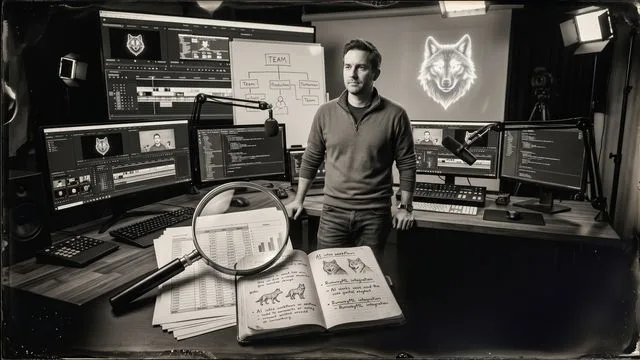
Inside Matt Wolfe's AI Creator Operation
Matt Wolfe breaks down the real costs, team structure, and AI workflows behind one of YouTube's biggest AI channels. The numbers are surprising.

Why Your Company's AI Tool Keeps Failing You (And How to Fix It)
Corporate AI tools often can't do the actual work. Here's how to measure the gap and make a case for better tools without sounding like the problem.
ChatGPT Ads Are Here—and the Playbook Looks Familiar
OpenAI is testing ads in ChatGPT. The current version looks fine. But if you've seen how Google and Facebook evolved, you know where this could go.

AI Coding Tools May Erode Developer Skills
A small but pointed Anthropic study finds junior developers who use AI score worse on coding quizzes—especially in debugging. Here's what the data actually says.

Garry Tan's Blueprint for the AI-Native Company
Y Combinator's Garry Tan argues that how you organize AI matters more than which AI you use. Here's what that means in practice.