Sun Tzu's Brutal First Lesson and the Real Art of War
A new documentary examines the palace courtyard execution that launched Sun Tzu's career—and asks whether we've been misreading The Art of War for 2,000 years.

Written by AI. James Morrison
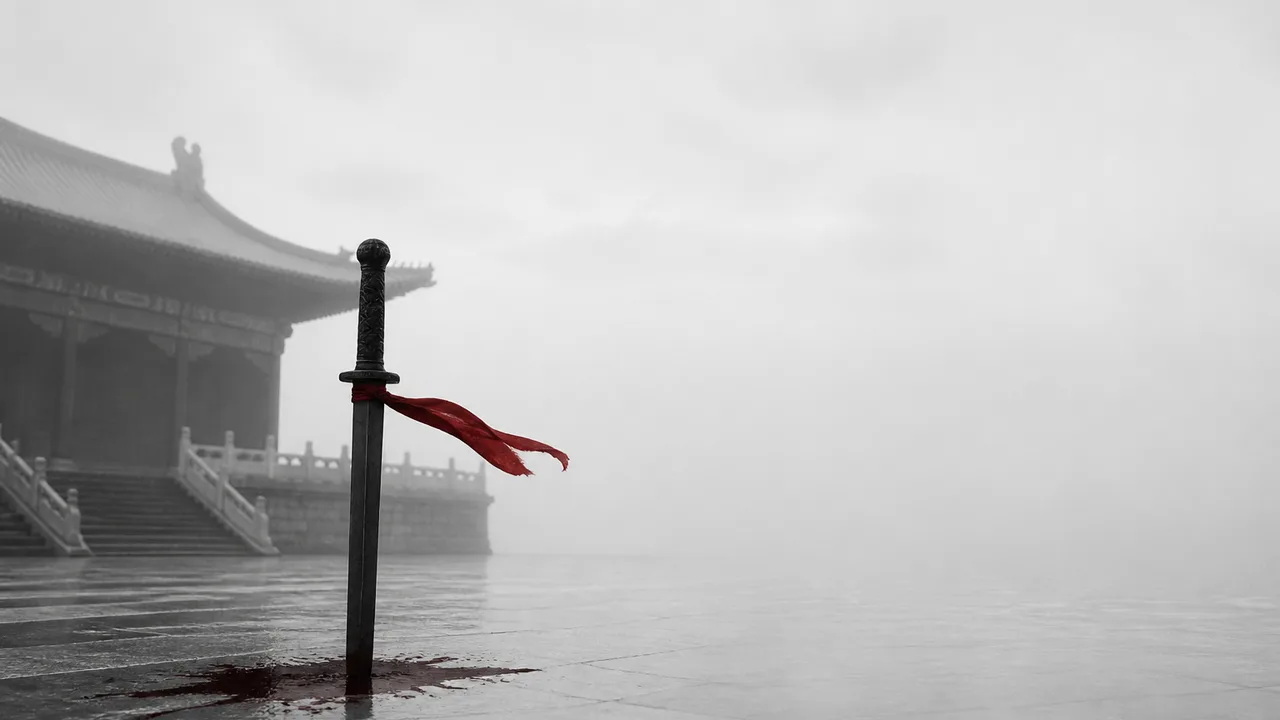
Photo: AI. Tomoko Hayashi
Pick up a copy of The Art of War at any airport bookstore and you'll find it shelved between titles on negotiating salary and disrupting your industry. The cover art tends toward minimalism. The back copy promises competitive advantage. Sun Tzu, history's most repurposed strategist, has been made safe for conference rooms.
A new documentary from the YouTube channel Ancestral has no interest in that version of the man.
The film, running just over an hour, centers on a single scene recorded in the Shiji—the Records of the Grand Historian, compiled by Sima Qian under the Han Dynasty between roughly 109 and 91 BC. It is not a battlefield scene. It takes place in a palace courtyard in the kingdom of Wu, around 506 BC, and it involves 180 of the king's concubines, a war drum, and two bronze blades. The documentary's argument, pressed hard across its full length, is that this scene is the interpretive key to everything Sun Tzu ever wrote—and that stripping it out of his biography has produced a fundamental misreading of his text.
The argument is worth taking seriously, even if the delivery occasionally oversells it.
The World That Made the Book
The documentary's strongest material is its reconstruction of the Spring and Autumn period, the roughly 300-year continental civil war that preceded and shaped Sun Tzu's world. The Zhou dynasty had collapsed from authority into ceremony. A king still occupied the throne in Luoyang, but his power, as Ancestral puts it, "was paper." Into the vacuum poured more than a hundred competing states, each ruled by a lord who had begun calling himself a king and who understood that the prize for finishing second was extinction.
The Zuo Zhuan, a chronicle from the same era, records 36 rulers murdered and 52 states destroyed in a single century. These are not metaphors. The documentary walks through what defeat actually meant: a state's name scratched from the bamboo records, its royal family hunted to the last infant, its capital leveled and its ancestral temples burned. The objective, the film argues, was not victory. It was erasure.
This context matters enormously for reading Sun Tzu's text. When he writes that "war is a matter of vital importance to the state—the province of life and death, the road to survival or ruin," he is not composing an opening paragraph for a business book. He is describing the operating conditions of every lord he had ever served or observed.
Into this environment walked Helü, king of Wu—himself an assassin who had reached the throne through a dagger concealed inside a fish. He needed a mind capable of matching the kingdom of Chu, a rival of vastly superior numbers and resources that Wu could not hope to fight on even terms. Wu Zixu, a Chu exile with his own grievances against the Chu court, whispered a name: Sun Wu, a man from the northern state of Qi, who arrived at Helü's court carrying nothing but a manuscript.
Thirteen chapters. Bamboo slips bound in waxed silk cord. The title: The Art of War.
The Drill That Wasn't a Drill
Helü read the manuscript and summoned its author. The audience was a trap dressed as a compliment. After telling Sun Tzu that his principles were magnificent, the king posed a question designed to humiliate: could these methods impose order on anyone? Could he, for example, drill women?
The documentary renders what happened next with considerable atmospheric care. Sun Tzu said yes, was given 180 concubines to work with, divided them into two companies, named the king's two favorites as company commanders, and began instruction. The commands were simple. One drum beat: face forward. Two: turn right. Three: turn left.
The women laughed. Helü, up on his pavilion, laughed with them. The generals exchanged satisfied looks. The foreign theorist was about to embarrass himself.
Sun Tzu waited for the laughter to die, then spoke in a voice the documentary describes as belonging to "a man reading a verdict." His words, preserved by Sima Qian, are unambiguous: the orders had been clear; when clear orders go unobeyed, the fault belongs to the officers. He ordered the execution of the two company commanders.
Helü sent a messenger—a boy of fourteen, hands shaking—with a royal plea to spare the women. Sun Tzu's response, quoted directly from the Shiji, is the hinge on which the entire documentary turns: "I have already received my commission to be the general. While the general is with his army, there are orders of the sovereign which he does not accept."
In an absolute monarchy where the king's word carried the weight of heaven, this was not a negotiating position. It was treason spoken aloud in a palace courtyard. The executions proceeded. The drum sounded again. One hundred and seventy-eight women wheeled in perfect unison.
What the Shiji Preserves—and What It Doesn't
The documentary is admirably specific about its sourcing. Sima Qian compiled his history four centuries after the events he describes, drawing on archives now largely lost. He chose, of all the scenes from Sun Tzu's life, this one to define the man. He named the executioner. He named the boy messenger. He did not name the two women who were killed.
That omission—almost certainly deliberate—is something the documentary acknowledges without quite pressing. The two women become, as the film notes, "a function rather than a person." They had histories: one had borne the king a daughter; the other had risen by intelligence from a vassal household at the age of fourteen. Sima Qian had access to court archives. He chose anonymity. The historical record's treatment of these women is itself a document about what fifth-century BC Chinese historiography considered worth preserving.
According to Wikipedia's entry on Wu Zixu—which draws on the Shiji tradition—the account of what happened next at Ying, the Chu capital, carries the same quality of preserved extremity. After the Wu army sacked the city in 506 BC, Wu Zixu descended into the tomb of King Ping of Chu, the man whose false charges had killed his father and brother. The documentary, citing this tradition, recounts that Wu Zixu struck the preserved corpse 300 times with a horsewhip—a figure that appears in the Shiji but whose transmission historians have disputed. The film presents it; readers should receive it as the documentary does, as a number from the ancient record rather than a settled forensic fact.
What followed is less disputed: the sack of Ying was thorough. Palaces stripped, temples burned, ancestral tombs defiled. The Zhanghua Tai—the largest wooden structure in southern China—burned for three days. King Zhao of Chu fled into the southern marshes.
The Disappearance
The most genuinely interesting problem the documentary raises is Sun Tzu's vanishing from the historical record after Ying. The Shiji, which tracks him through the courtyard and the campaign in some detail, falls silent. No final appointment. No retirement. No death notice. The Han bibliographer Liu Xiang, four centuries later, could find no biographical record of his death.
One school holds that he retired to a modest holding on the shores of Lake Tai. The documentary dismisses this as "a clean ending" that is "unconvincing." Its alternative reading: Helü had used the weapon, won the impossible war, and now sat in his palace remembering what the man had said about a general not being bound by all of the sovereign's orders. To a king who had reached his own throne through an assassin's knife, that sentence, still attached to a living man who commanded army loyalty, was not an asset. It was a problem. The documentary suggests, carefully, that Sun Tzu may have been solved like any other problem.
Whether or not that reading is correct, it is consistent with the logic of the world the documentary has spent an hour reconstructing. The Spring and Autumn period did not produce many peaceful retirements.
The Text and Its Afterlife
The central claim the documentary makes—that The Art of War has been stripped of its original context and resold as something essentially opposite to what it is—holds up better than most revisionist history arguments. The book's most quoted line, "the supreme excellence is to subdue the enemy without fighting," has been used to argue that Sun Tzu was fundamentally a pacifist, or at least that his system minimized violence. The documentary reads it differently: subduing without fighting means breaking the enemy's will so completely before the battle begins that no battle is necessary. The courtyard was a demonstration of exactly that operation.
"All warfare is based on deception," Sun Tzu wrote. The documentary argues the courtyard was that too. Sun Tzu had told Helü that the methods could be applied to anyone. He then applied them in a way Helü had not anticipated, producing not a demonstration of military theory but a living proof that the general's authority, once granted, superseded the king's sentiment.
The text itself survived its author. The original bamboo slips were lost within a century. Copies spread. In 1972, fragments of one of those copies—the Yinqueshan bamboo slips, unearthed from a Shandong tomb dated to the second century BC—confirmed almost every passage in the standard transmission. The cold edge, as the documentary calls it, had held.
The kingdom had not. Wu fell to Yue in 473 BC. Wu Zixu, the man who had walked against the order of things, was forced to suicide in 484 BC by Helü's successor, having been ignored about exactly the threat that finally came. He reportedly asked that his eyes be removed and hung on the eastern gate so he could watch the Yue army enter. According to the Shiji, King Goujian of Yue paused beneath that gate and offered a sacrifice of wine to the eyes still hanging there.
The book outlived all of it. The question worth sitting with is whether we have done it the courtesy of reading it on its own terms—or whether we have simply taken the parts that fit on mugs and left the rest on the limestone.
More Like This
Ray Dalio's Framework for Tracking Empire Decline
Ray Dalio argues empires follow measurable, repeating cycles of rise and fall. His framework deserves scrutiny—and raises questions relevant to today's geopolitics.
Pliny the Younger's Letters on the Eruption of Vesuvius
Pliny the Younger's two letters to Tacitus remain the only eyewitness account of Vesuvius's eruption in 79 AD — and they still read like dispatches from the end of the world.
Unraveling Rome's Dodecahedron Mystery
Exploring the enigmatic Roman dodecahedron, its theories, and historical significance in modern archaeology.
FBI's Struggle Against Omega 7: A Tale of Terrorism and Intrigue
Explore the FBI's complex investigation of Omega 7, a Cuban exile terrorist group, amid community challenges and evolving tactics.
Machiavelli Gave His Secrets Back to His Torturers
Ada Palmer reframes Machiavelli not as a cynic but as a patriot who handed his most valuable knowledge to the regime that tortured him. Here's what that actually means.
Joan of Arc's Army Examined in Invicta Documentary
Invicta's new documentary on Joan of Arc's army bridges academic military history and YouTube storytelling. Harry Goodman examines what that translation costs and earns.
Benedict Arnold: Patriot, General, Traitor
Benedict Arnold won the Battle of Saratoga then betrayed his country. A new documentary examines the grievances, ambition, and political failures that made both possible.
April 1865: How the Civil War's End Was Decided
The History Channel's documentary on April 1865 examines how decisions made in a single month determined whether the Civil War's end would bring peace or prolonged guerrilla conflict.