Roosevelt's 1936 Peace Promise: What He Really Meant
In 1936, FDR ran on "peace" — but he meant three different things by it. Unpacking that word reveals a political strategy still worth examining today.

Written by AI. Sofia Ramirez
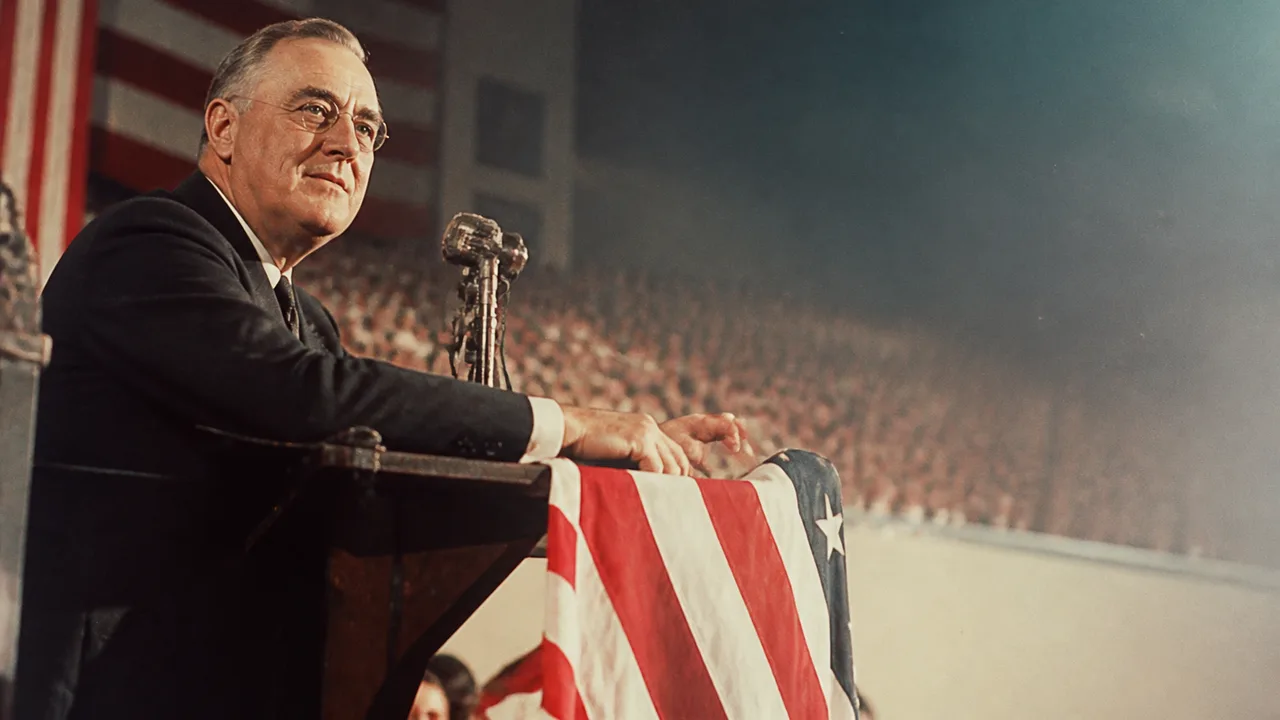
Three days before the 1936 presidential election, Franklin Roosevelt stood at Madison Square Garden and used the word "peace" to mean at least three distinct things at once. He meant it internationally — war was spreading across Europe and Asia and the crowd knew it. He meant it industrially — the labor wars of the early Depression had left real bodies and real bitterness. And he meant it as infrastructure: schools, playgrounds, parks, highways, sanitation. The government's ability to provide those things, he argued, was itself a form of peace.
Most campaign speeches collapse under that kind of analysis. Roosevelt's 1936 address holds up because each of those definitions was doing different political work, and he was skilled enough to let them blur together without the audience noticing.
Peace as a Paycheck, Peace as a Park
Start with what Roosevelt said about community. According to the MIT-archived text of his 1936 campaign address, voters "wanted peace in the community, the peace that springs from the ability to meet the needs of community life: schools, playgrounds, parks, sanitation, highways — those things which are expected of solvent local government."
Think about who was in that room hearing those words. Not just an abstract electorate — among them were people like the packinghouse workers on Chicago's South Side who had spent the early 1930s watching their neighborhoods deteriorate while their wages collapsed and their aldermen took phone calls from the meatpacking companies. For a family in a tenement with no working plumbing, a sanitation system wasn't a civic abstraction. A playground wasn't a luxury. These were the material conditions that determined whether a neighborhood held together or came apart. Roosevelt was naming that experience and calling it, pointedly, peace — the absence of the low-grade daily violence of poverty.
This was a deliberate expansion of what "peace" could mean. It reframed the New Deal not as charity but as conflict resolution — the government intervening to settle a structural dispute between the conditions people needed to live decently and the conditions the market had produced. Whether you buy that framing depends on what you think government is for. But you can see why it worked in 1936, and why the language has outlasted the specific programs.
Peace Between Worker and Boss
The second definition of peace in the Madison Square Garden speech was more pointed. The American Presidency Project's text of the address has Roosevelt calling out "reckless men" who would destroy "a new peace between worker and employer by returning to the tactics of the labor spy." He then named the paradox directly: the employers and publishers most loudly warning about class antagonism were the ones actively funding it.
The labor spy reference wasn't rhetorical flourish. Industrial espionage — planting informants in union organizing drives, surveilling workers' meetings, blacklisting organizers — was standard practice in American manufacturing through the 1930s. A union steward in an auto plant or a textile mill in 1936 operated under real surveillance, faced real retaliation, and knew that the peace Roosevelt was promising would require defeating people with money and lawyers and connections to local police. When Roosevelt named the labor spy as a threat to peace, he was speaking directly to that person.
Wikipedia's account of the Madison Square Garden speech notes that Roosevelt used the occasion to pledge continuation of the New Deal while criticizing those he believed were prioritizing personal gain over national recovery. What the encyclopedia entry doesn't quite capture is how combative the speech actually was — Roosevelt wasn't asking for cooperation. He was identifying enemies. "Never before in all our history have these forces been so united against one candidate," he said of concentrated economic power. "I welcome their hatred." That's not the language of a man trying to cool tensions. It's the language of a man who had decided that naming the conflict was itself a form of peacekeeping — that pretending the conflict didn't exist was what actually kept it hot.
Peace Abroad, and the Limits of Promise
The third register is the hardest to evaluate cleanly. The Miller Center's record of the speech quotes Roosevelt stating: "All our actions, all our ideals, spell also peace with other nations. Today there is war and rumor of war. We want none of it. But while we guard our shores against threats of war, we will continue to remove the causes of unrest and antagonism."
The crowd wanted to believe this. So, probably, did Roosevelt — at least in 1936, before Germany's intentions became undeniable and before the scale of what was coming in Asia became clear. The question is how much the promise of international peace was contingent on conditions Roosevelt couldn't control and knew he couldn't control.
His Chautauqua address earlier that year, preserved by the American Presidency Project, pointed toward hemispheric solidarity as the practical expression of that peace — the twenty-one American republics, he said, were "not only living together in friendship and in peace" but "united in the determination so to remain," with a conference scheduled for December in Buenos Aires to give that determination concrete form. This was real policy: the Good Neighbor Policy represented a genuine shift from the interventionist posture of earlier administrations, and the Buenos Aires conference happened as promised.
But the Neutrality Acts, which Roosevelt signed in this same period, constrained American action in ways that historians have since argued conflicted with his own foreign policy instincts — treating aggressor and victim nations identically, by some readings, in the name of keeping the country out of war. The gap between the peace Roosevelt promised and the mechanisms he was working with was real, even in 1936. His international peace was less a policy than a disposition, and dispositions don't hold against fascist armies.
What the Word Was Doing
The three-tiered use of "peace" across the 1936 campaign wasn't accidental. It solved a specific political problem: how do you hold together a coalition that includes industrial workers who want the government to protect their right to organize, middle-class voters who want stable communities, and an isolationist electorate that wants no part of European conflicts — without making promises to any one group that alienate the others?
You find a word capacious enough to mean something real to all of them. "Peace" in 1936 meant the WPA worker who finally had a paycheck; the union organizer who could hold a meeting without a company informant in the room; the farm family in Ohio who didn't want their son in a trench somewhere in France. Roosevelt's campaign went on to produce one of the largest electoral landslides in American history — a verdict that suggests the word found its mark.
The tension in all of this is that "peace" as a political concept does exactly what it did for Roosevelt: it resolves apparent contradictions by sitting above them. It lets a candidate be simultaneously for labor and against "class antagonism," for international engagement and against war, for government intervention and for social harmony. The word is doing the work that the policy hasn't finished yet.
That's not a criticism unique to Roosevelt. It's a feature of political language in moments of genuine crisis, when the full cost of the promises being made can't yet be calculated. The specific calculation 1936 was deferring: that keeping the peace at home and staying out of war abroad were compatible goals. By 1941, the answer was in. The workers who heard Roosevelt at Madison Square Garden and went home believing peace was coming had, within five years, sent their children to North Africa and the Pacific.
What they got instead of the peace they were promised was the GI Bill, the labor protections of the New Deal's second wave, and the postwar economic expansion that briefly made working-class prosperity look like the American default. Whether that trade was worth making — whether the infrastructure of community peace Roosevelt named in 1936 was built on a foundation that required the war to fund it — is a question the history of federal investment in American cities since 1980 keeps reopening. Look at what happened to public housing policy under Reagan, or at the fiscal crises that have gutted municipal services in post-industrial cities from Detroit to Rockford, Illinois: communities where the schools and parks and sanitation systems Roosevelt listed as conditions for peace have been systematically defunded, and where the social fabric has frayed in ways that look, from a distance, a lot like low-grade conflict. The peace Roosevelt defined was always contingent on the political will to fund it. When that will collapsed, so did the peace.
More Like This
Douglas MacArthur and the People He Left Behind
MacArthur is remembered as a military legend. But what about the veterans he gassed, the soldiers he abandoned, and the Japanese citizens who built a new democracy?
The Bari Disaster: Mustard Gas, Secrecy, and 1943
On December 2, 1943, a German raid on Bari killed over a thousand people—and released mustard gas that officials spent decades trying to erase from history.
America's Economic Cycles: Reinvention or Stagnation?
Examining America's economic pivots every 80-90 years and their impact.

Financial Crises Follow Patterns — But Not for Everyone
Kuran Francis maps four recurring patterns behind every major financial crisis. The framework is solid. What it leaves out is the story of who pays when the system breaks.
Attila the Hun: Scourge of God or Economic Strategist?
Attila never sacked Rome—yet he's history's ultimate barbarian. The real story is stranger, and more familiar, than the legend.
Rockefeller, Morgan, and Ford: Who Really Built America
How Rockefeller, Morgan, Ford, and immigrant entrepreneurs shaped American capitalism — and who paid the price along the way.
The Anaconda Plan Was Right. People Paid for It.
Winfield Scott's Anaconda Plan was strategically vindicated — but the years it took to work were paid for in hunger, death, and bondage by ordinary people.
The Spanish Civil War at 90: What the Coup Unleashed
On July 17, 1936, a military coup fractured Spain and drew the world in. What the Spanish Civil War's 90th anniversary still asks of us.