The Anaconda Plan Was Right. People Paid for It.
Winfield Scott's Anaconda Plan was strategically vindicated — but the years it took to work were paid for in hunger, death, and bondage by ordinary people.

Written by AI. Sofia Ramirez
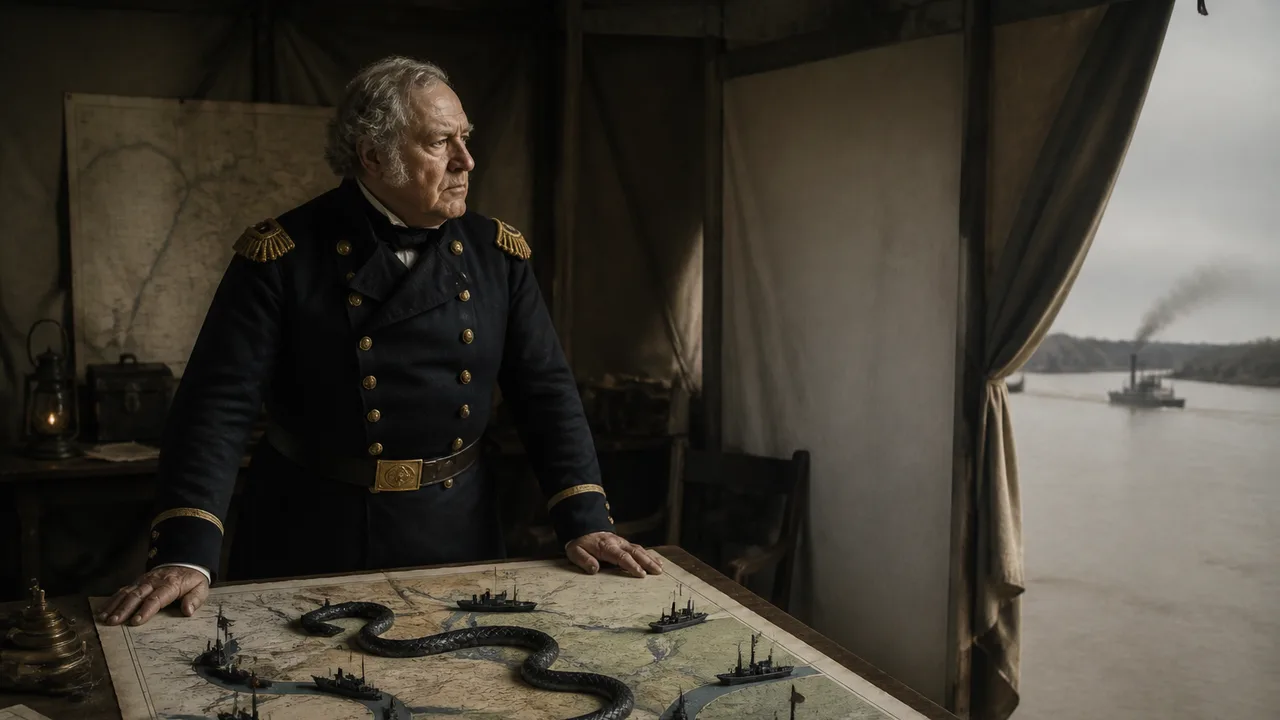
In the spring of 1861, while Northern newspapers were printing cartoons of a massive snake coiling around a map of the Confederacy — and laughing at it — Winfield Scott was sitting in Washington with gout so severe he could no longer ride a horse. He was 74 years old. He had been in uniform, at some level of service or another, for more than half a century. According to Emerging Civil War, Scott was already widely understood to be one of the longest-serving officers in American military history by the time Fort Sumter fell (Emerging Civil War). What he was proposing — a slow naval blockade of Southern ports combined with control of the Mississippi River, designed to strangle Confederate commerce without a single decisive battle — was not what the country wanted to hear.
They wanted to hear On to Richmond. They got, eventually, Appomattox. But the distance between those two things was paid for by people who never made it into the history books.
The Plan the Press Mocked
The mockery was immediate. Northern editors named it the Anaconda Plan as a taunt — the image of a snake squeezing its prey to death struck critics as sluggish, inglorious, un-American. A republic that had just been attacked wanted a war that looked like a war: infantry charges, captured capitals, the swift humiliation of traitors. Scott's proposal, according to World History Encyclopedia, was a "methodical strategy that would slowly build up a trained army while the navy enforced a blockade on southern ports meant to suffocate the Confederate economy." Slowly was the word people couldn't stand.
Scott's military logic was sound, shaped by decades of experience that included the War of 1812, the Mexican-American War, and the political crises he had personally navigated as general-in-chief. Britannica describes him as one of the commanding figures of 19th-century American military history, whose strategic thinking defined the U.S. Army for a generation. He understood — in a way that many civilian observers and even some fellow officers did not — that the Confederacy could not be defeated by capturing Richmond any more than a fire is extinguished by smothering one room. The economic and logistical infrastructure of the South had to be dismantled. That took time. That took blockades and gunboats and river campaigns, not cavalry charges.
But Scott was gone before any of it bore fruit. He resigned as general-in-chief in November 1861, according to Encyclopedia Virginia, with Lincoln immediately replacing him with George B. McClellan — a younger, more energetic man who the administration hoped might better satisfy the public's demand for visible action. McClellan's record turned out to be a catalogue of hesitations and missed opportunities that would frustrate Lincoln for the better part of a year. The contrast is almost too neat: the old man with the long view, replaced by the young man who kept finding reasons not to fight.
What "Patient" Looked Like From the Ground
Here is where I need to stop and say something the strategic analysis always leaves out.
The plan's genius was patience. But patience, as a political and military category, has a way of landing unevenly. The people absorbing it are rarely the people designing it.
Take the Union soldiers who enlisted in the summer of 1861, full of whatever combination of patriotism, economic necessity, and anti-slavery conviction brought men to the recruiting offices. Through 1861 and into 1862, the war they experienced was largely a war of stalled campaigns, inadequate supply, disease in camp, and inconclusive engagements that left them wondering what the point was. A strategy that required years to work asked those men to be its raw material in the meantime. Soldiers' letters from that period are full of a specific kind of frustration — not cowardice, but the exhaustion of men who could not see what their suffering was building toward. The Anaconda Plan did not explain itself to the private dying of dysentery outside Corinth.
Then there were Southern civilians — ordinary people, not planters, not officers — who experienced the blockade's tightening as a material fact. Inflation in Confederate states was catastrophic by 1863. Goods that had been cheap became luxuries; luxuries disappeared entirely. There were bread riots in Richmond in April 1863, led mostly by working-class women whose husbands were at the front and whose children were hungry. The blockade that Northern strategists drew on maps as a clean line of ships was, for those women, the absence of coffee and salt and eventually adequate flour. Scott's snake was squeezing them.
And then there were the people the Anaconda Plan never liberated on its own timeline: the enslaved people of the Confederate interior, for whom a naval blockade provided no freedom and considerable additional suffering. A strategy designed to weaken the Confederate economy did not, by definition, move quickly to the plantations of Georgia or Alabama. The Emancipation Proclamation of January 1863 changed the war's stated purpose, but even then, freedom arrived irregularly, violently, and only when Union armies physically appeared. The patience the Anaconda Plan required was, for enslaved people, more years inside the system the war was supposed to destroy. That is not an argument against the plan. It is an argument for understanding what "correct strategy" actually costs when it plays out across years instead of months, and who holds the tab.
Vindication, Delayed
When the war did turn, it turned on the axes Scott had identified. Fiveable summarizes the historical consensus plainly: Scott designed the Anaconda Plan — blockading Southern ports and seizing the Mississippi — and it became the strategy behind Union victory. Control of the Mississippi was achieved with the fall of Vicksburg in July 1863. The blockade, though never perfectly enforced, steadily degraded Confederate capacity to import war materiel and export cotton. The plan that the press had mocked in 1861 was, by 1863 and 1864, the operating logic of the war.
In 1864, Scott published his memoirs and sent a copy to Ulysses S. Grant, who had superseded Henry Halleck as General-in-Chief — a succession documented by the Library of Congress — and who was by then executing a campaign of sustained pressure against Lee that bore significant resemblance to the strategic patience Scott had always advocated. The gesture of one old soldier sending his book to a younger one carries something — a kind of continuity that institutions rarely acknowledge in the moment but history tends to notice later.
Encyclopedia Virginia records that Scott lived until 1866, long enough to see the Union preserved but not long enough to see whatever reckoning Reconstruction might have produced. He had been right about how to win the war. Whether anyone learned the right lessons from that vindication is a separate question.
The Harder Question, Which Is Actually About Right Now
The Anaconda Plan is a military history story, but it keeps generating a political one: what happens when the correct approach to a catastrophe is slow, indirect, and structurally invisible — and the political system demands proof of forward motion right now?
We have seen this pattern elsewhere, in ways that don't require a history degree to recognize. Climate policy that requires decades to produce measurable results, asked to compete politically with immediate economic pain. Public health interventions that work by preventing things from happening, which means their success is definitionally hard to see. Poverty reduction programs that take a generation to shift outcomes, evaluated on four-year election cycles.
Scott's story suggests that the correct strategy and the politically survivable strategy are often different things — and that the gap between them is paid for by specific people, in specific ways, that the strategy's architects never had to experience personally. The general with gout could wait. He had the luxury of the long view. Not everyone did.
The Anaconda Plan was right. The snake, eventually, did its work.
More Like This
Douglas MacArthur and the People He Left Behind
MacArthur is remembered as a military legend. But what about the veterans he gassed, the soldiers he abandoned, and the Japanese citizens who built a new democracy?
Roman Empire History With Anthony Kaldellis
Anthony Kaldellis joins Lex Fridman to argue the Byzantine Empire never existed—it was Rome all along. A historian makes the case across 2,200 years.
Gettysburg's Command Failures and What They Still Cost Us
Dr. Roy Casagranda's Gettysburg lecture reveals how four command archetypes from 1863 shaped the battle's outcome—and what they still tell us about military leadership today.
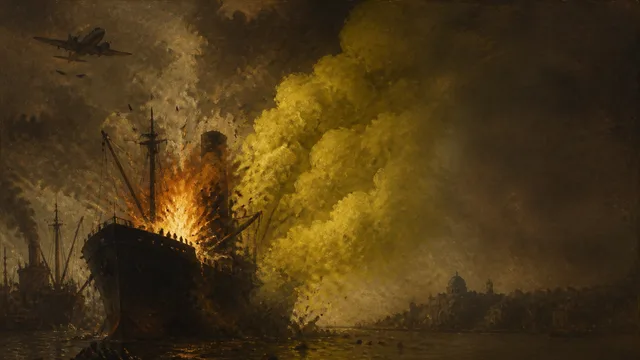
The Bari Disaster: Mustard Gas, Secrecy, and 1943
On December 2, 1943, a German raid on Bari killed over a thousand people—and released mustard gas that officials spent decades trying to erase from history.
Attila the Hun: Scourge of God or Economic Strategist?
Attila never sacked Rome—yet he's history's ultimate barbarian. The real story is stranger, and more familiar, than the legend.

When Basic Physics Secretly Rewrites the World
Don Lincoln explains how Maxwell's equations revealed the speed of light — and why what we ignore in physics today may determine our climate future.
The Spanish Civil War at 90: What the Coup Unleashed
On July 17, 1936, a military coup fractured Spain and drew the world in. What the Spanish Civil War's 90th anniversary still asks of us.
Medieval England: How Peasants and Guilds Shaped Society
A new documentary traces medieval England's social divide through two real families—one peasant, one guild merchant—and the starkly different worlds they inhabited.