The Spanish Civil War at 90: What the Coup Unleashed
On July 17, 1936, a military coup fractured Spain and drew the world in. What the Spanish Civil War's 90th anniversary still asks of us.

Written by AI. Sofia Ramirez
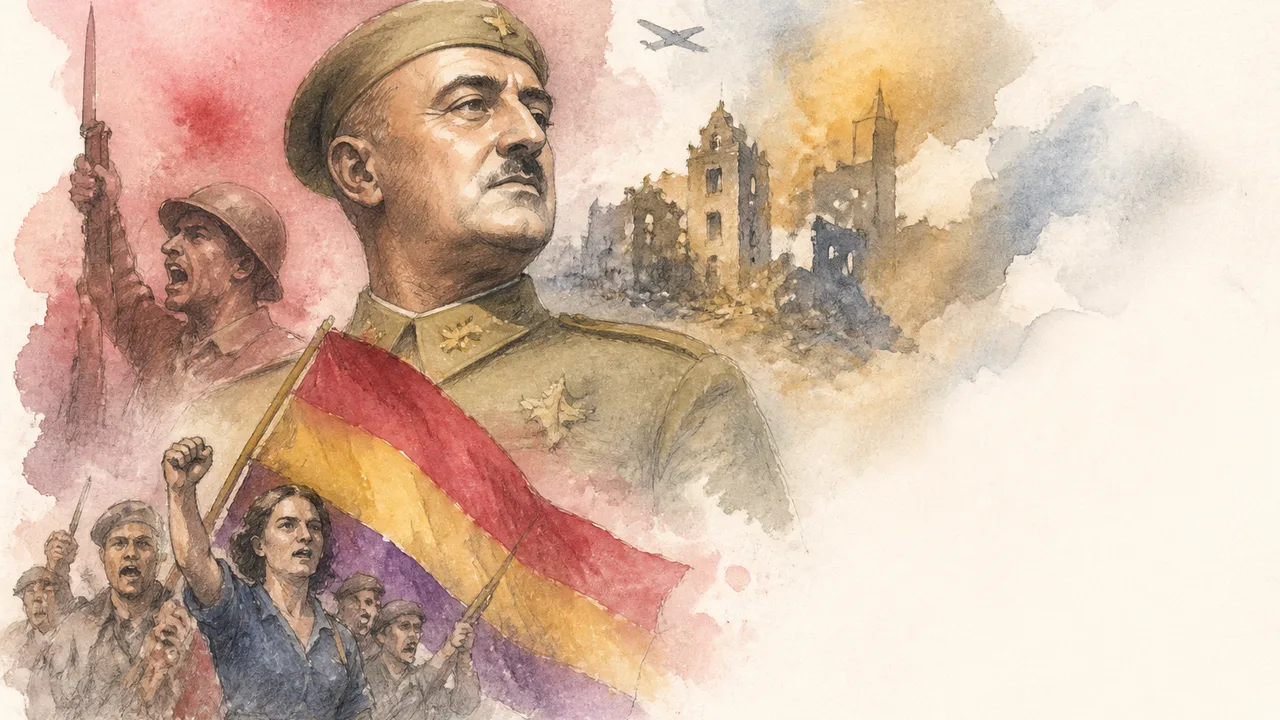
July 17, 1936. Spanish Morocco. An army mutiny begins before dawn, almost quiet, almost unremarkable — just officers turning against a government they had decided they would not serve. By the following morning, according to Britannica's timeline, General Francisco Franco was broadcasting a manifesto from his base in the Canary Islands, declaring that the rebellion had begun. The Spanish Civil War had started, and it would not end until nearly three years later, a republic destroyed, a dictatorship installed, and a rehearsal complete for the catastrophe that was about to consume Europe.
That's the clean version. The one that fits on a commemorative plaque. The actual story is considerably messier, and considerably more useful.
What broke first
The coup didn't come from nowhere. Spain in the early 1930s was a country trying to modernize against the grain of entrenched military, clerical, and landowning power. The Second Republic had attempted land reform, separation of church and state, regional autonomy. Conservative forces pushed back hard, reversing many of those reforms between 1933 and 1936 — a period Spaniards called the bienio negro, the two black years. According to EBSCO Research, the war broke out "amid escalating tensions in Spain following years of political instability and social unrest" after a conservative backlash had undone much of what the Republic had built.
Then, on February 16, 1936, a coalition of left and center-left parties — the Popular Front — won the national elections. Britannica notes that "fascist and extreme-right forces responded in July 1936 with an army mutiny and coup attempt that expanded" into full civil war. The sequence matters: there was an election, the left won it, and the right responded with guns. That's not a both-sides story. It's a coup.
What the coup's architects may not have anticipated was how thoroughly it would fail to deliver a quick victory. Spain did not fall in days. The Republic held major cities. Workers organized. And suddenly what had been a domestic political crisis became something the whole world was watching.
The war the world made
What happened next was a preview of the geopolitical logic that would define the following decade. Nazi Germany and Fascist Italy poured support into Franco's Nationalist forces — weapons, aircraft, personnel. The Soviet Union backed the Republic, with all the strings that attached. Western democracies, Britain and France foremost among them, declared non-intervention and largely held to it, watching a democratic government get strangled while their legal obligations as non-belligerents kept their hands officially clean.
The Holocaust Encyclopedia frames the stakes plainly: the war began "when generals Emilio Mola and Francisco Franco launched an uprising aimed at overthrowing the country's democratically elected republic." The framing matters. This was not a revolution against order — it was a counter-revolution against a legitimate democratic government. Nationalist propaganda worked hard to obscure that. Wikipedia's account documents how the war "was cast by Republican sympathisers as a struggle between tyranny and freedom, and by Nationalist supporters as communist and anarchist red hordes versus Christian civilisation." Each side had its narrative artillery, and both fired constantly.
But the propaganda didn't land evenly. Outside Spain, intellectuals and workers' organizations recognized the coup for what it was. Volunteers flooded in to fight for the Republic from dozens of countries, forming the International Brigades. For many on the left, Spain felt like the place where fascism could be stopped before it became unstoppable.
Who was actually fighting
Here is what the textbook versions tend to compress: the Republican side was not a unified army. It was a coalition so fractious that the miracle isn't that they lost — it's that they lasted as long as they did.
The anarchist CNT — the Confederación Nacional del Trabajo — represented a genuine mass movement of Spanish workers, particularly in Catalonia and Aragon. According to GlobalSecurity.org, the CNT worked in close, if often tense, alliance with the FAI (Federación Anarquista Ibérica), the Federation of Iberian Anarchists. These weren't fringe groups. They represented a tradition of labor organizing that had deep roots in Spanish working-class life, and they had their own vision for what a post-coup Spain should look like — one that didn't include a centralized Stalinist state any more than it included Franco.
That internal fracture is where George Orwell enters the story. He went to Spain to fight and came back with Homage to Catalonia, his firsthand account of the war. What he documented — and what transformed him as a writer and thinker — included not just the violence of the Nationalists but what he personally witnessed during the May Days of 1937: the suppression of the POUM, the anti-Stalinist Marxist militia he'd fought alongside. Orwell described what he saw on the streets of Barcelona. Historians have since corroborated Soviet-directed involvement in the broader suppression of anti-Stalinist leftists within the Republican coalition, but Orwell's account remains notable precisely because it was eyewitness — a committed anti-fascist recording how the Republic's most powerful backer was eating the coalition from within.
This is the tension that the Spanish Civil War keeps forcing back to the surface: the fight against fascism was real, and the threats within the anti-fascist coalition were also real. Holding both of those things simultaneously is harder than picking a side, but it's what the history demands.
What it cost, and what it became
The war ended in April 1939 with a Nationalist victory. Franco's Spain became a dictatorship that would endure until his death in 1975. The Republic's supporters faced execution, imprisonment, exile. History.com documents the coup's opening move — the broadcast from the Canary Islands, the army moving from Morocco to the mainland — but the human toll that followed those first communiqués was staggering in ways that historians still debate in their specifics. What isn't debated is the scale of suffering: mass executions, forced labor, the systematic destruction of leftist and regional political culture.
Ernest Hemingway, like Orwell, went to Spain and was changed by it. For Whom the Bell Tolls came from that reckoning. So did a generation of political commitments, disillusions, and recalibrations across the European and American left. Spain was the education.
For the Nationalists, victory meant constructing a usable past — one in which the coup was a liberation, a defense of civilization against chaos. That construction work continued under Franco for nearly four decades, and its residue in Spanish public memory is a subject Spanish historians and politicians are still actively contesting. The country passed a Democratic Memory Law in 2022 aimed at removing Francoist symbols from public space and supporting victims' descendants in recovering the buried remains of those executed. The war is not finished being argued about.
The question that travels forward
What makes the Spanish Civil War persistently instructive is not that it offers clean lessons, but that it dramatizes a cluster of problems that don't resolve: How do democracies respond when part of the political spectrum rejects democracy's outcomes? What happens to coalitions under external pressure? Who gets to define the official story of a civil conflict — and for how long?
The History Today archive frames this as a story about how quickly the beginning of a civil war can move — how a mutiny in Morocco becomes a manifesto in the Canary Islands becomes three years of carnage becomes forty years of dictatorship. The speed is clarifying. So is the recognition that none of it was inevitable at the start.
A coup launched on July 17, 1936, by officers who thought they'd wrap it up in days, instead produced a conflict the world used as a screen onto which it projected every anxiety it had about where the 1930s were heading. They were right to be anxious. The question — and it lands differently depending on where you're sitting in 2026 — is what those projections revealed about the projecters, and what they missed about Spain itself.
More Like This
Douglas MacArthur and the People He Left Behind
MacArthur is remembered as a military legend. But what about the veterans he gassed, the soldiers he abandoned, and the Japanese citizens who built a new democracy?
The Battle of Verdun: Attrition, Leadership, and 300,000 Dead
Ten months, 300,000 dead, and less than five miles of ground changed hands. Epic History's Verdun series examines what that arithmetic actually meant.
Common History Myths That Schools Still Teach
From Napoleon's height to Viking helmets, a new video maps the historical myths that textbooks kept alive—and asks why bad history is so hard to dislodge.
The Bari Disaster: Mustard Gas, Secrecy, and 1943
On December 2, 1943, a German raid on Bari killed over a thousand people—and released mustard gas that officials spent decades trying to erase from history.
Ancient Greece: Democracy, Empire, and Extremes
From Homer's epics to Alexander's conquests, ancient Greece shaped the Western world through democracy, warfare, and cultural fusion. Here's what the evidence shows.
Attila the Hun: Scourge of God or Economic Strategist?
Attila never sacked Rome—yet he's history's ultimate barbarian. The real story is stranger, and more familiar, than the legend.
Medieval England: How Peasants and Guilds Shaped Society
A new documentary traces medieval England's social divide through two real families—one peasant, one guild merchant—and the starkly different worlds they inhabited.
Egypt's New Delta Project: Green Miracle or Mirage?
Egypt is engineering a new Nile in the desert. But satellite data, groundwater depletion, and a troubling history raise urgent questions about who this is really for.