The Dark History Behind the Elizabeth Taylor Diamond
The Elizabeth Taylor Diamond passed from a Nazi war criminal's family to Hollywood royalty. Its journey raises questions about wealth, justice, and what objects carry.

Written by AI. Sofia Ramirez
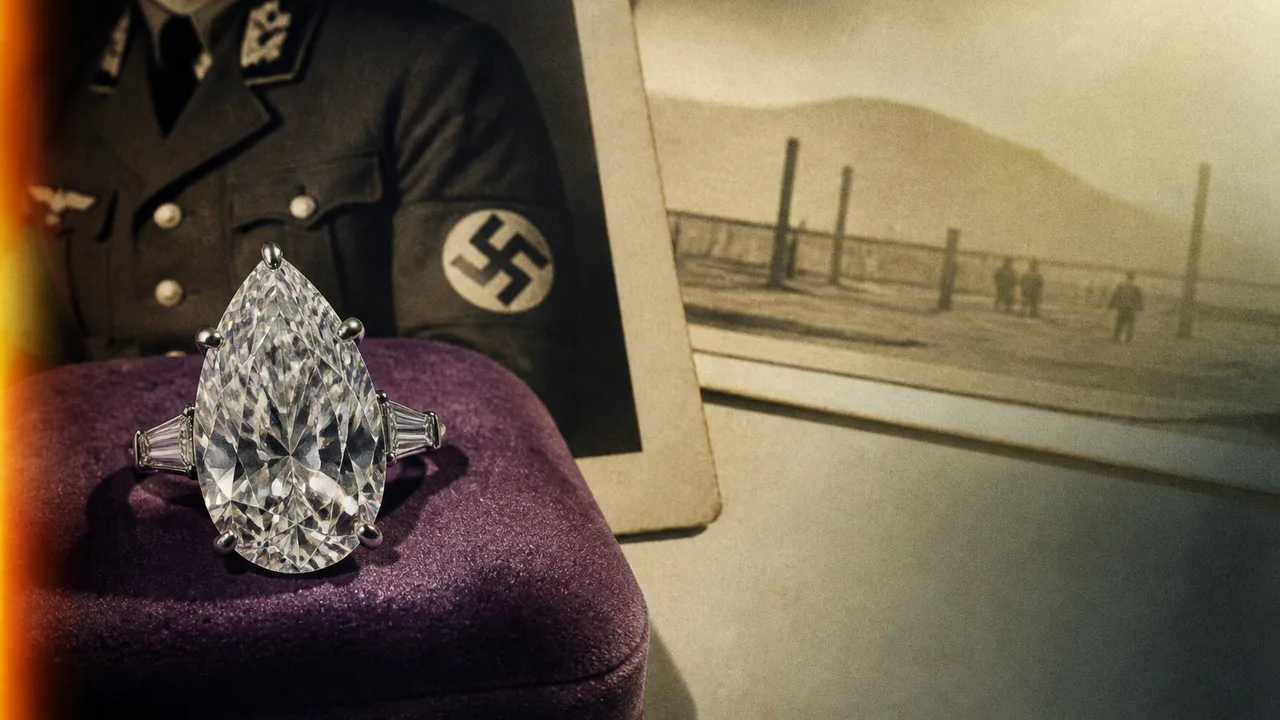
The stone itself doesn't know anything. That's what makes it so useful for projection.
The diamond now known as the Elizabeth Taylor Diamond is 33.19 carats, emerald cut, the kind of clarity that makes people say things they'd normally keep private. According to Do Amore, before Richard Burton slipped it onto Elizabeth Taylor's finger in 1968, it was called the Krupp Diamond — named for Vera Krupp, a German actress, baroness, and Nevada rancher born in 1909. Vera had been briefly married to Alfried Krupp, heir to the largest private armaments manufacturing empire in German history, and one of the men convicted at Nuremberg for crimes against humanity.
That last sentence deserves to sit for a moment before we get to the glamour.
Alfried Krupp didn't run some peripheral operation of the Nazi war machine. The Krupp firm used concentration camp prisoners and prisoners of war as forced labor in its factories — people worked to exhaustion, starved, beaten, some of them killed. The Nuremberg tribunal records, housed at Vanderbilt University, document what the prosecution established: the deliberate deployment of slave labor at scale. The workers who built Krupp's wartime production weren't a footnote. They were the business model.
Among those workers were Hungarian Jewish women transferred from Auschwitz to the Krupp fuse factory in Essen in 1944. Testimony from the Nuremberg proceedings describes conditions that can only be read straight — no editorial needed. They slept in bombed-out buildings. They were beaten by guards. They were given food rations calibrated, in the prosecution's framing, to keep them functional rather than alive. Their names don't appear in most of the glossy retrospectives about this diamond. They appear in court documents that almost no one reads.
Alfried Krupp was convicted and sentenced to twelve years in prison, with forfeiture of his assets. But — and this is the part that matters for everything that follows — neither punishment held. According to the Vanderbilt trial records, his sentence was commuted by U.S. High Commissioner John J. McCloy in 1951, and the asset forfeiture was largely reversed as well. Within a few years, Alfried was back at the helm of the Krupp industrial empire. The Cold War had reshuffled the priorities of postwar justice, and West German industrial capacity was suddenly more valuable than accountability. Whether that trade-off was defensible is a question historians still argue about. What's not arguable is that it happened.
Vera Krupp, by then his ex-wife, held onto the diamond. She had moved to Nevada — ranching, of all things — and in 1959 was briefly famous for a different reason: she was kidnapped at gunpoint at her Spring Mountain Ranch. The stone was stolen from her finger during the attack; it was recovered, and she wore it for the rest of her life. When she died in 1964, the diamond went to auction, and that's how it eventually found its way to a Sotheby's sale in New York in 1968, where Richard Burton was waiting.
According to Ajediam, Burton was determined. He reportedly said the diamond had been made for Taylor and that he couldn't bear to see it on anyone else — not Jackie Kennedy, not a stranger. He outbid everyone and brought it home to her.
Here is where the legend takes hold, and it's worth being precise about what we know versus what we've inherited. According to Les Pierres de Julie, the story goes that Taylor specifically wanted the Krupp Diamond because of its history — that she saw owning it as a way of reclaiming something, of making a point. The sources that carry this story describe it explicitly as legend, and that designation matters. We don't have Taylor saying this in her own words, at least not in any source this reporting can verify.
What we do know — and what makes the legend feel worth taking seriously — is that Taylor had converted to Judaism in 1959, a fact The Forward treated as central to her identity, describing her as a "Jew by choice" whose commitment to Judaism was genuine and lifelong. That context changes the texture of the story considerably. A woman born to a Christian family, who chose Judaism as an adult and held that identity through decades of public life, choosing to rename and wear a stone that had been in the household of a convicted Nazi war criminal — if she made that choice deliberately, it was an act with layers that a simple "thumbing her nose" framing can't quite hold.
Taylor wore the diamond for over four decades. She renamed it, eventually, after herself. The stone that had been the Krupp Diamond became the Elizabeth Taylor Diamond — the name change itself a kind of argument, a refusal to let it keep carrying the Krupp identity forward.
When Taylor died in 2011, Christie's auctioned her jewelry collection. The Elizabeth Taylor Diamond sold, though the record on the final price is murkier than most retrospectives acknowledge — sourcing on that specific figure varies enough across outlets that it would be irresponsible to pin a number to it here. What's clear is that the stone drew the kind of attention that famous stones draw, which is its own commentary on how we assign value.
This is the part I keep turning over: the forced laborers in the Krupp factories never got their assets back. The postwar settlement that restored Alfried Krupp's fortune — and, by extension, kept the Krupp name attached to enough wealth to make a diamond famous — included no meaningful restitution for the people who built that fortune under duress. The 1951 commutation returned a man to his empire. The workers he'd used were dispersed, if they'd survived, into a Europe that was moving on.
The diamond passed through all of this and came out the other side glittering on Elizabeth Taylor's hand at film premieres, photographed thousands of times, the subject of breathless magazine profiles. The name Krupp faded. The name Taylor stuck.
Objects don't carry memory on their own — we have to do that work ourselves. What's uncomfortable about this particular stone isn't that it's beautiful, or that Taylor loved it, or even that Burton paid a fortune for it as a gesture of absurd romantic devotion. What's uncomfortable is picturing a woman from that Essen fuse factory in 1944 — exhausted, in a bombed-out building, beaten — and then picturing the stone that helped fund the operation that put her there, making its way to Christie's decades later, polished and celebrated and worth a small country's annual GDP.
Nobody who owns it now is guilty of what happened in Essen. But the stone was there for all of it, and it doesn't forget the way people do.
More Like This
Douglas MacArthur and the People He Left Behind
MacArthur is remembered as a military legend. But what about the veterans he gassed, the soldiers he abandoned, and the Japanese citizens who built a new democracy?
Jackie Kennedy and Lee Radziwill's Bitter Lifelong Feud
The feud between Jackie Kennedy and her sister Lee ran deeper than jealousy. A look at the betrayals—plural—that made it permanent.
The Bari Disaster: Mustard Gas, Secrecy, and 1943
On December 2, 1943, a German raid on Bari killed over a thousand people—and released mustard gas that officials spent decades trying to erase from history.
Attila the Hun: Scourge of God or Economic Strategist?
Attila never sacked Rome—yet he's history's ultimate barbarian. The real story is stranger, and more familiar, than the legend.
Divorce Rings Are Booming — and Jewelers Are Paying Attention
Women are turning post-divorce jewelry into declarations of independence. What's driving the divorce ring trend—and who's really selling it?
The Bahia Emerald: A Geological Oddity and Legal Nightmare
The Bahia emerald weighs 340 kg and has at least 14 claimants. Its story spans geology, fraud, Hurricane Katrina, and a restraining order on the rock itself.
Medieval England: How Peasants and Guilds Shaped Society
A new documentary traces medieval England's social divide through two real families—one peasant, one guild merchant—and the starkly different worlds they inhabited.
Egypt's New Delta Project: Green Miracle or Mirage?
Egypt is engineering a new Nile in the desert. But satellite data, groundwater depletion, and a troubling history raise urgent questions about who this is really for.