Medieval England: How Peasants and Guilds Shaped Society
A new documentary traces medieval England's social divide through two real families—one peasant, one guild merchant—and the starkly different worlds they inhabited.

Written by AI. Sofia Ramirez
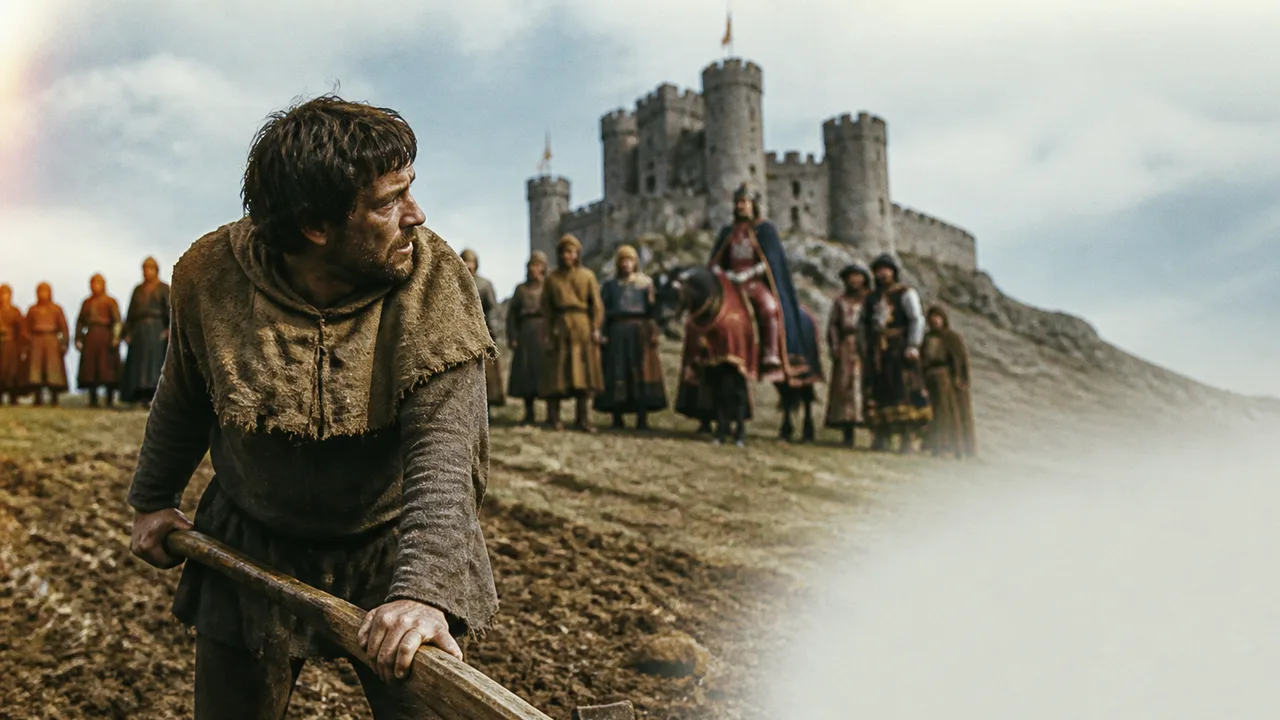
Photo: AI. Nikolai Brandt
The word "peasant" has gotten a bad reputation it doesn't quite deserve. We use it now as an insult—shorthand for someone crude, low, beneath notice. But in medieval England, a peasant was simply a farmer. A specific, technical thing. A person tied to land, working it, feeding everyone else. About 80% of the European medieval population were peasants. Which means that when we casually deploy "peasant" as a slur, we're accidentally dismissing most of the people who ever lived.
This is the friction at the heart of Life in Medieval England: Peasants vs. Lords, a documentary from All Out History that splits its time between the marshy fenlands around Denny Abbey and the gilded halls of London's livery companies. The documentary moves between two worlds—the countryside where most people barely survived, and the city where a small merchant class accumulated enough wealth and power to essentially govern themselves.
What makes it work is that it doesn't stay abstract. It finds real people.
The Collins Family, and the Trap of the Land
Thomas Collins shows up in the historical record in the 1270s as a man doing genuinely well. He held around 15 acres of land, raised cattle, sheep, and geese—a reliable Christmas cash crop—and his wife brewed beer, which was one of the primary feminine industries of the period alongside weaving. They were, by any reasonable measure, medieval middle class.
Then the records go quiet for a decade, and when Thomas resurfaces in the early 1290s, the ledger has turned against him. A man named Walter of Oldbury is suing him for five shillings. Thomas can't pay. He's already mortgaged his coming harvest—essentially pledging future crops as collateral, the medieval version of borrowing against your house—and it's not enough. He has to sell his land. But because he's a serf, the land technically belongs to the Abbey. The only buyer is the institution that already owns it. The Abbey gives him £2.
That covered the debt. It did not cover the nine mouths he still had to feed.
Thomas died in 1312, massively in debt again. His land passed to his wife and daughters. By 1319, all record of the Collins women had vanished. The documentary allows for two possibilities with equal weight: they moved on, which would have been unusual but possible for women who were considered less economically productive by their landlords. Or they died. The Great Famine of 1317-1319 swept through Europe and cut the population hard, hitting peasants worst of all. A landlord's risk was distributed across many tenants—when yields dropped, they still collected something from everyone. A peasant family dependent on one patch of ground had nowhere to spread that risk.
The Collins story is not exceptional. It's ordinary. Which is exactly why it matters.
The Technology That Made It Possible—and the Climate That Ended It
The documentary is sharp on the infrastructure that sustained medieval peasant life before it collapsed. The three-field system, which rotated crops to allow soil to recover nitrogen between growing seasons, meant land could be worked continuously without exhausting it. The horse collar, a deceptively simple innovation, solved the problem of how to harness a horse to a plow without restricting its breathing—horses being faster than oxen, this meaningfully accelerated agricultural work. The draining of fenlands like those surrounding Denny Abbey converted previously unusable marsh into arable ground.
These weren't minor upgrades. The documentary argues they outpaced anything Roman agriculture had managed. England could support a larger population because its peasants had figured out how to feed more people from the same land.
Then the climate turned.
The Medieval Warm Period, a stretch of unusually stable and mild temperatures from roughly 900 to 1300, had quietly underwritten the whole system—longer growing seasons, shorter winters, consistent harvests. Medieval art from that era shows December scenes with no snow on the ground. When the warmth ended, the paintings changed. The snow came back. Then came two years of extreme rainfall and flooding. The crops failed. The famine followed.
And the lords still collected rent.
The De Garthon Family, and How the Other Half Lived
Running parallel to the Collins story is the De Garthon family, mercers operating out of Soper's Lane in the City of London. (The street itself is gone—destroyed in the Great Fire of 1666—but the Mercers' Hall still stands just across where it once ran.)
The guilds they belonged to were remarkable institutions. They controlled access to entire industries within city walls: you could not simply arrive in London and start selling fish or gold or cloth. Guild membership was the gate, and the gate was guarded. Entry came through birth (if your father was a mercer, you could be one), apprenticeship (years of unpaid labor in a guild household), purchase (buying your way in, if the guild would take your money), or the exceedingly rare invitation, which was reserved for royalty and people of equivalent prestige.
Being a guild member also made you a freeman of the city, an alderman eligible to vote for and become Lord Mayor, and—not incidentally—exempt from certain taxes that applied to everyone else. A peasant from the countryside bringing sheep across London Bridge to sell at Smithfield Market paid a toll. A freeman did not. These small asymmetries compounded.
The documentary's most clarifying moment involves Hugh de Garthon, elected sheriff of London in 1314. At some point, Hugh joined what the documentary describes without ceremony as a gang, and robbed a neighbor of £200 in cash. To calibrate that figure: Thomas Collins sold 15 acres of land—his family's entire foundation—for £2. Hugh stole a hundred times that amount.
Nothing happened to him. The king pardoned him. Hugh was too connected, too useful—he served as a royal courier, ferrying letters and money across the kingdom—to prosecute. The documentary doesn't editorialize much here. It doesn't need to. The math speaks for itself: a desperate peasant stealing a few pounds would have been executed. A wealthy merchant stealing a fortune got a royal pardon.
Smithfield, 1381
Smithfield—the "Smooth Field" as it may have been called in the medieval period—was where the countryside met the city. Peasants brought their livestock here to be slaughtered and sold. It's also where the Peasants' Rebellion reached its crisis point in 1381.
The rebellion, led by Wat Tyler, was not a mob action. The documentary is clear on this. When the rebels took London and burned the Savoy Palace—one of the grandest private residences in England—they didn't loot it. They burned the contents. This was a symbolic act, a statement about what kind of society they were trying to end. The preacher John Ball had been circulating a question that the documentary notes was probably not his own invention but became attached to him: "When Adam delved and Eve span, who was then a gentleman?" The argument was theological and radical: nobility was not God-given. Everyone started equal.
At Smithfield, something went wrong. A scuffle broke out. Wat Tyler was stabbed and died. The rebellion fractured. King Richard II, according to the documentary's account, told the assembled peasants they were rustics and always would be—the crown's position on social mobility made explicit.
A memorial to Wat Tyler and the Peasants' Revolt now stands at Smithfield. According to the documentary, it wasn't until 2015 that any physical memorial existed at the site at all—a gap that the documentary clearly finds telling, and that local history sources confirm. The rebellion of 1381 was one of the largest mass political movements in 14th-century England, and for centuries it had no marker.
The Archive Problem
There's a methodological honesty running through the documentary that's worth sitting with. The guild families—the De Garthons, the mercers of Soper's Lane—are visible to us precisely because they were rich and well-connected enough to generate records, to matter to scribes and clerks and royal courts. We know about Hugh de Garthon's crime because it was important enough to document. We know about his sheriff's tenure and his witness testimony in a murder case because those things required paperwork.
Thomas Collins comes through to us via debt records. His daughters don't come through at all.
The documentary frames this honestly: historians tell the stories they can find, and the stories they can find are the stories of people powerful enough to leave traces. The baker on Soper's Lane, the woman selling cheese at market, the man driving pigs through the city toward slaughter—they existed, they worked, they shaped daily life, and they are mostly gone from the record.
What the documentary does, by pairing these two families, is make that absence visible. The Collins story survives only because it intersected with institutional power—the Abbey's land records, Walter of Oldbury's lawsuit. Strip away those moments of friction with authority, and the family disappears entirely.
Which raises a question that the medieval period doesn't have a monopoly on: whose stories are we losing right now, because they're not generating the kind of records that institutions bother to keep?
More Like This
Douglas MacArthur and the People He Left Behind
MacArthur is remembered as a military legend. But what about the veterans he gassed, the soldiers he abandoned, and the Japanese citizens who built a new democracy?
Attila the Hun: Scourge of God or Economic Strategist?
Attila never sacked Rome—yet he's history's ultimate barbarian. The real story is stranger, and more familiar, than the legend.
The Teutonic Knights Built a Medieval Corporate State
The Teutonic Knights weren't holy warriors — they were medieval operators who built a sovereign state on contract law, grain prices, and systematic erasure of native Prussian culture.
Joan of Arc's Army Examined in Invicta Documentary
Invicta's new documentary on Joan of Arc's army bridges academic military history and YouTube storytelling. Harry Goodman examines what that translation costs and earns.
Medieval Knights: The Gap Between Code and Conduct
Medieval knights lived by a strict code of chivalry—and routinely broke it. A look at the real training, politics, and moral failures behind the armor.
What 21 Global Jobs Reveal About Work and Worth
From Louisiana shrimp docks to Everest base camp, Business Insider's job profiles reveal a pattern: the harder and more essential the work, the thinner the margin.
Egypt's New Delta Project: Green Miracle or Mirage?
Egypt is engineering a new Nile in the desert. But satellite data, groundwater depletion, and a troubling history raise urgent questions about who this is really for.
Ancient Megastructures That Still Puzzle Engineers
From Göbekli Tepe to the Great Pyramid, these ancient sites raise genuine questions about what early human societies were capable of building—and how.